VIII.3.14
Pompeii. Casa della Regina Carolina or House of Queen Caroline.
Excavated 1809, 1812, 1818, 1826 and 1839.
Part 2 Part 1
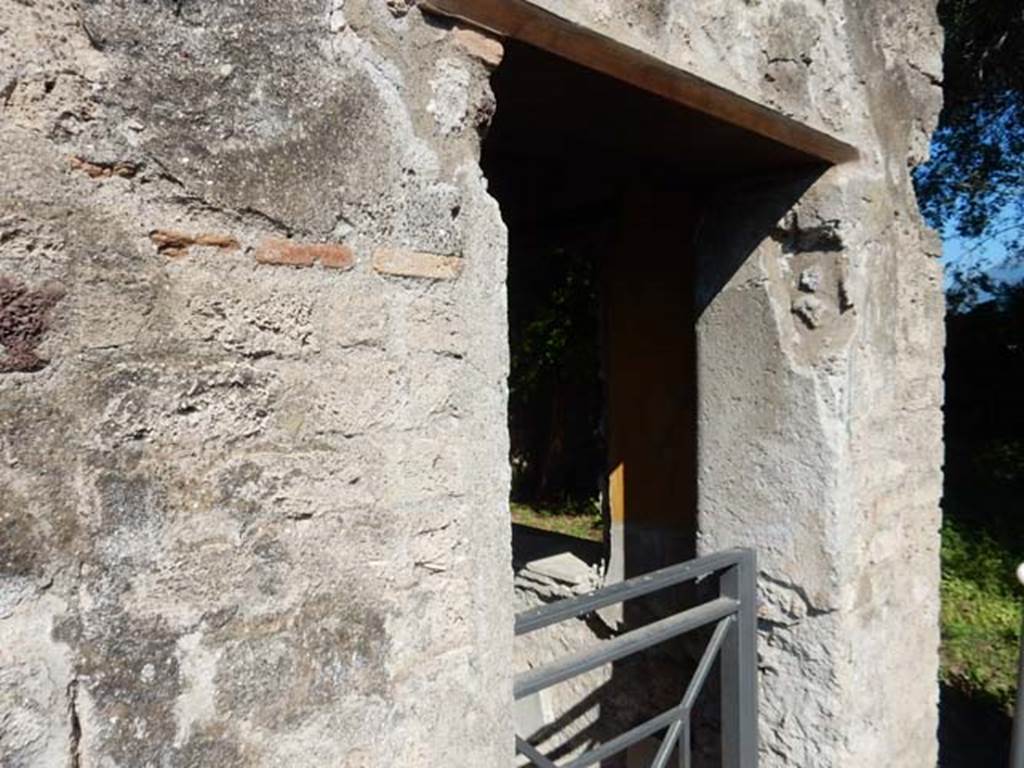
VIII.3.14 Pompeii. May 2016. Doorway to cubiculum. Photo courtesy of Buzz Ferebee.
According to Helbig, wall paintings found in this room (Erstes Zimmer von recht hinter dem Atrium) included -
Apollo, Chiron & Asclepius (Aesculapius), (Helbig no 202), now in Naples Archaeological Museum.
Crowning of a woman, (Helbig 1412), now in Naples Archaeological Museum.
Paintings of cupids, (Helbig 802, 803).
See Helbig, W., 1868. Wandgemälde der vom Vesuv verschütteten Städte Campaniens. Leipzig: Breitkopf und Härtel. (nos. 202, 1412, 802 and 803).
(Note: the paintings of Apollo, Chiron & Asclepius (Aesculapius), (Helbig no 202), Naples Inventory number 8846; and Crowning of a woman, (Helbig 1412), Naples Inventory number 9127; have also both been entered into VI.17.10, as their provenance for which area they were found in, seems to be in dispute).
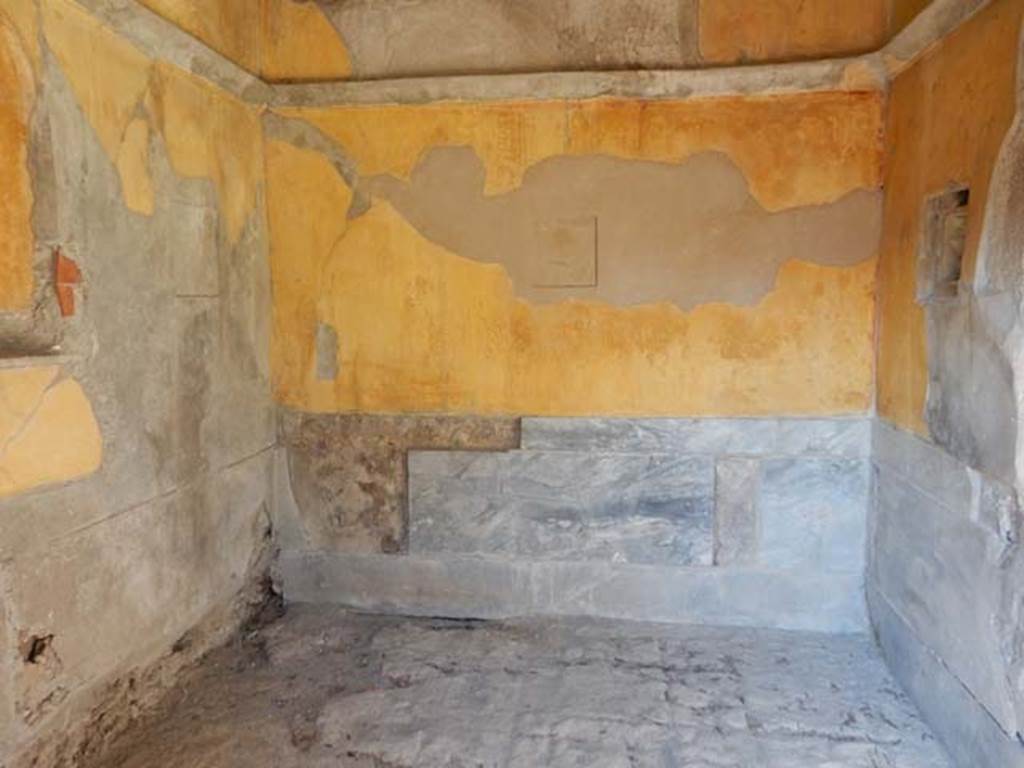
VIII.3.14 Pompeii. May 2016. Looking through doorway into cubiculum. Photo courtesy of Buzz Ferebee.
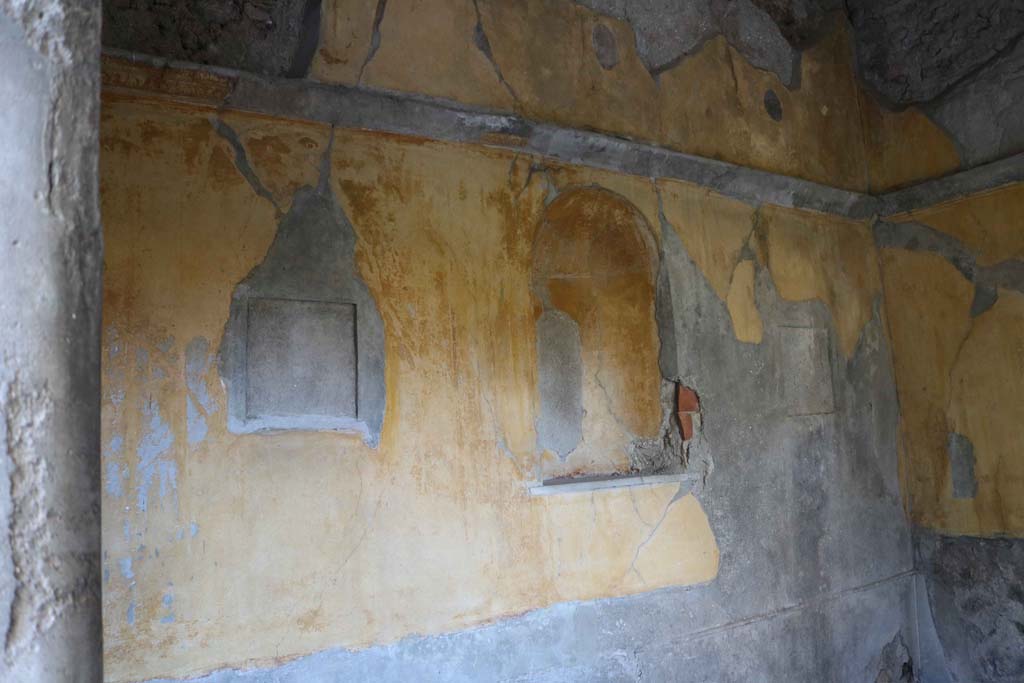
VIII.3.14 Pompeii. December 2018. Looking towards south wall of cubiculum. Photo courtesy of Aude Durand.
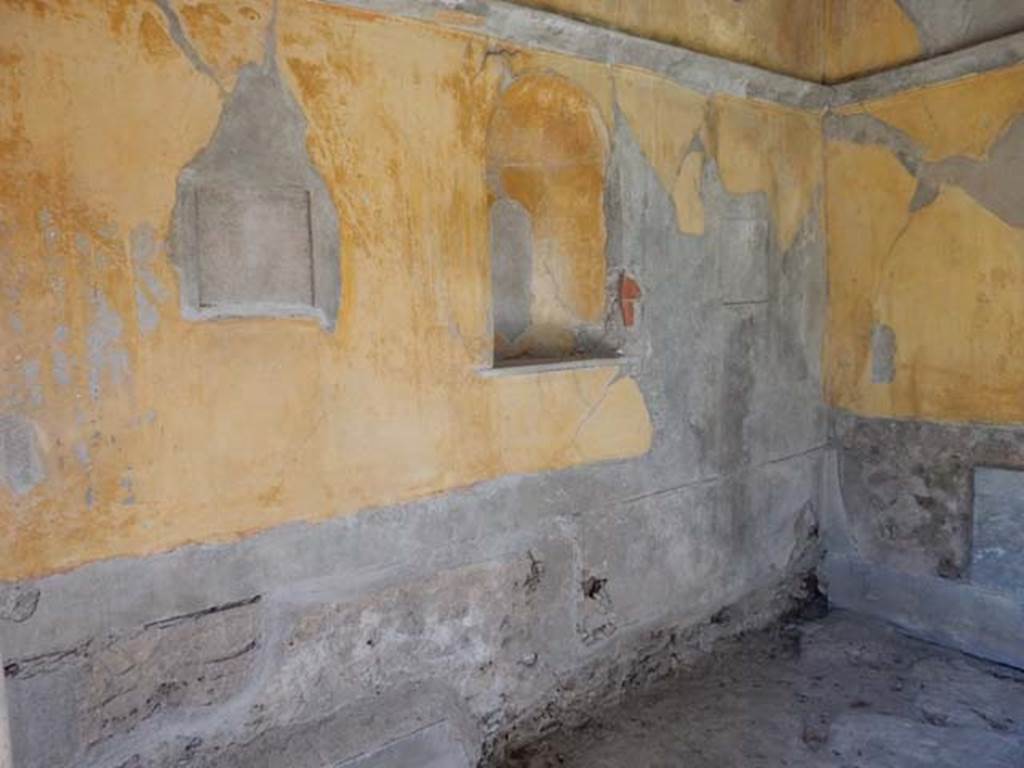
VIII.3.14 Pompeii. May 2016. South wall of cubiculum. Photo courtesy of Buzz Ferebee.
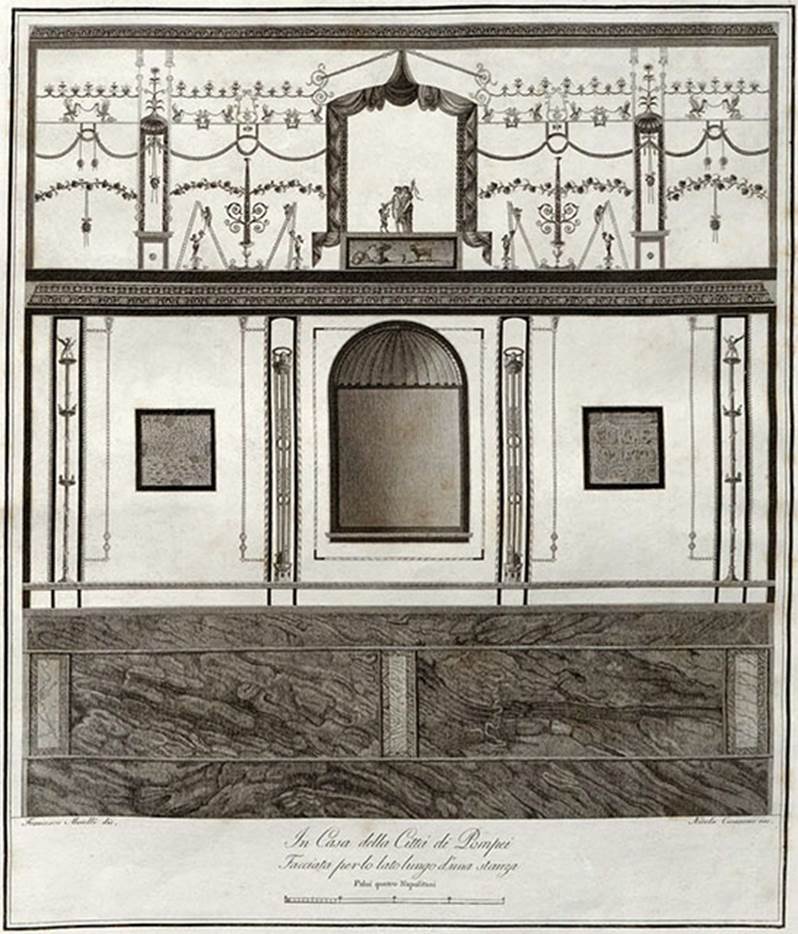
VIII.3.14 Pompeii. Painting by F. Morelli, published in 1838, of south wall with niche.
See Gli ornati delle pareti ed i pavimenti delle
stanze dell'antica Pompei incisi in rame: 1838, tav. 63.
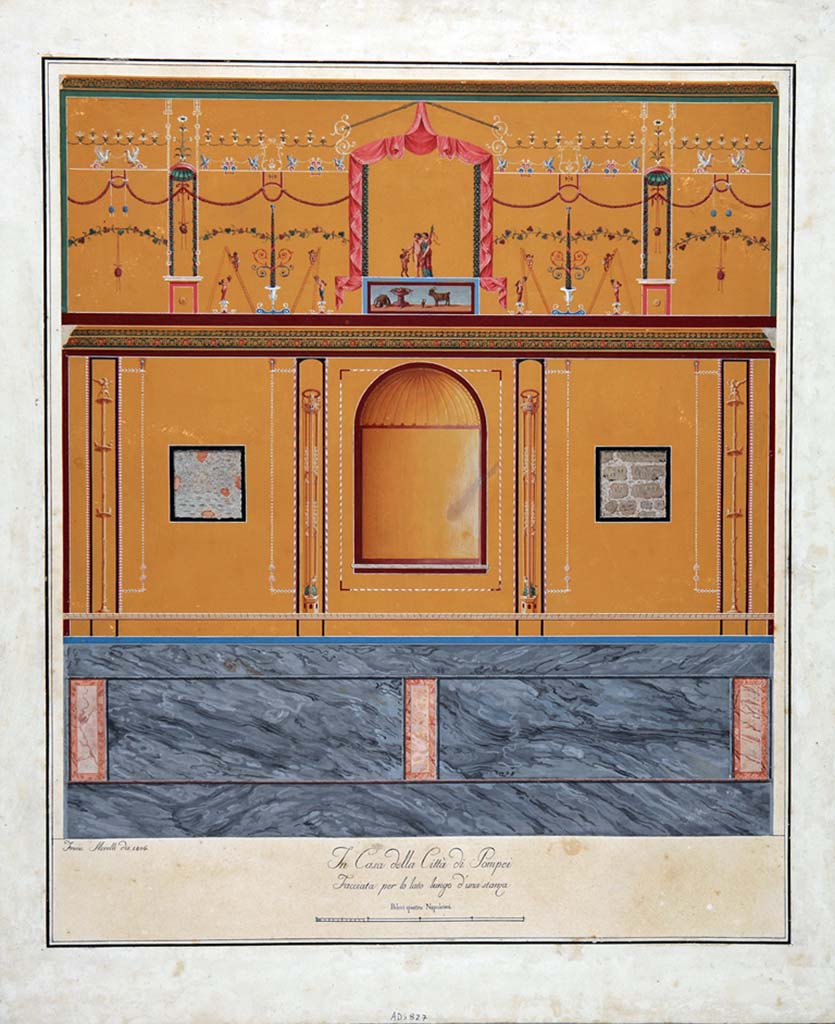
VIII.3.14 Pompeii. 1806 painting by F. Morelli of south wall with niche.
See Carratelli,
G. P., 1990-2003. Pompei: Pitture e Mosaici: Vol. VIII.
Roma: Istituto della enciclopedia italiana, p. 407, fig.
21.
Now in Naples Archaeological Museum. Inventory number ADS 827.
Photo © ICCD. https://www.catalogo.beniculturali.it/
Utilizzabili alle
condizioni della licenza Attribuzione - Non commerciale - Condividi
allo stesso modo 2.5 Italia (CC BY-NC-SA 2.5 IT)
Kuivalainen describes the upper south wall as showing –
A composition of three figures inside a draped frame, standing on a podium decorated with a still-life with a goat, a jug, a stemmed large bowl with fruit, and a capsa with writing equipment. On the left, a small faun with hoofs tries to catch a bunch of grapes held by the almost naked youth in the middle. On his back he wears a cloak reaching down to his knees. Partly overlapping him is a robed female figure on his left, seen in side view; in her left hand she holds a thyrsus with long ribbons.
On both sides, cupids harvesting with ladders, garlands, masks and birds.
Kuivalainen comments –
A naked young Bacchus holding grapes in his right hand appears from time to time in Pompeian wall paintings. Here, they are linked to the activity performed by the cupids. The scene imitates a theatre, and the goat in the socle is one of the characteristic animals of Bacchus.
See Kuivalainen, I., 2021. The
Portrayal of Pompeian Bacchus. Commentationes Humanarum Litterarum 140. Helsinki: Finnish Society of Sciences
and Letters, (F18, p.173).
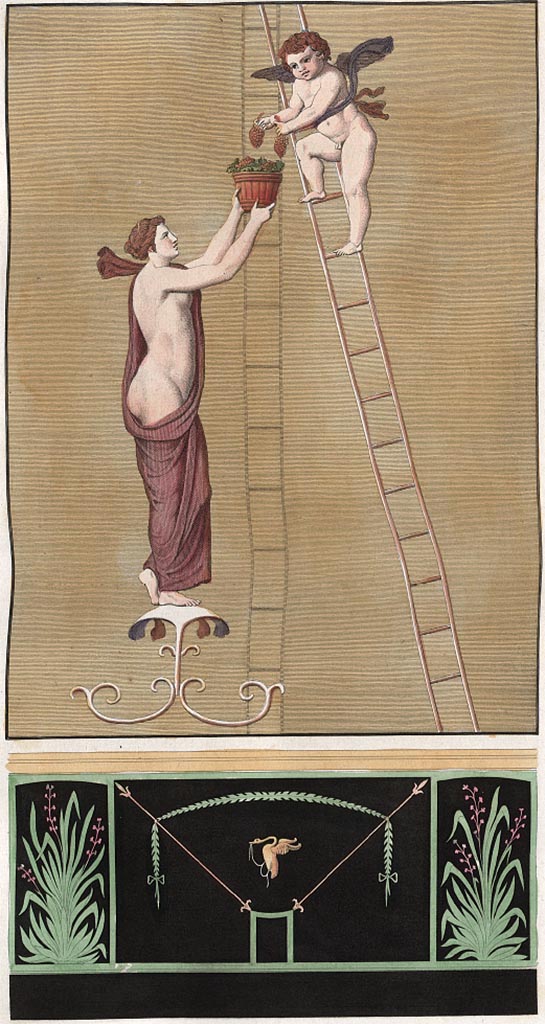
VIII.3.14 Pompeii. Upper south wall of cubiculum.
Painting by Mazois showing a Cupid on a ladder placing grapes into a bucket held by a young girl.
The lower painting from a zoccolo, may or may not be from this house.
See Mazois, F., 1838. Les Ruines de Pompei :
Quatrième Partie. Paris : Didot Frères, (vol.4, 1838, Pl.1.)
Mazois died in 1826, and this volume IV was published in 1838.
In the description of this painting called “La Vendange” (The Harvest) – it says –
“Mazois did not leave any note to indicate the place where he had found this wall painting, and the collections that we have consulted have not been able to give us any information in this regard.
But Mazois formally intended this first plate to be placed before the views of the Greek temple and the puteal. (Pl. II, fig, I and II).”
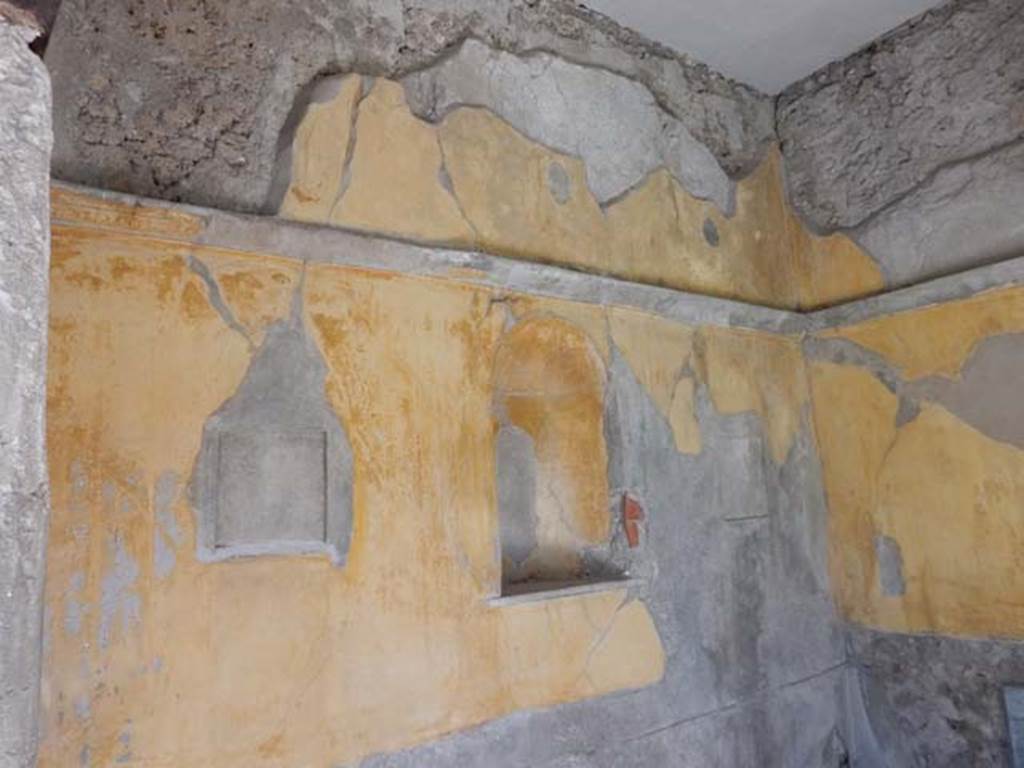
VIII.3.14 Pompeii. May 2016. Upper south wall of cubiculum. Photo courtesy of Buzz Ferebee.
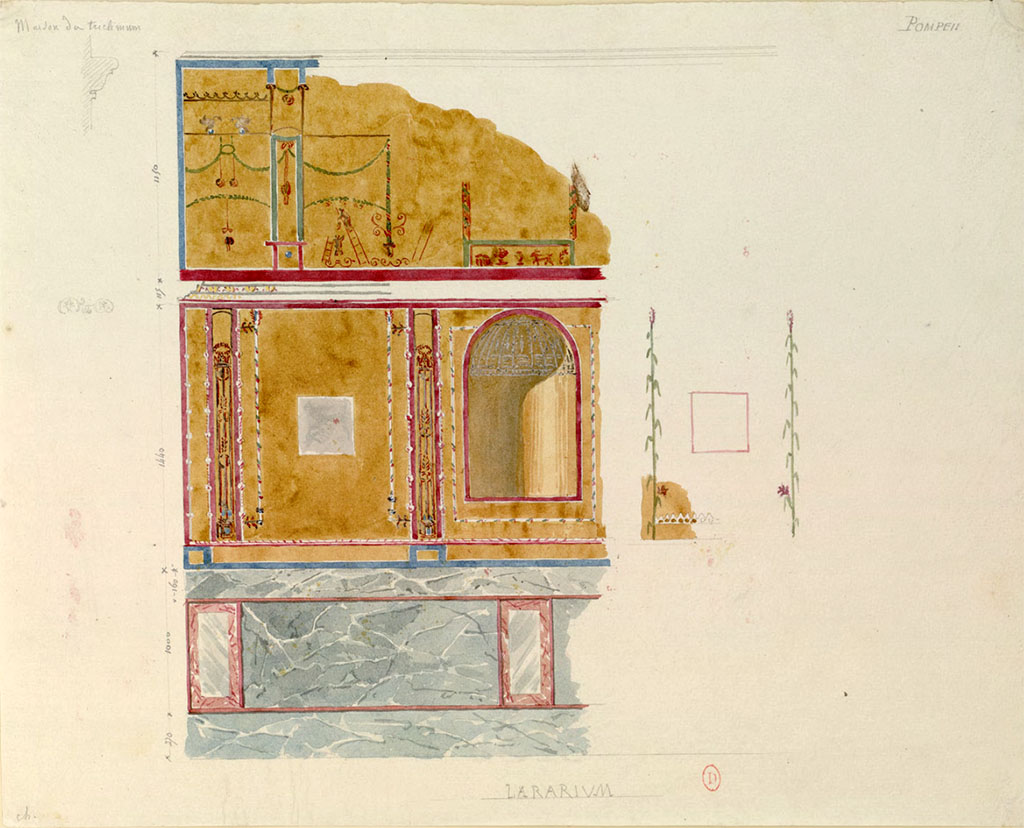
The INHA web site records: "Maison du triclinium
Pompeii" "Lararium": Casa della Regina Carolina (VIII, 3, 14) (reproduction
de peinture)
See Chenavard, Antoine-Marie (1787-1883) et al. Voyage
d'Italie, croquis Tome 3, pl. 120.
INHA Identifiant
numérique : NUM MS 703 (3). See Book
on INHA
Document placé sous « Licence
Ouverte / Open
Licence » Etalab
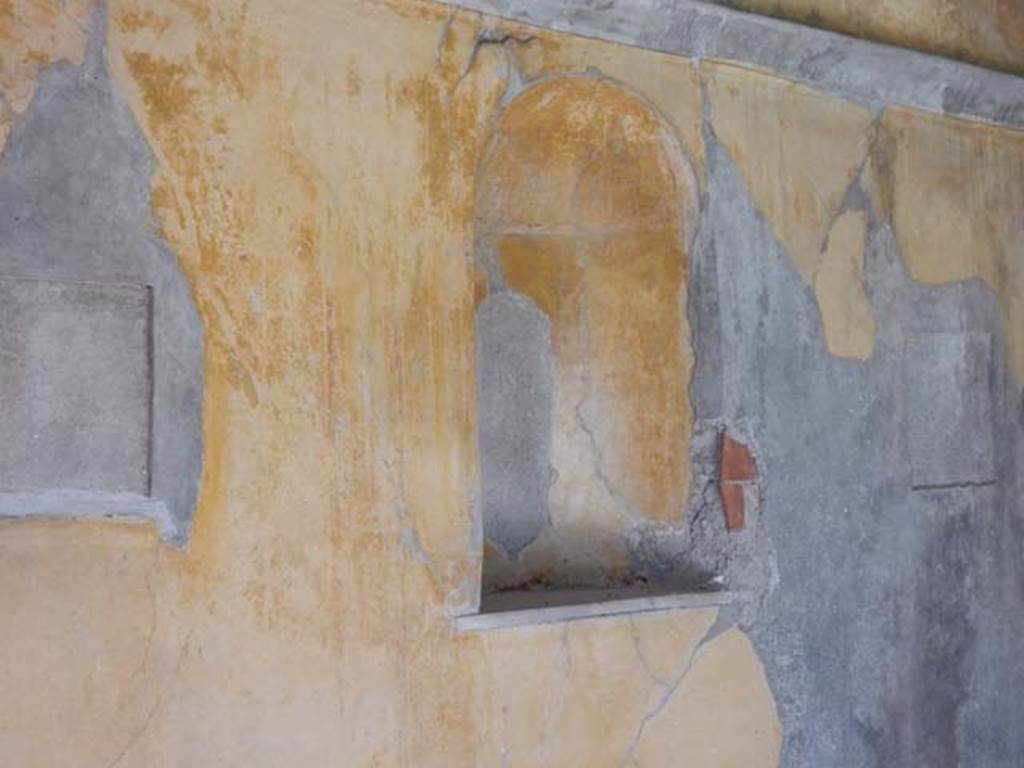
VIII.3.14 Pompeii. May 2016. Detail of niche in south wall. Photo courtesy of Buzz Ferebee.
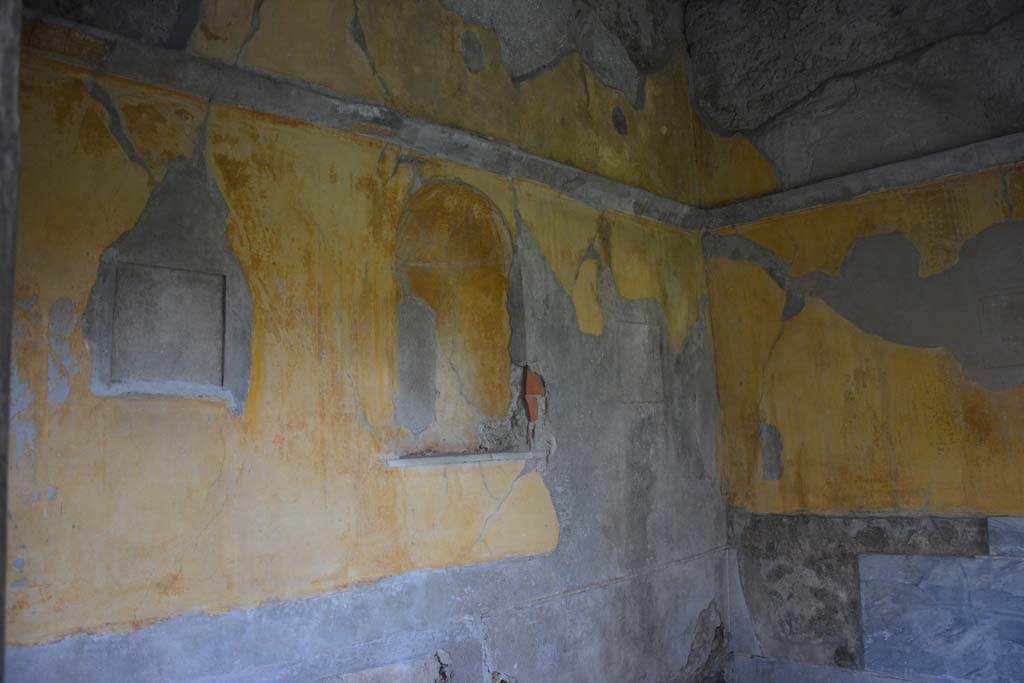
VIII.3.14 Pompeii. March 2019. Looking along south wall towards
south-west corner of cubiculum.
Foto Annette Haug, ERC Grant 681269 DÉCOR.
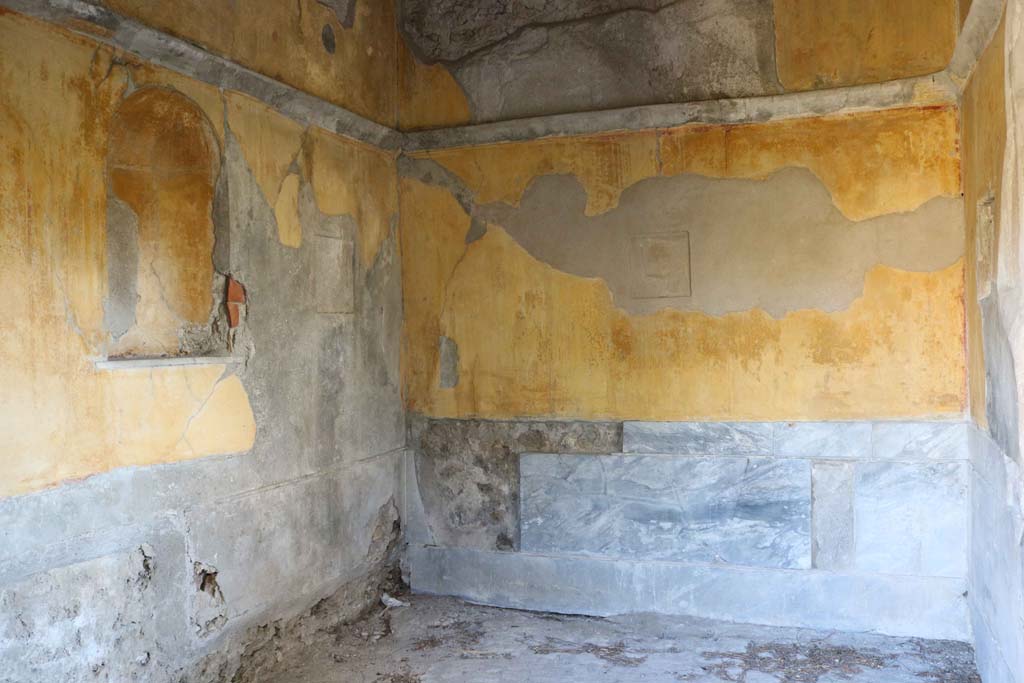
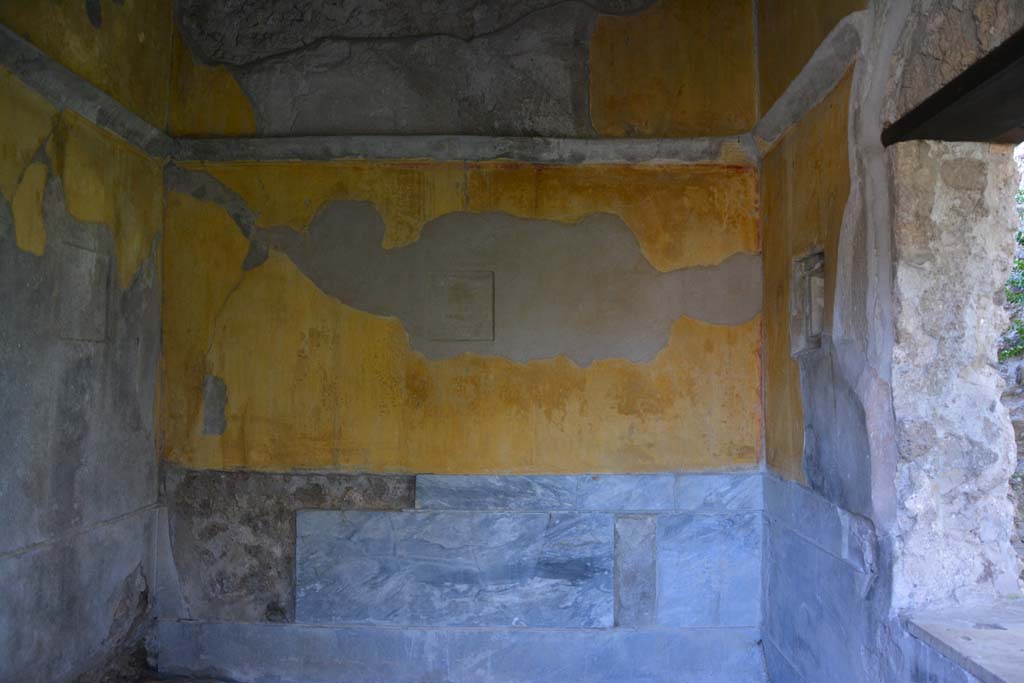
VIII.3.14
Pompeii. March 2019. Looking towards west wall of cubiculum.
Foto Annette Haug, ERC Grant 681269 DÉCOR.
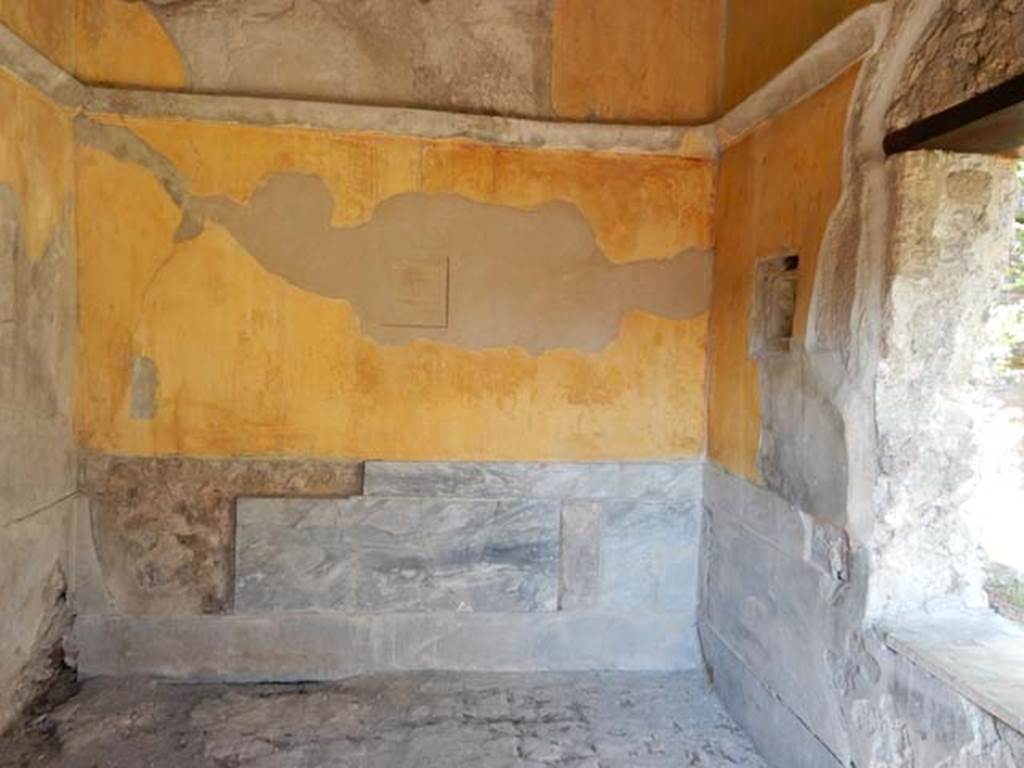
VIII.3.14 Pompeii. May 2016. West wall of cubiculum. Photo courtesy of Buzz Ferebee.
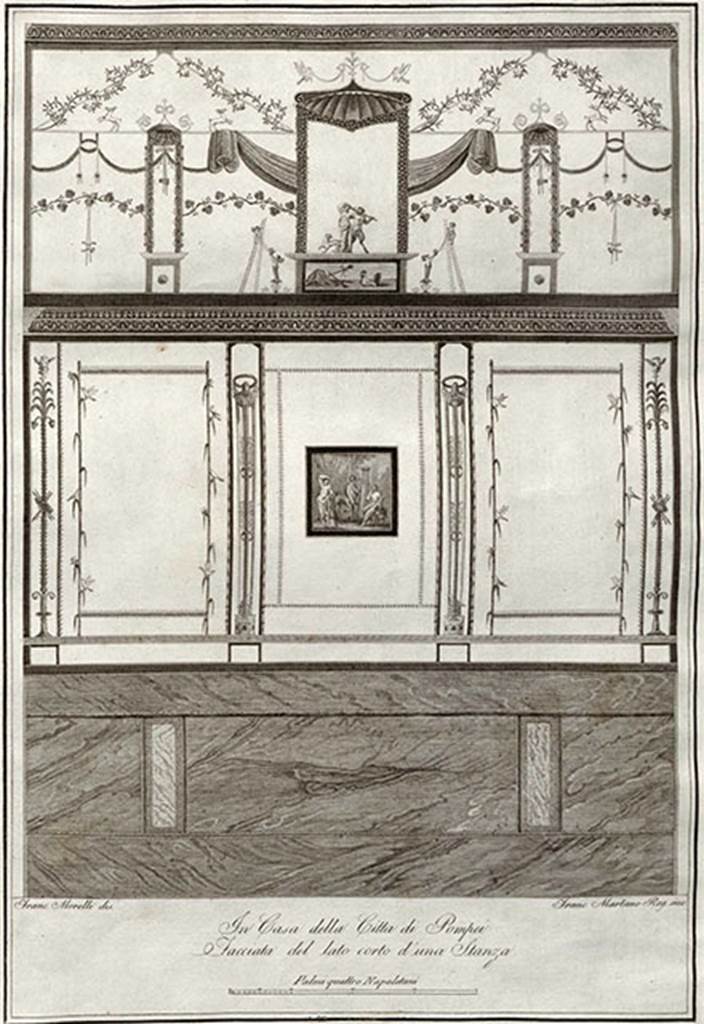
VIII.3.14 Pompeii. Painting by F. Morelli, as published in 1838, of west wall of cubiculum.
See Gli ornati delle pareti ed i pavimenti delle
stanze dell'antica Pompei incisi in rame: 1838, tav. 65, indice 65.
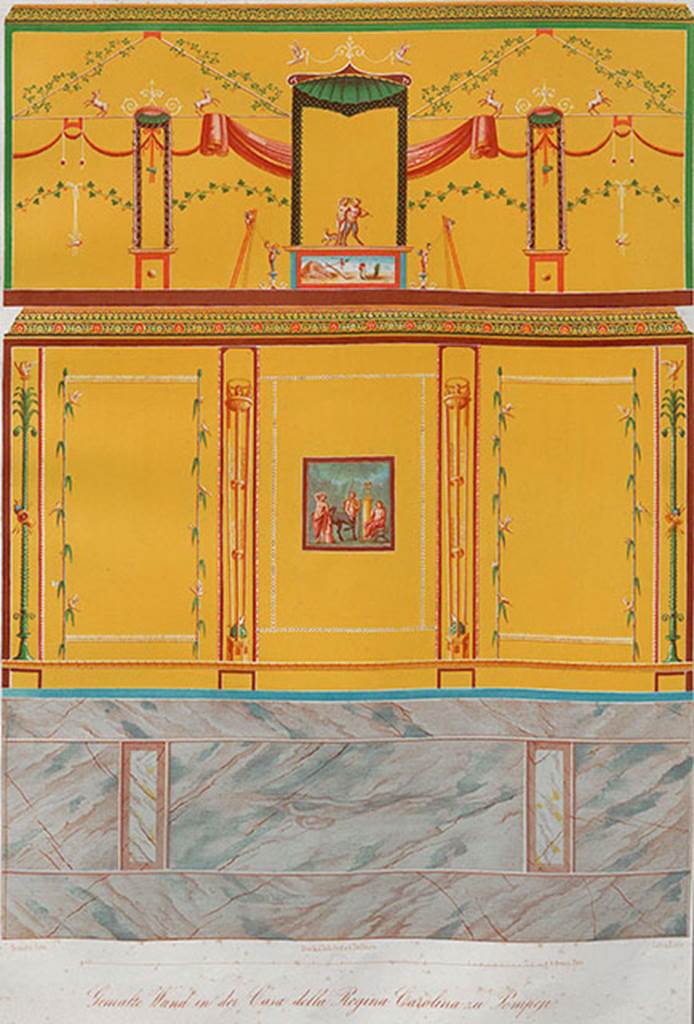
VIII.3.14 Pompeii. West wall of cubiculum with painting of Apollo, Chiron and Asclepius.
See Zahn, W., 1852. Die schönsten Ornamente und merkwürdigsten Gemälde aus Pompeji, Herkulanum und Stabiae: III. Berlin: Reimer, taf. 47.
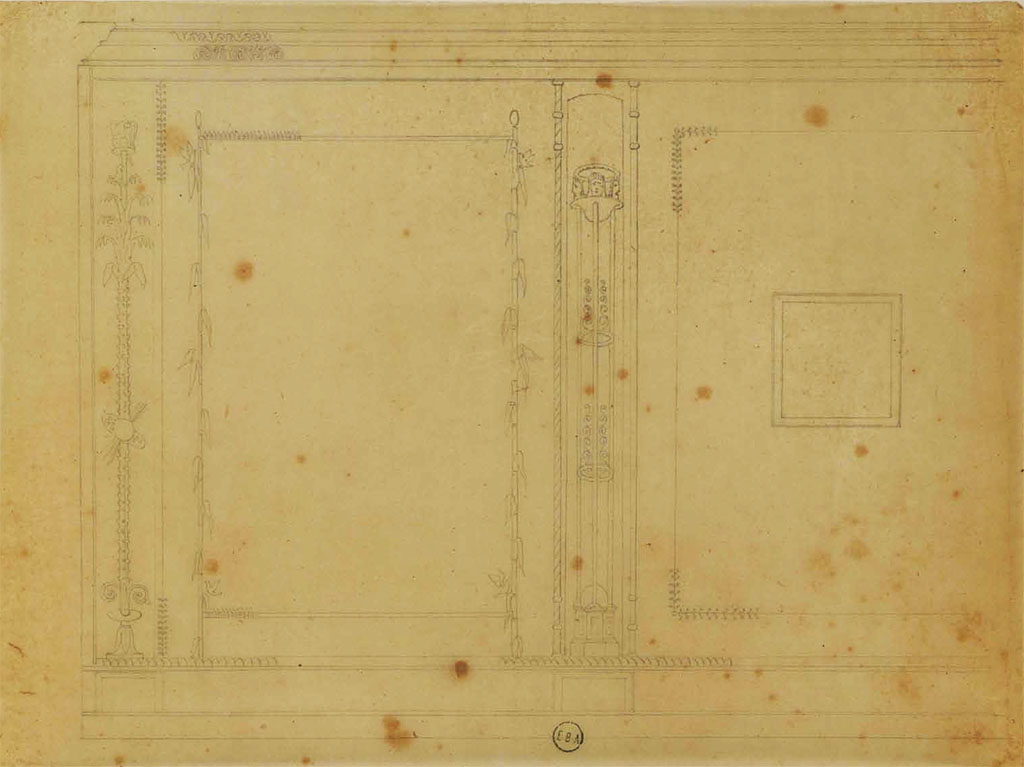
VIII.3.14 Pompeii. Undated sketch by J.B.C Lesueur of part of west wall of cubiculum, showing three masks on top of the painted candelabra.
See Lesueur, Jean-Baptiste Ciceron. Voyage
en Italie de Jean-Baptiste Ciceron Lesueur (1794-1883), pl. 97.
See Book on INHA reference INHA NUM PC 15469 (04) « Licence Ouverte / Open Licence » Etalab
![VIII.3.14 Pompeii. Drawing by W. Gell, c.1819, the drawing of the candelabra, second on the left, is from the south wall of the cubiculum.
The three candelabra, on the right, are from the west wall of the cubiculum.
See Gell W & Gandy, J.P: Pompeii published 1819 [Dessins publiés dans l'ouvrage de Sir William Gell et John P. Gandy, Pompeiana: the topography, edifices and ornaments of Pompei, 1817-1819], pl. 55 verso.
See book in Bibliothèque de l'Institut National d'Histoire de l'Art [France], collections Jacques Doucet Gell Dessins 1817-1819
Use Etalab Open Licence ou Etalab Licence Ouverte](8%2003%2014%20p2_files/image028.jpg)
VIII.3.14 Pompeii. Drawing by W. Gell, c.1819, the drawing of the candelabra, second on the left, is from the south wall of the cubiculum.
The three candelabra, on the right, are from the west wall of the cubiculum.
See book in Bibliothèque de l'Institut National
d'Histoire de l'Art [France], collections Jacques Doucet Gell
Dessins 1817-1819
Use Etalab Open Licence ou
Etalab Licence Ouverte
![VIII.3.14 Pompeii. Between 1819 and 1832, sketches by W. Gell of painted decoration.
On the left is the detail from the candelabra on west wall of cubiculum.
See Gell, W. Pompeii unpublished [Dessins de l'édition de 1832 donnant le résultat des fouilles post 1819 (?)] vol II, pl. 35.
Bibliothèque de l'Institut National d'Histoire de l'Art, collections Jacques Doucet, Identifiant numérique Num MS180 (2).
See book in INHA Use Etalab Licence Ouverte](8%2003%2014%20p2_files/image029.jpg)
VIII.3.14 Pompeii. Between 1819 and 1832, sketches by W. Gell of painted decoration.
On the left is the detail from the candelabra on west wall of cubiculum.
See Gell, W. Pompeii
unpublished [Dessins de l'édition de 1832 donnant le résultat des fouilles post
1819 (?)] vol II, pl. 35.
Bibliothèque de
l'Institut National d'Histoire de l'Art, collections Jacques Doucet, Identifiant
numérique Num MS180 (2).
See book in INHA Use Etalab Licence Ouverte
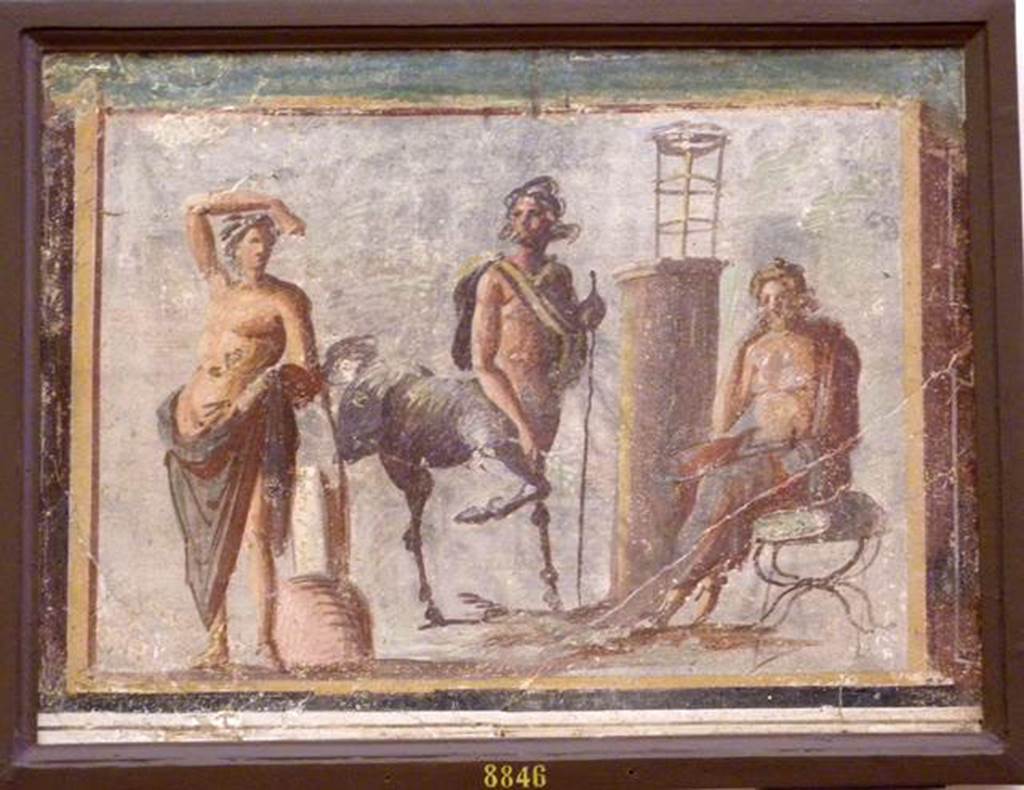
VIII.3.14 Pompeii. West wall of cubiculum. Painting of Apollo, Chiron and Asclepius.
Now in Naples Archaeological Museum. Inventory number 8846.
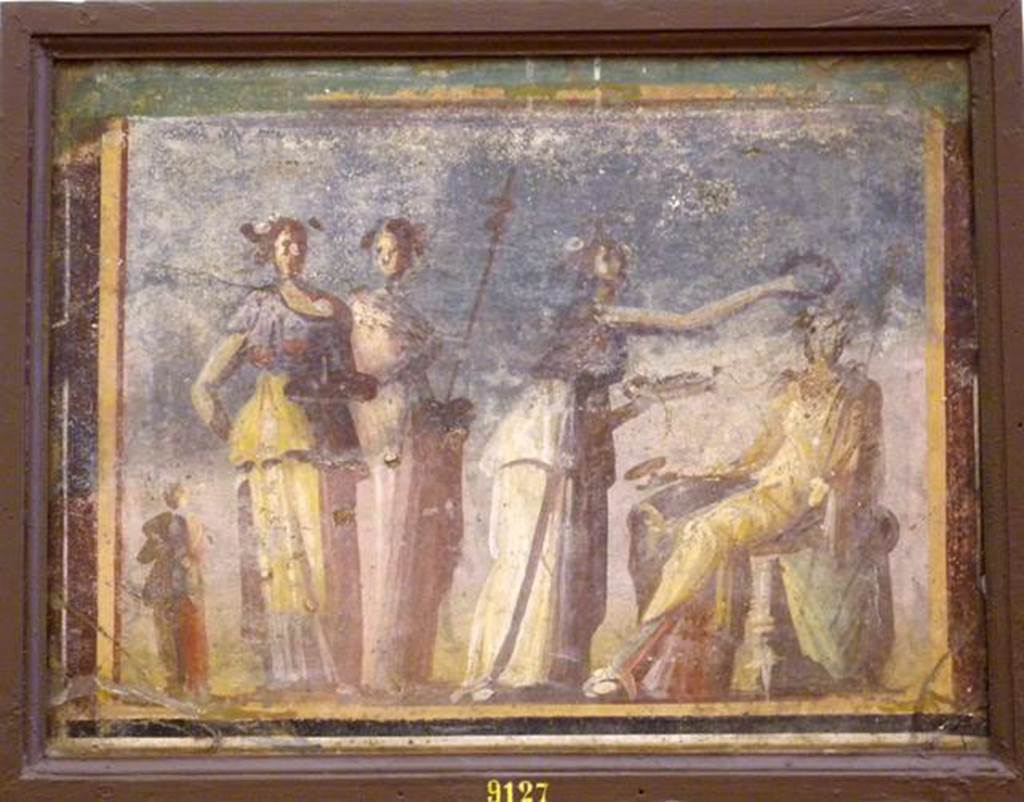
VIII.3.14 Pompeii. Found 20-29 October 1763. Nymphs crowning a seated figure in a Bacchic rite.
Now in Naples Archaeological Museum. Inventory number 9127.
This painting and inventory number 8846 were found on two walls in the same room.
See Antichità di Ercolano: Tomo Setto: Le
Pitture 5, 1779, p.217-221, pl.50.
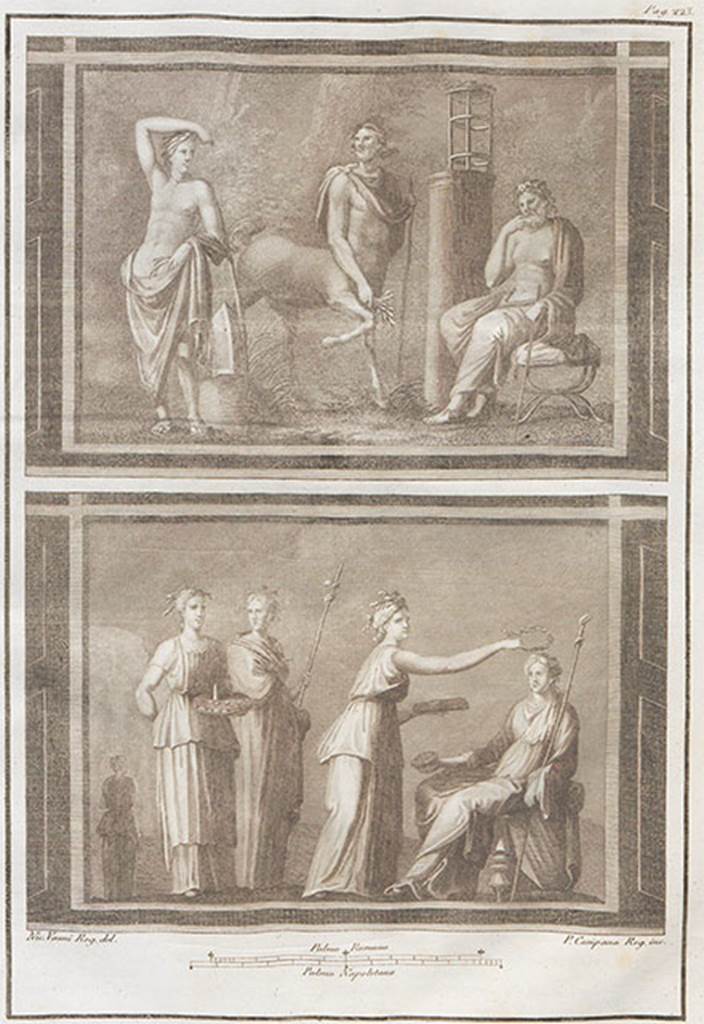
VIII.3.14 Pompeii. Found 20-29 October 1763.
The above two paintings were found on two walls in the same room.
See Antichità di Ercolano: Tomo Setto: Le
Pitture 5, 1779, p.217-221, pl.50.
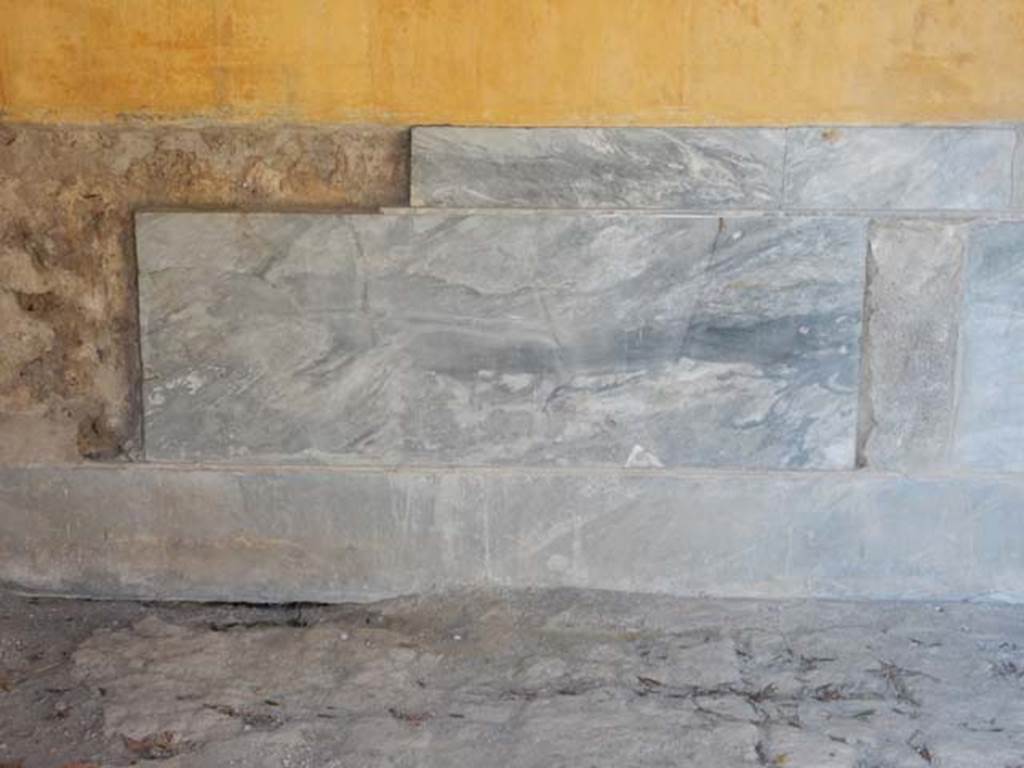
VIII.3.14 Pompeii. May 2016. Detail of zoccolo on lower part of west wall. Photo courtesy of Buzz Ferebee.
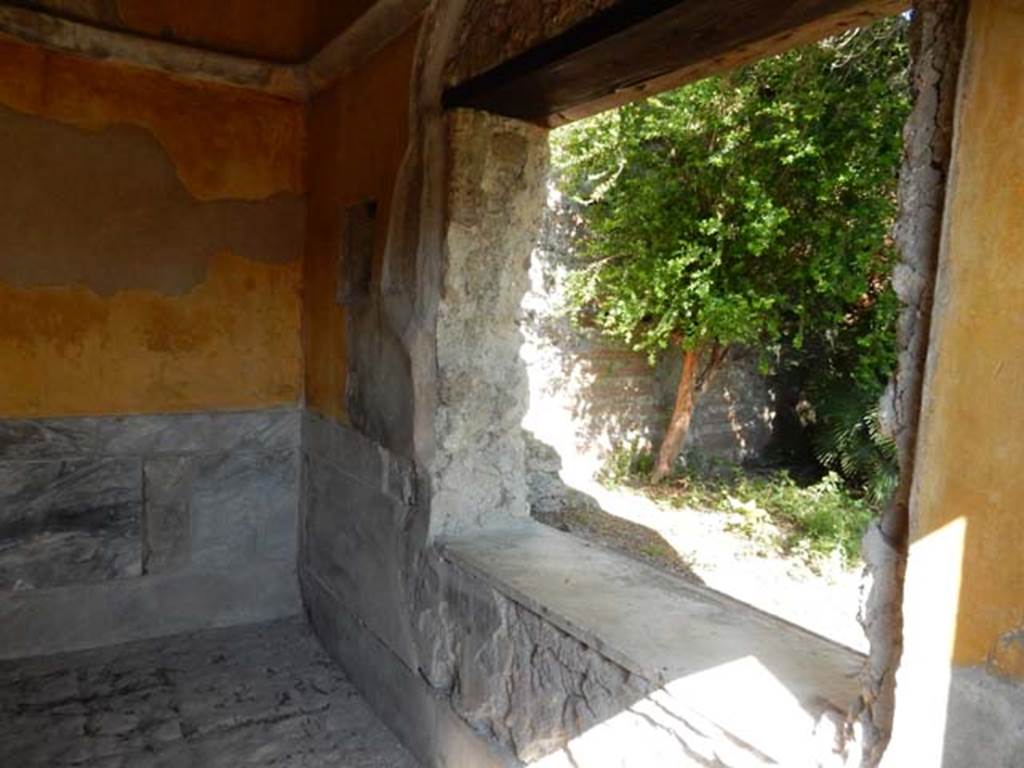
VIII.3.14 Pompeii. May 2016. Window in north wall of cubiculum. Photo courtesy of Buzz Ferebee.
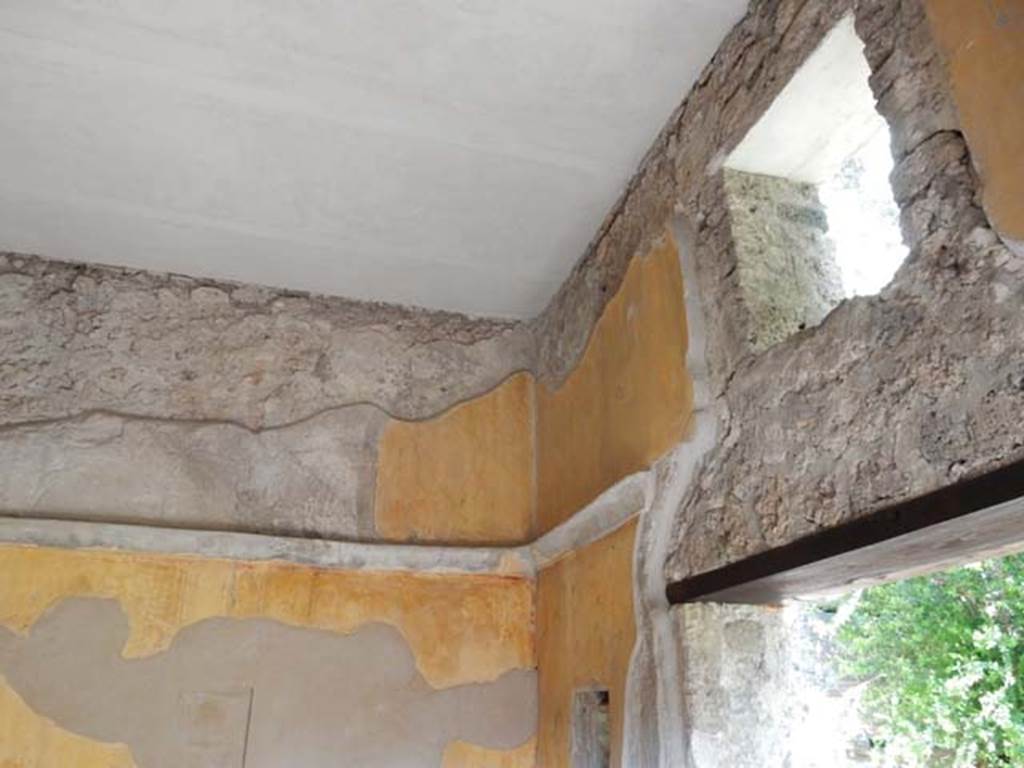
VIII.3.14 Pompeii. May 2016.Upper north-west corner of cubiculum. Photo courtesy of Buzz Ferebee.
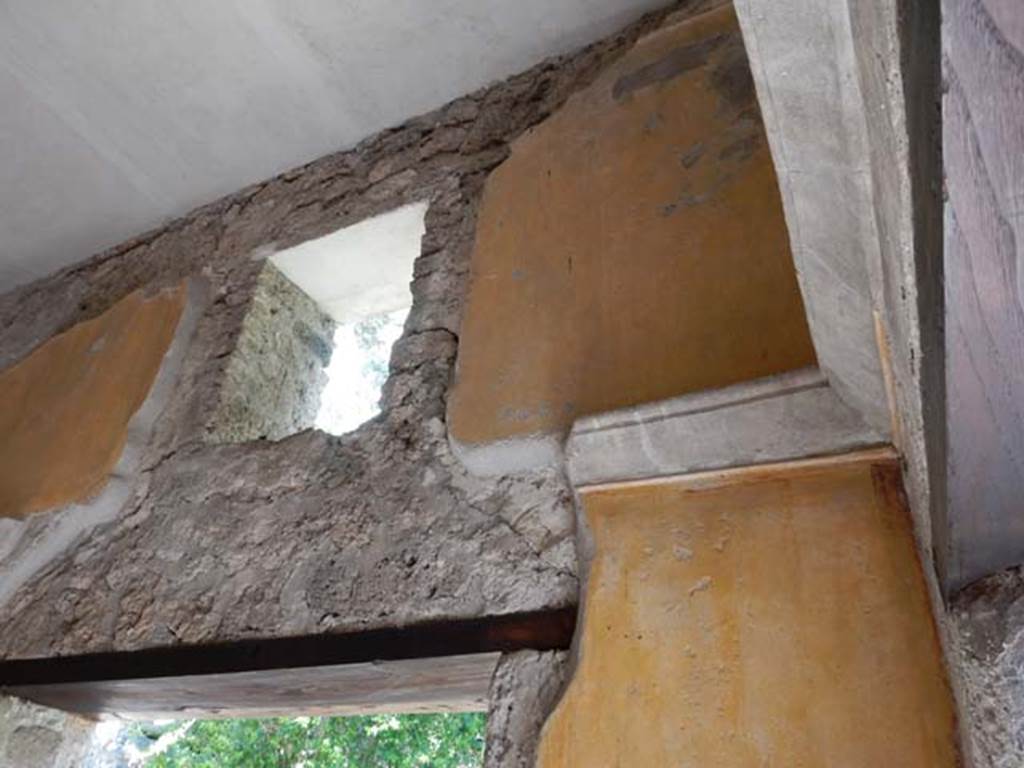
VIII.3.14 Pompeii. May 2016. Upper window in north wall of cubiculum, and north-east corner. Photo courtesy of Buzz Ferebee.
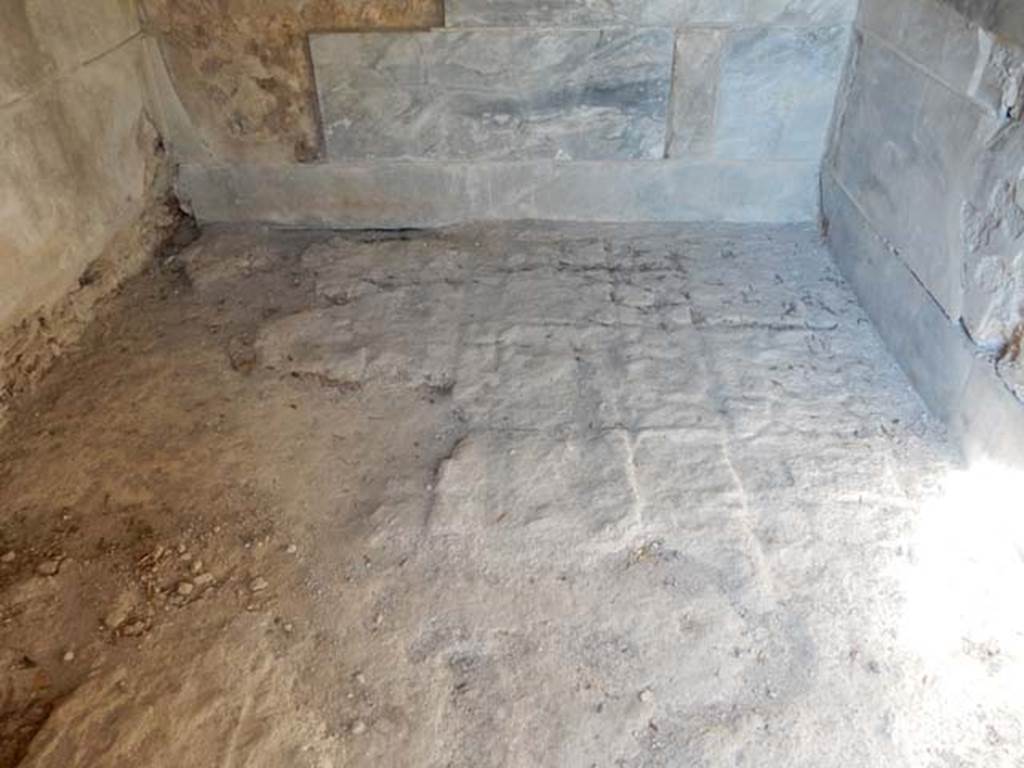
VIII.3.14 Pompeii. May 2016.
Imprint of opus sectile flooring in cubiculum. The flooring
was probably removed in antiquity. Photo
courtesy of Buzz Ferebee.
See Carratelli,
G. P., 1990-2003. Pompei: Pitture e Mosaici: Vol. VIII. Roma: Istituto della enciclopedia italiana, p. 407, fig.
21.
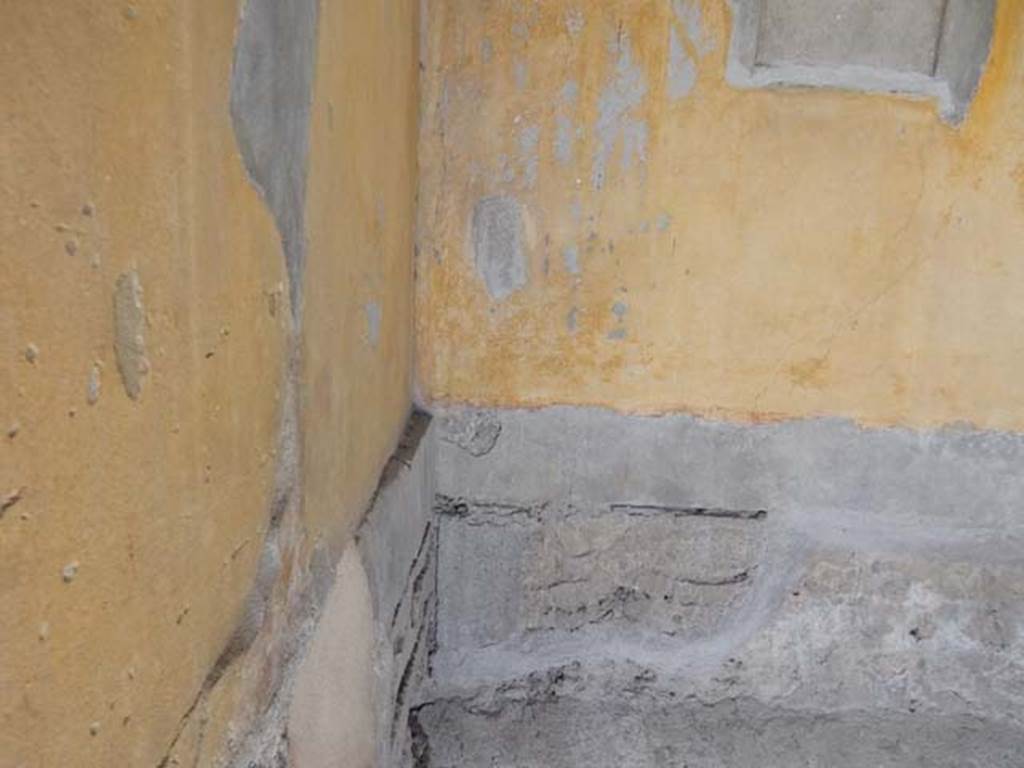
VIII.3.14 Pompeii. May 2016. South-east corner of cubiculum. Photo courtesy of Buzz Ferebee.
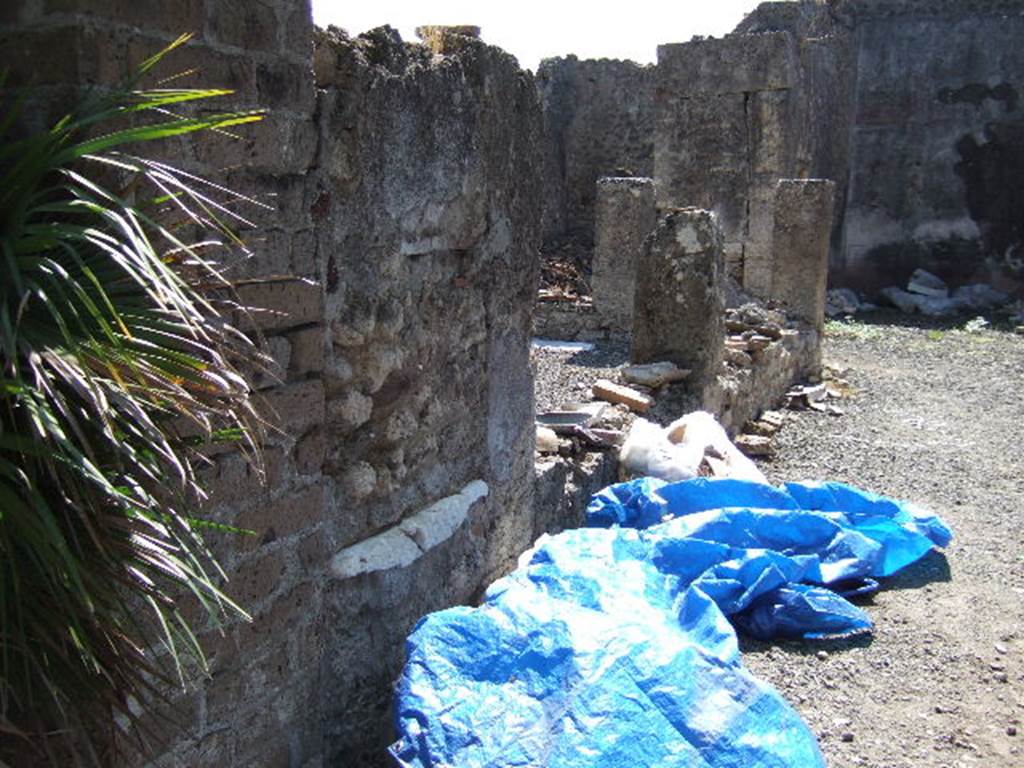
VIII.3.14 Pompeii. September 2005. Looking south along west side of atrium.
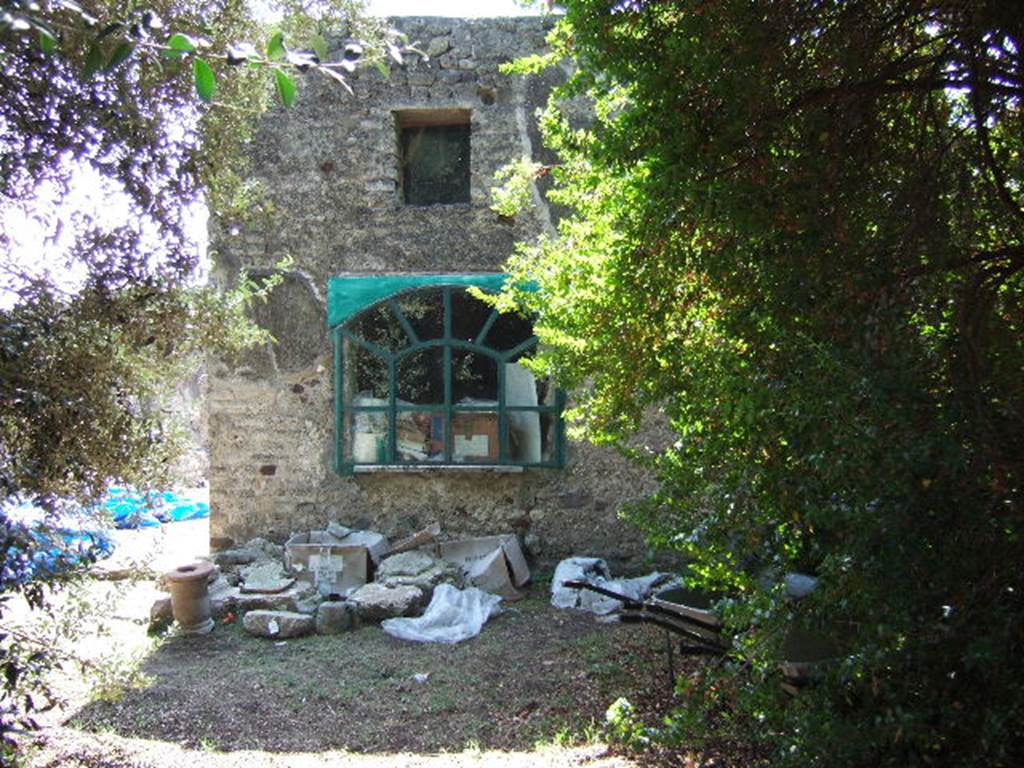
VIII.3.14 Pompeii. September 2005. Looking south across west side of garden.
According to Boyce, in a cubiculum located on the north side of the tablinum, in the south wall was a semi-circular, vaulted niche.
The inside walls of the niche were coated with yellow stucco like the walls of the room, its floor was a marble slab.
Fiorelli called
it “una nicchia per qualche simulacro di deità”.
See Boyce G. K., 1937. Corpus
of the Lararia of Pompeii. Rome:
MAAR 14. (p.75, no.352)
See Pappalardo, U., 2001. La Descrizione di Pompei per Giuseppe Fiorelli (1875). Napoli: Massa Editore. (p.124)
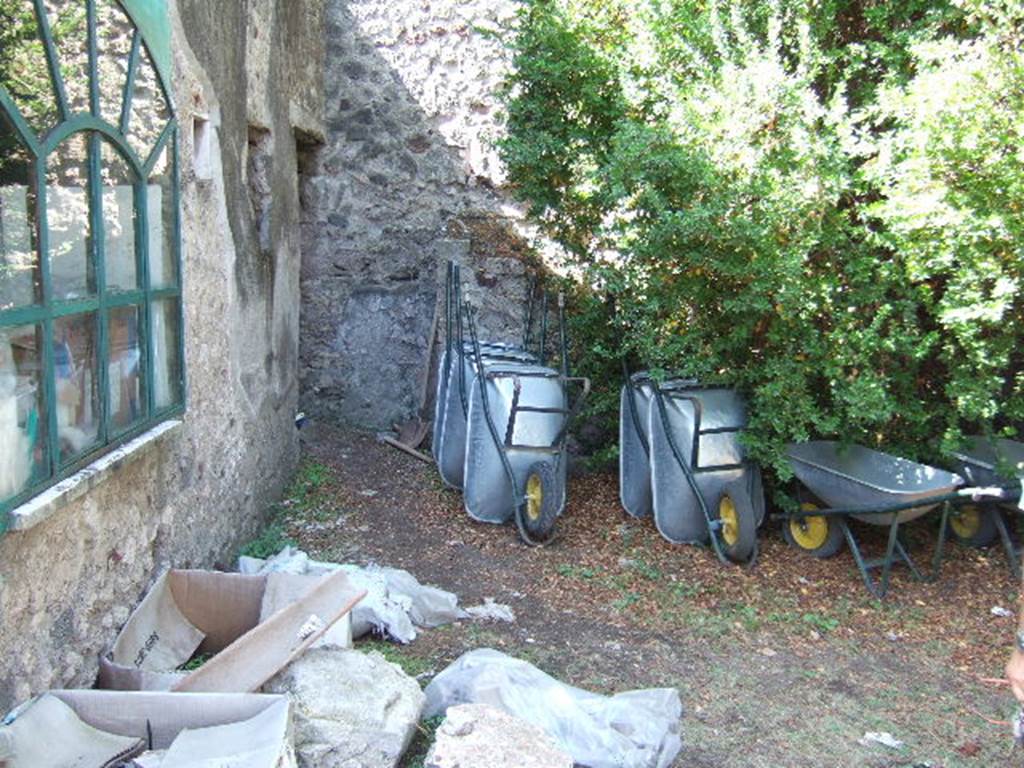
VIII.3.14 Pompeii. September 2005. West side of garden with doorway to small room or cupboard on west side of cubiculum.
At the rear of the wheelbarrows are steps to an upper floor.
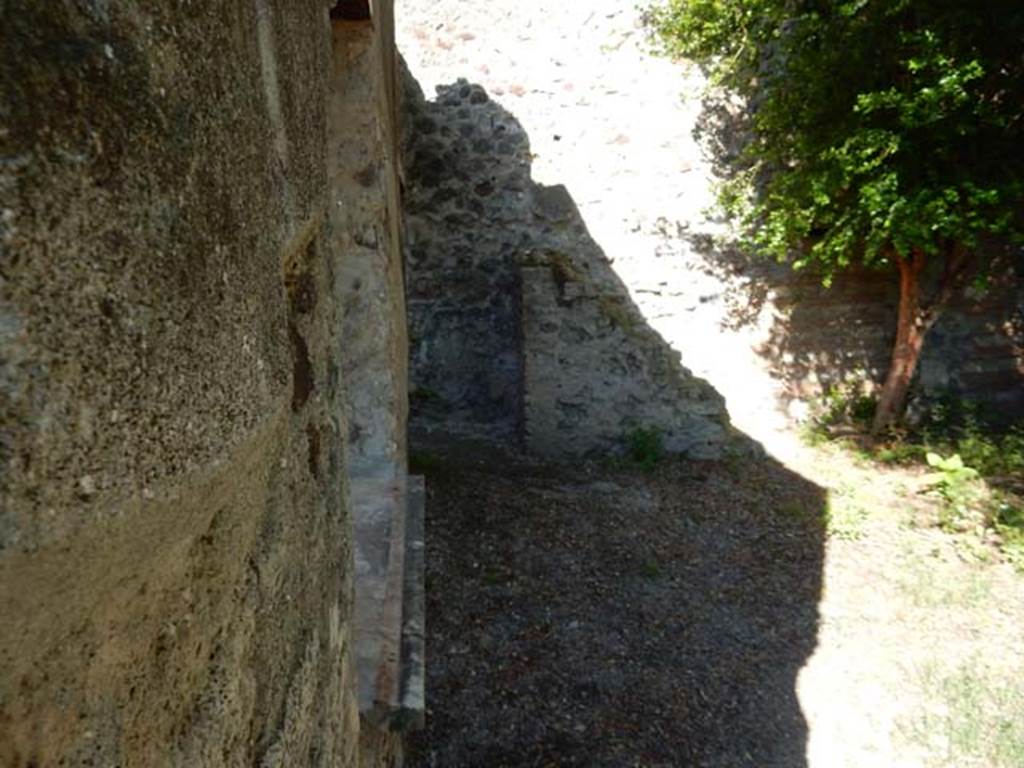
VIII.3.14 Pompeii. May 2016.
Looking west along exterior north wall of cubiculum towards small room. Photo courtesy of Buzz Ferebee.
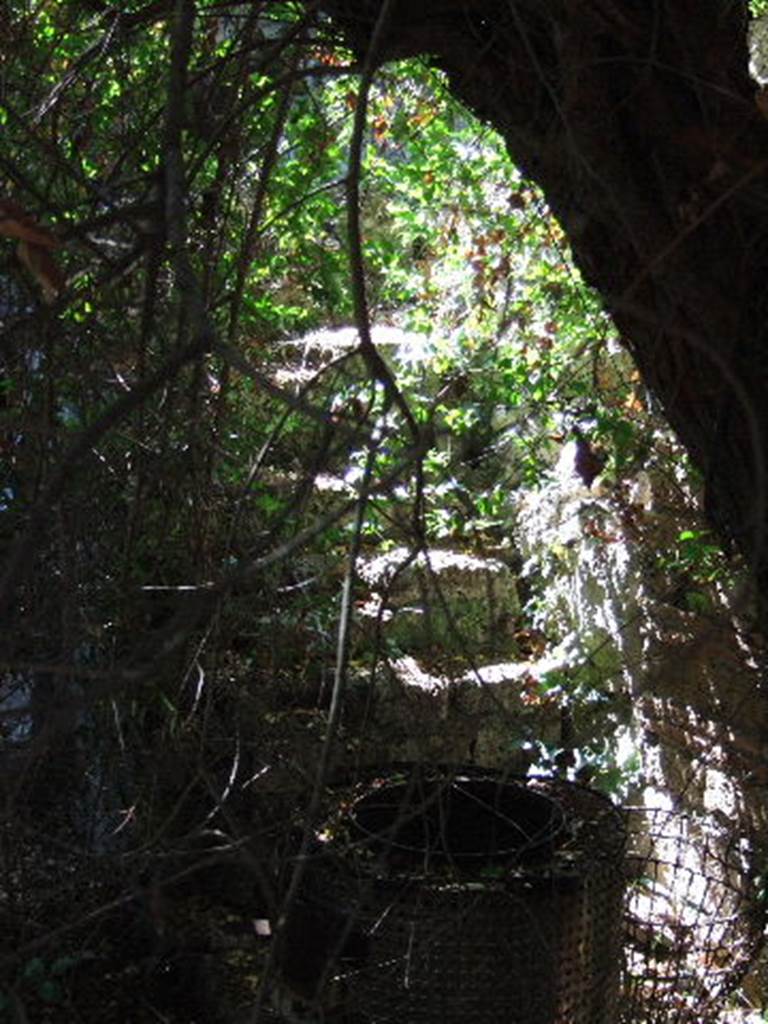
VIII.3.14 Pompeii. September 2005.
West side of garden, steps to upper floor, with cupboard or small room below.
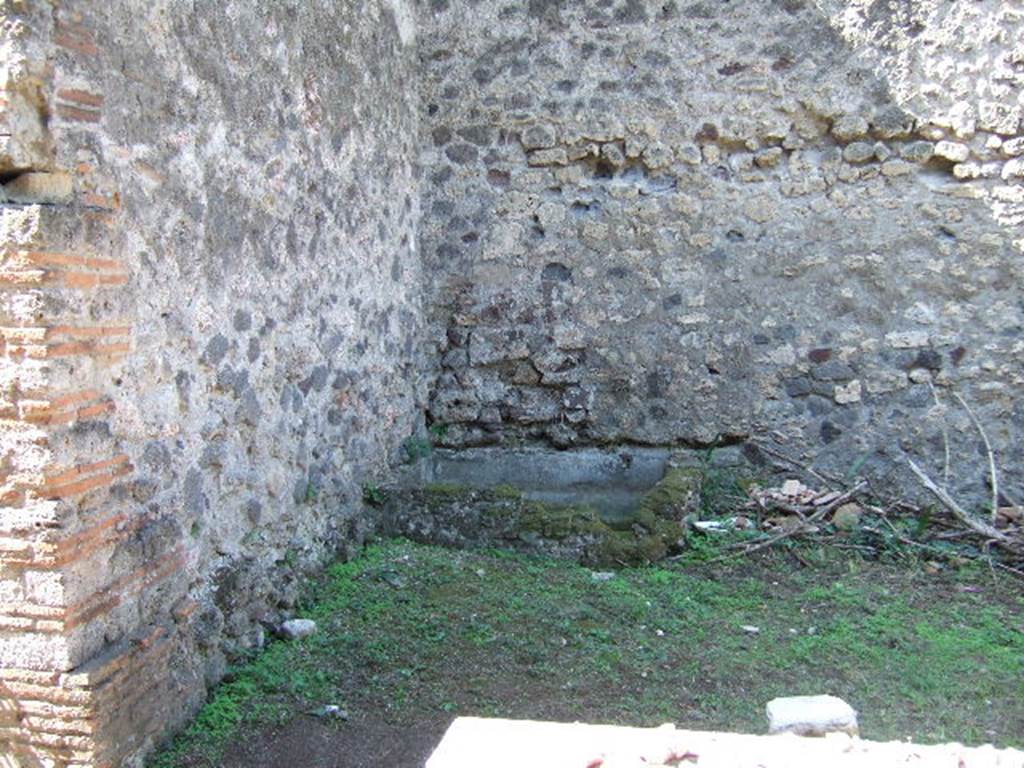
VIII.3.14 Pompeii. September 2005. Water basin in south-west corner of garden, behind projection of neighbouring house
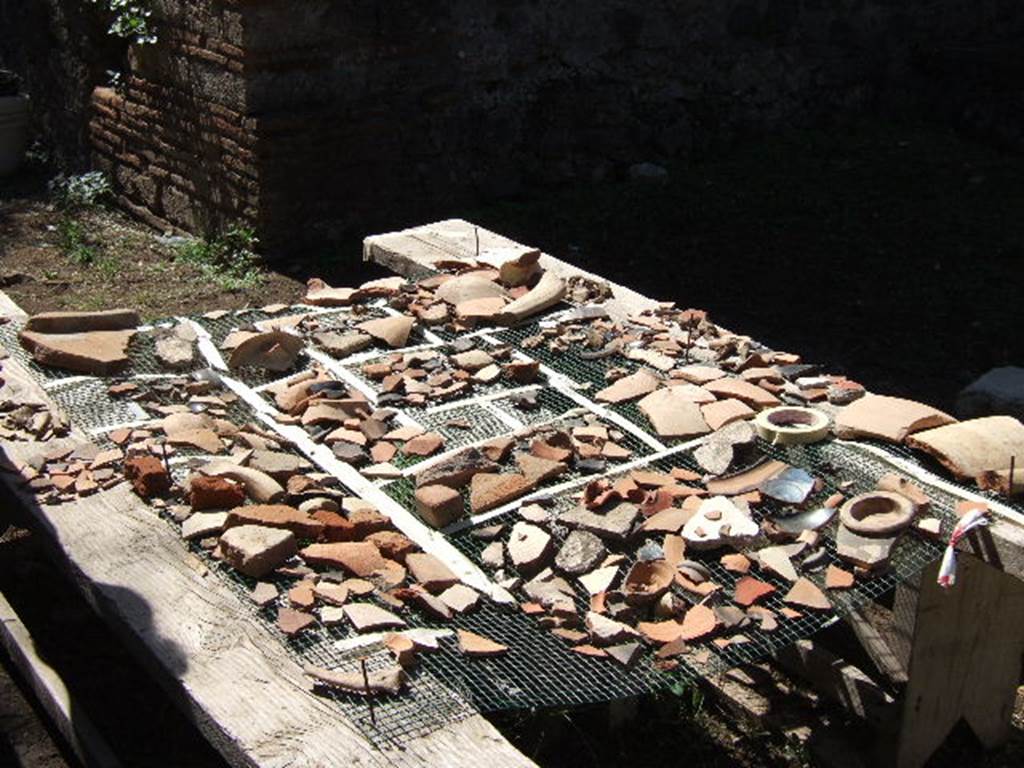
VIII.3.14 Pompeii. September 2005. Finds table.
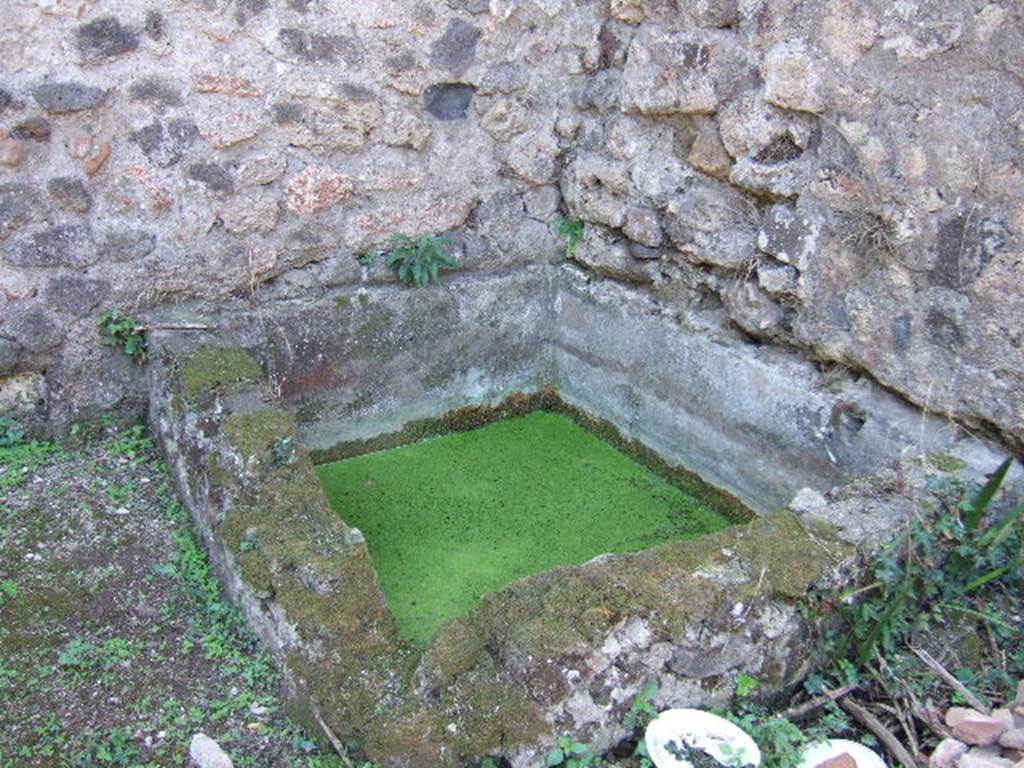
VIII.3.14 Pompeii. September 2005. Water basin in south-west corner.
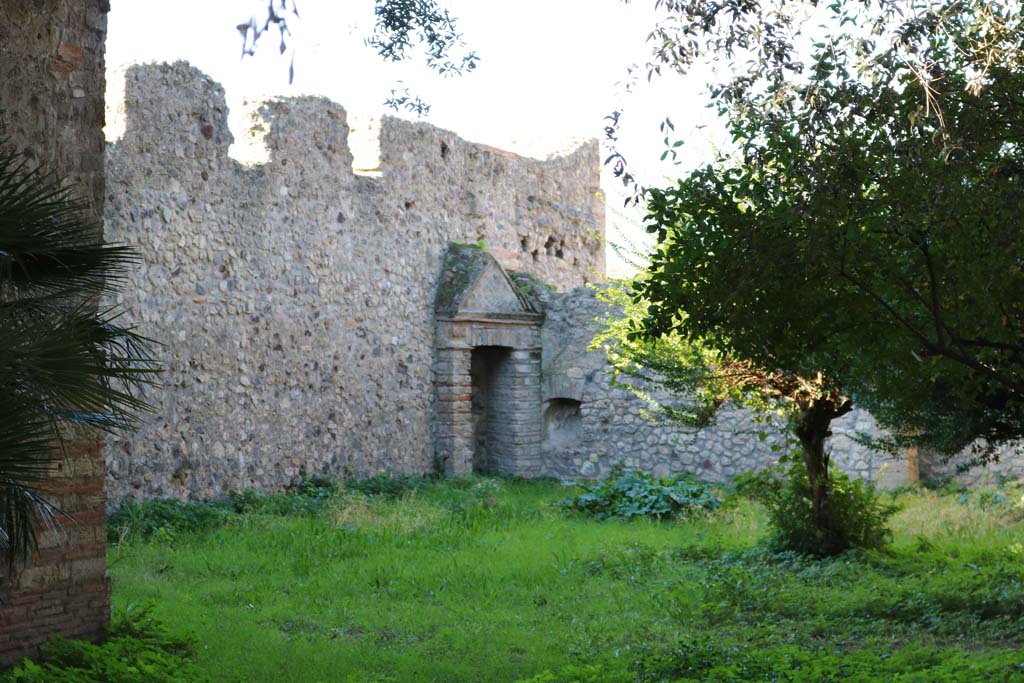
VIII.3.14, Pompeii. December 2018.
Looking towards
north-west corner of garden area, with aedicula niche on west wall. Photo
courtesy of Aude Durand.
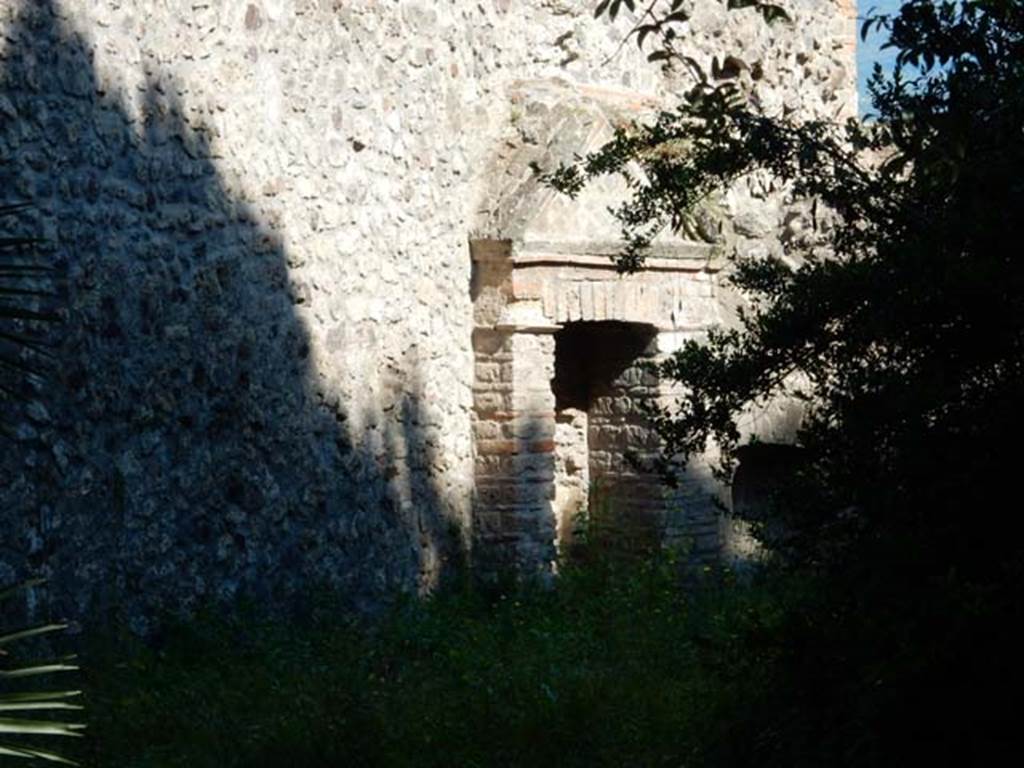
VIII.3.14 Pompeii. May 2016. Aedicula niche in north-west corner of garden area. Photo courtesy of Buzz Ferebee.
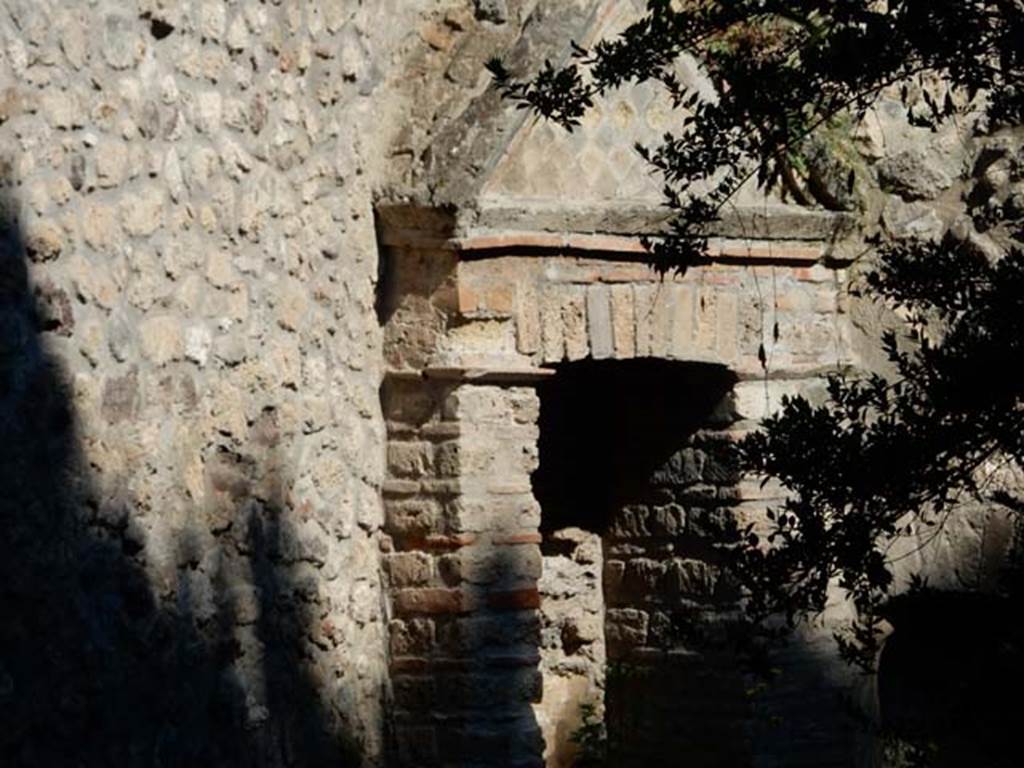
VIII.3.14 Pompeii. May 2016. Detail of niche with aedicule façade. Photo courtesy of Buzz Ferebee.
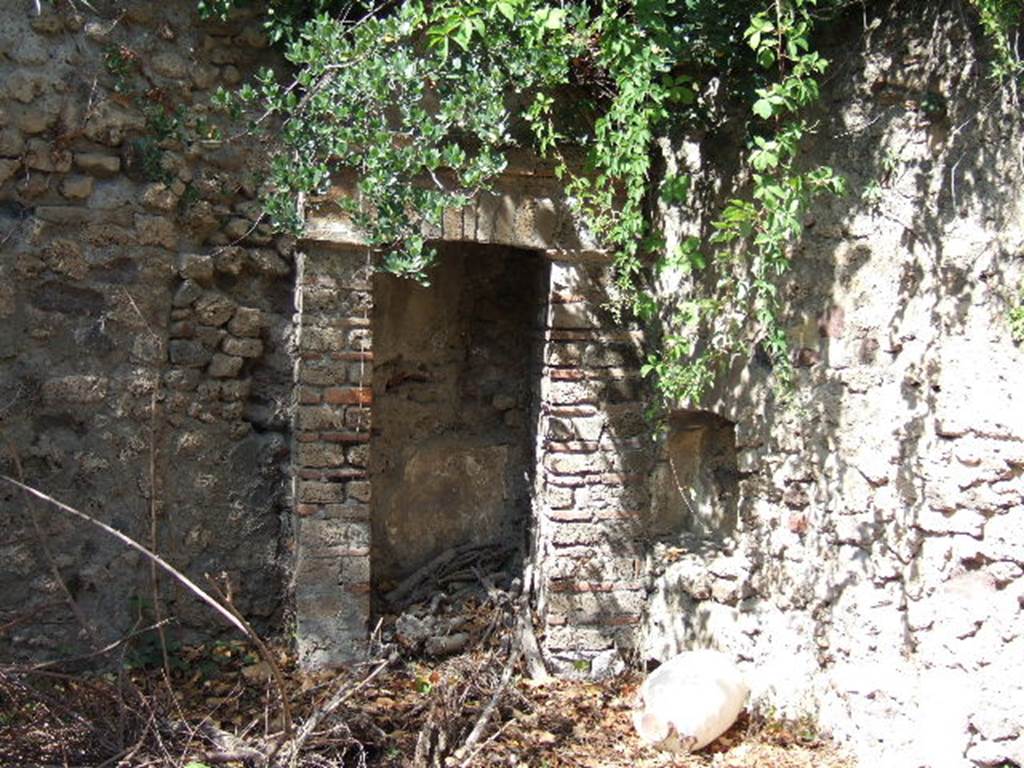
VIII.3.14 Pompeii. September 2005. North-west corner of garden.
According to Boyce, in the north-west corner of the garden was a niche adorned with an aedicula facade.
There were two rectangular pilasters supporting a pediment, which was built on the top of a base.
Before the aedicula stood an altar.
See Boyce G. K., 1937. Corpus of the Lararia of Pompeii. Rome: MAAR 14. (p.75, no.351).
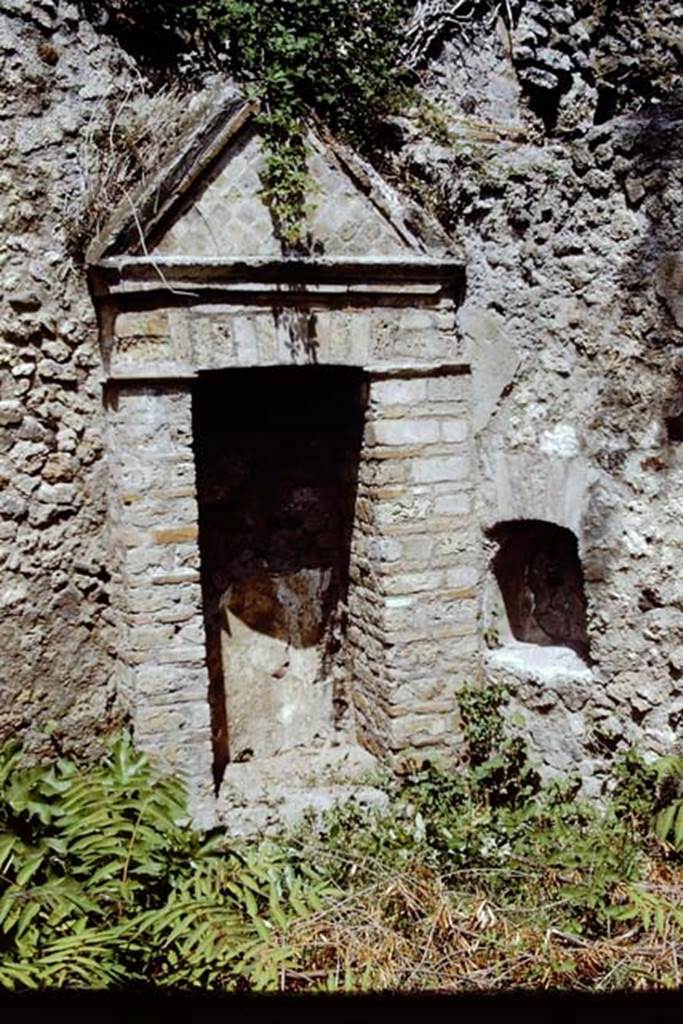
VIII.3.14
Pompeii. 1971.
Aedicula niche
in north-west corner of garden. Photo by Stanley A. Jashemski.
Source: The
Wilhelmina and Stanley A. Jashemski archive in the University of Maryland
Library, Special Collections (See collection page) and made available under the Creative
Commons Attribution-Non-Commercial License v.4. See Licence and use details.
J71f0153
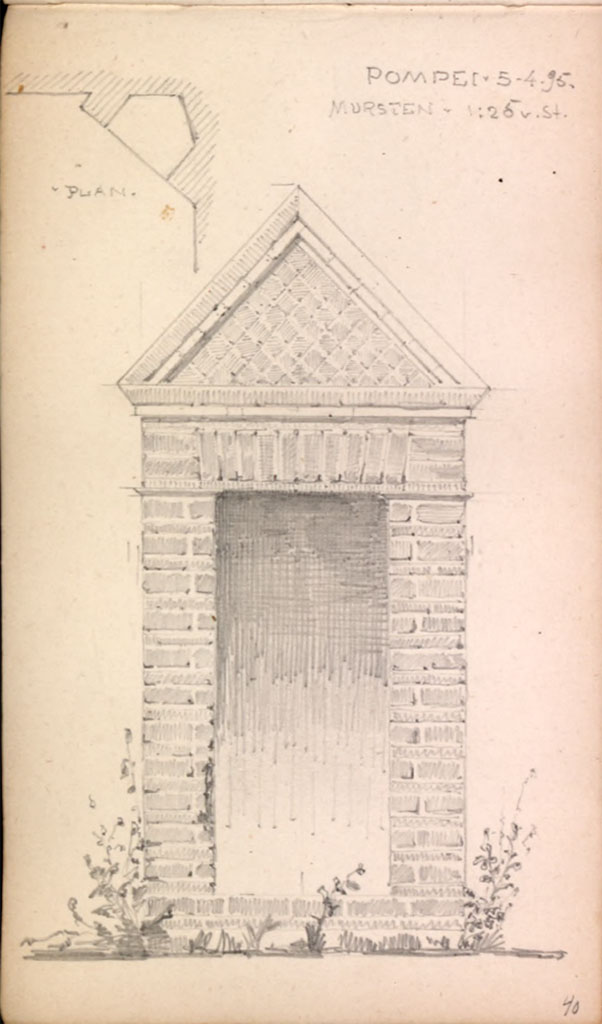
VIII.3.14
Pompeii.
Sketch dated
5.4.1895 by Johannes Magdahl Nielsen (1862-1941) of aedicula niche in garden.
See Johannes Magdahl Nielsen (1862-1941), Rejseskitser,
Tyskland, Italien, skitsebog fra 1891 og 1895, pl. 40.
Photo
© Danmarks Kunstbibliotek, inventory number 53802. Download sketchbook
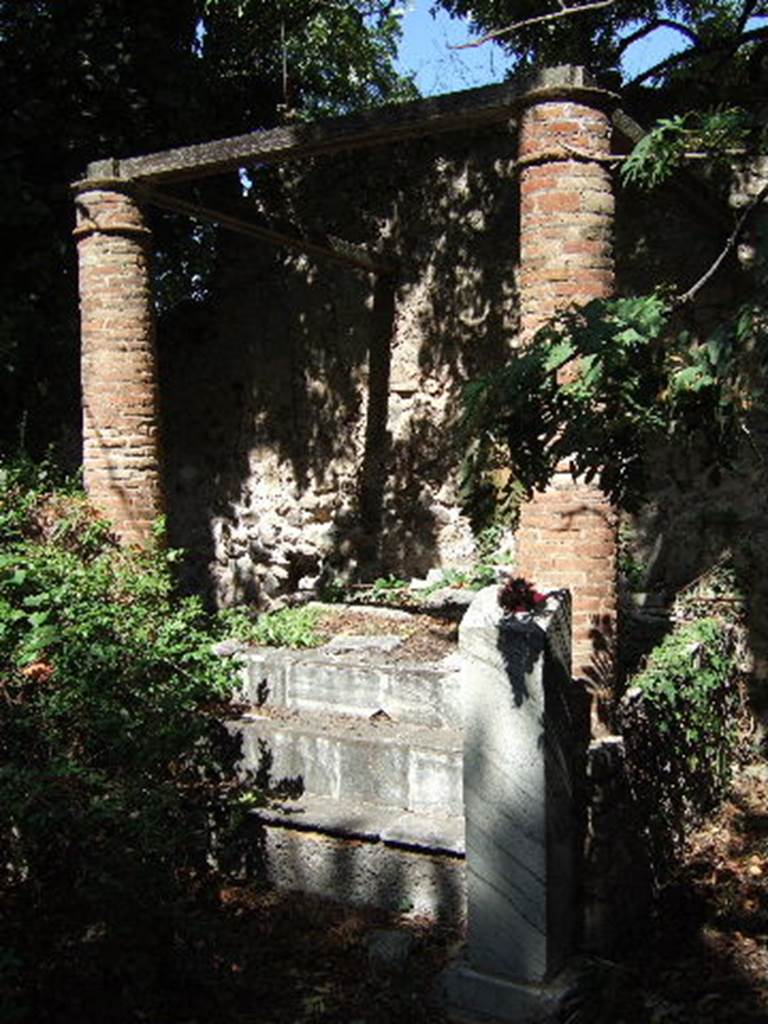
VIII.3.14 Pompeii. September 2005. Garden.
According to Boyce, in the centre of the north wall of the garden stands a large aedicula.
Four steps lead up to the top of the broad podium.
The podium and the steps are covered with marble slabs.
In the centre of the podium stands a ruinous base which supported a statue of Diana.
Two columns of brick supported the front end of the roof over the shrine.
In front of the podium, on each side of the steps, stands a marble base which originally held a herm.
See Boyce G. K., 1937. Corpus of the Lararia of Pompeii. Rome: MAAR 14. (p.75, no.350).
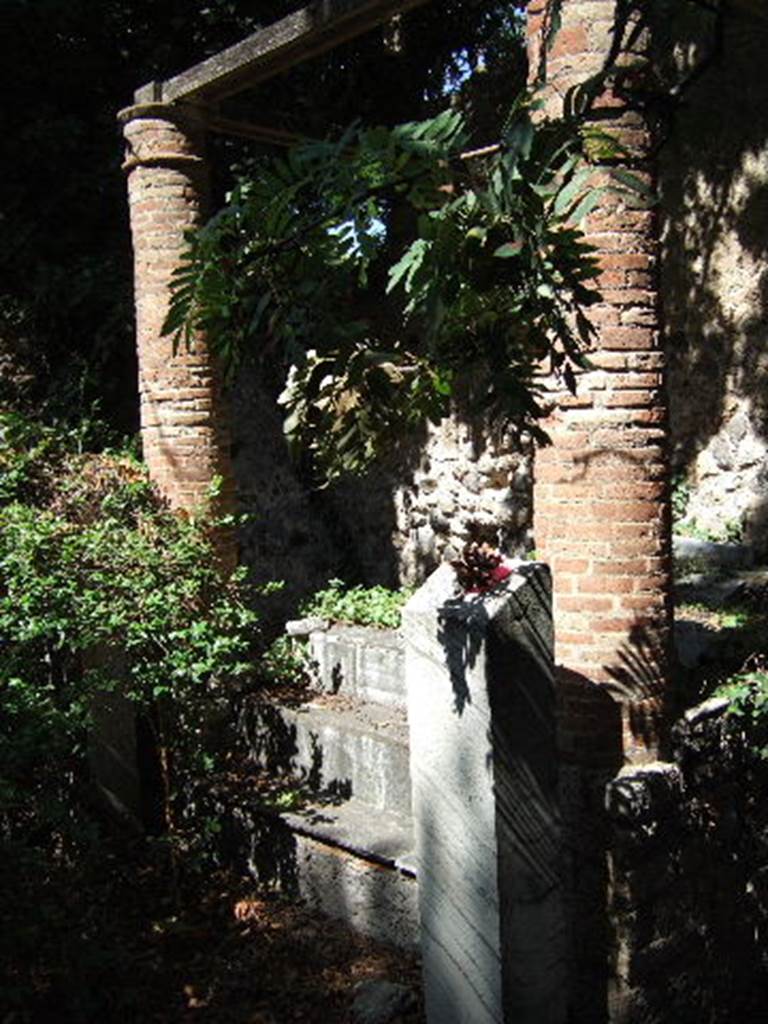
VIII.3.14 Pompeii. September 2005.
Garden. Aedicula with remains of marble base for a herm, at the side of the steps.
According to Schulz in BdI, at the beginning of October 1839, in the garden, an aedicula was found, which one ascended by four steps.
At the foot of the aedicula were found two marble herms and a marble candelabrum.
And in the left corner of the same courtyard was another niche, of elegant architecture, made from masonry.
In various parts of this Courtyard were found many fragments of marble and bronze pots, including a marble head of Jupiter.
See Bullettino dell’Instituto di Corrispondenza
Archeologica (DAIR), 1841, p. 121.
See Fiorelli G., 1862. Pompeianarum antiquitatum historia, Vol. 2: 1819 - 1860, Naples, (p.373, 9th October 1839).
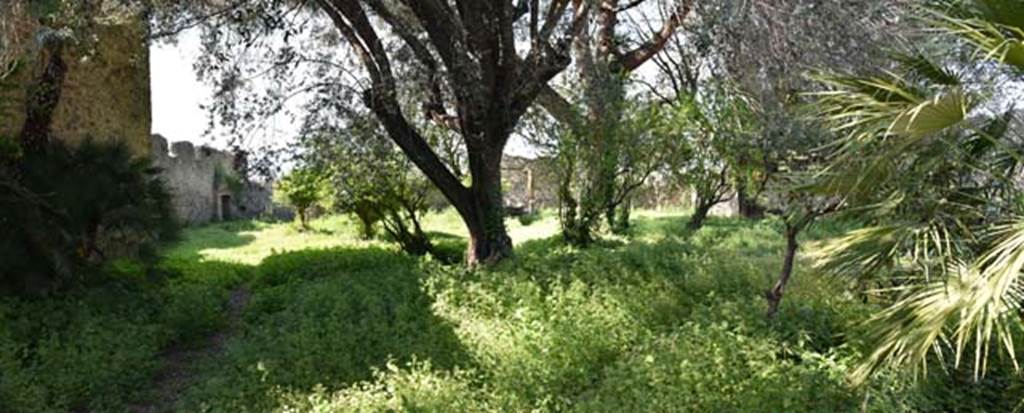
VIII.3.14 Pompeii. April 2018. Looking north-east across
garden area. Photo courtesy of Ian Lycett-King.
Use is subject to Creative
Commons Attribution-NonCommercial License v.4 International.
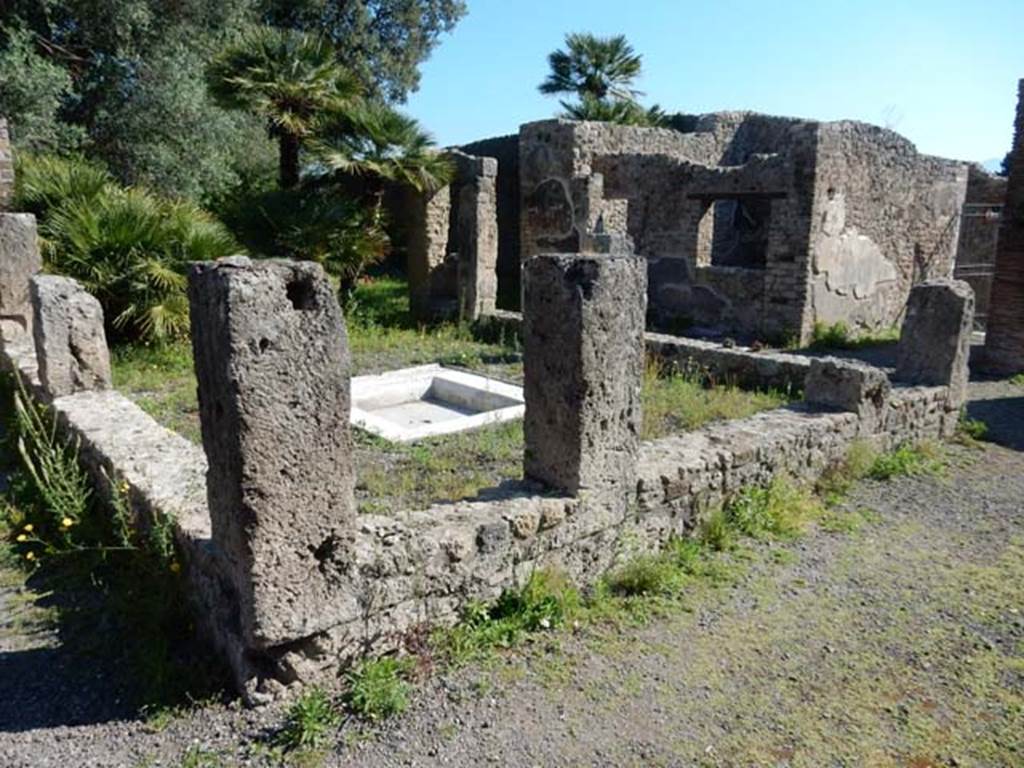
VIII.3.14 Pompeii. May 2016.
Looking north-east across atrium towards oecus fenestratum and entrance corridor. Photo courtesy of Buzz Ferebee.
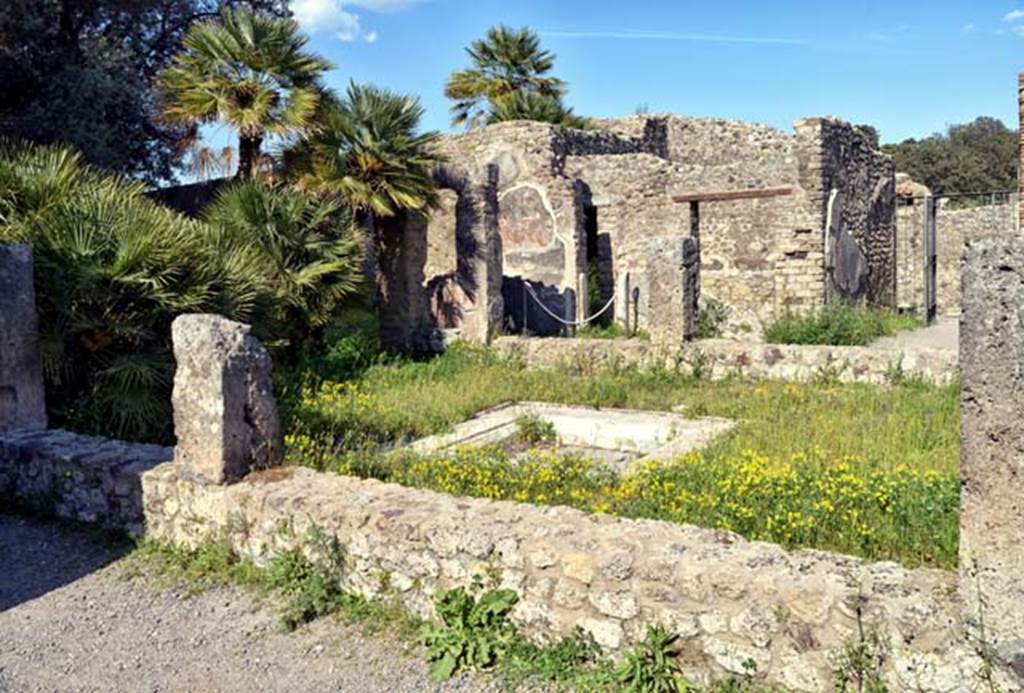
VIII.3.14 Pompeii. April 2018.
Looking east across atrium towards oecus fenestratum and
entrance. Photo courtesy of Ian Lycett-King.
Use is subject to Creative
Commons Attribution-NonCommercial License v.4 International.
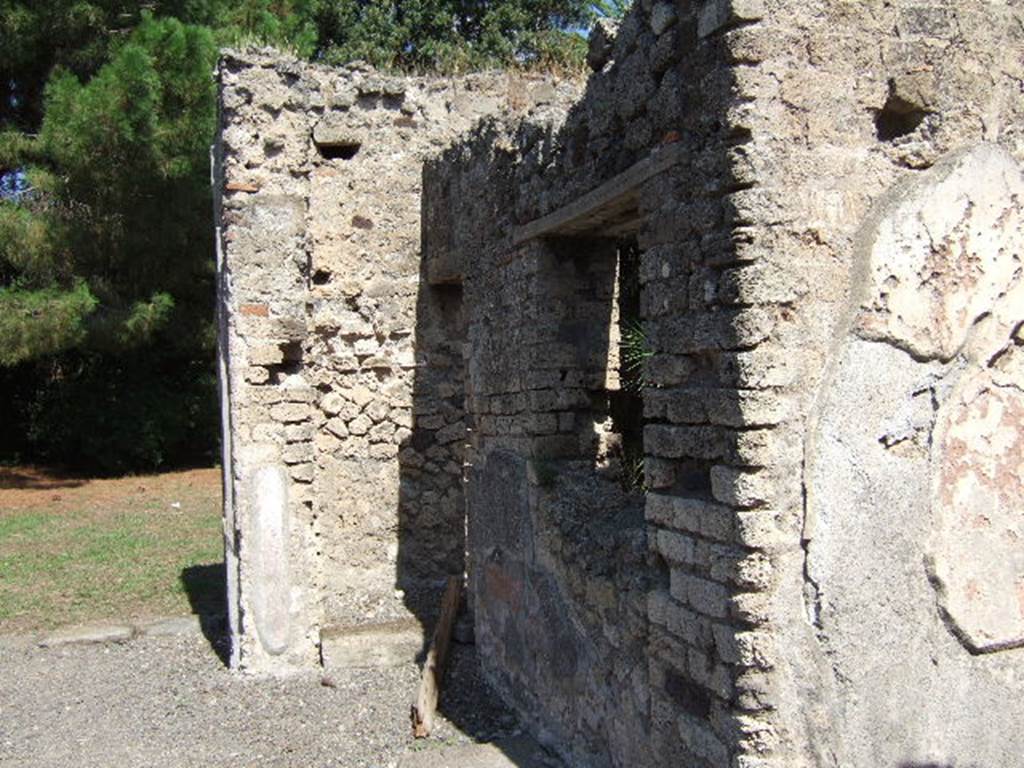
VIII.3.14 Pompeii. September 2005.
Looking north along east side of atrium, towards doorway, and window of oecus fenestratum.
According to Helbig, and described as found in the “First corridor, on right out of atrium”, were paintings of Centaurs, (Helbig no 503).
In the predella: Battle of Five Pygmies & 5 Cocks, (Helbig no. 1529).
See Helbig, W., 1868. Wandgemälde der vom Vesuv verschütteten Städte Campaniens. Leipzig: Breitkopf und Härtel. (nos.503 and 1529)
According to Fiorelli -
“From the walkways of the atrium, of which the eastern still holds the remains of a small painting, showing a Bacchante being carried on the back of a Centaur, and below, a fight of Pygmies ......”
See Pappalardo,
U., 2001. La Descrizione di Pompei per
Giuseppe Fiorelli (1875). Napoli: Massa Editore. (p.124)
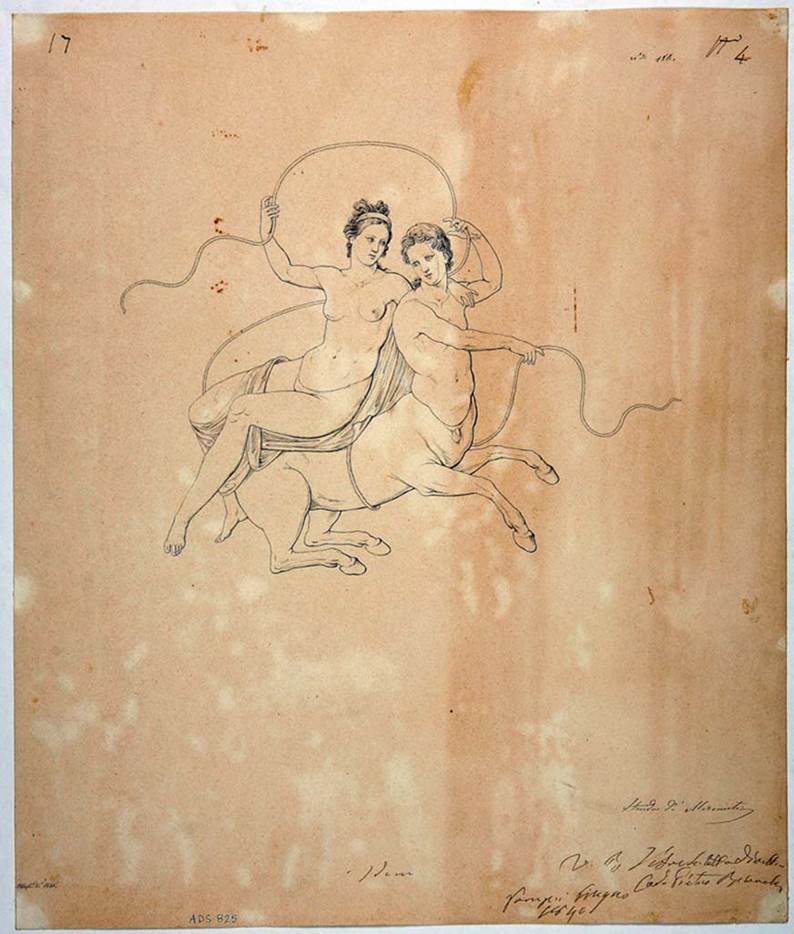
VIII.3.14 Pompeii.
Drawing by Giuseppe Abbate, 1840, of centaurs seen above the predella in a panel on a wall of the corridor leading from atrium to peristyle.
See Helbig, W.,
1868. Wandgemälde der vom Vesuv
verschütteten Städte Campaniens. Leipzig: Breitkopf und Härtel, (Helbig 503).
Now in Naples Archaeological Museum. Inventory number ADS 825.
Photo © ICCD. https://www.catalogo.beniculturali.it/
Utilizzabili alle condizioni della licenza Attribuzione
- Non commerciale - Condividi allo stesso modo 2.5 Italia (CC BY-NC-SA 2.5 IT)
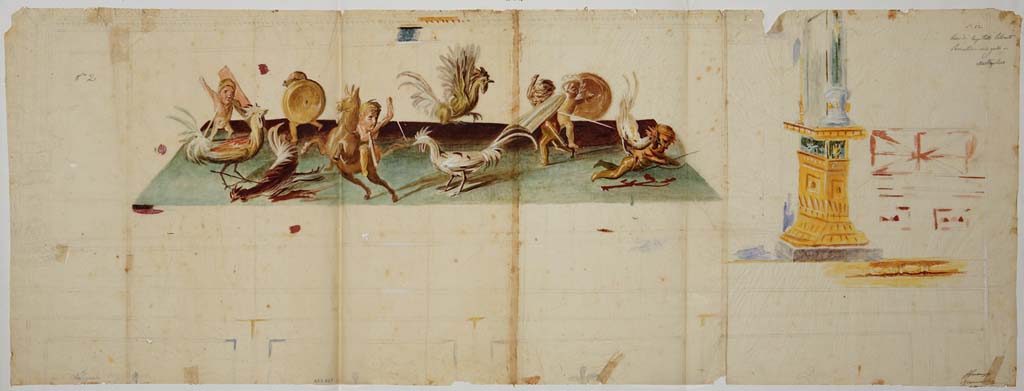
VIII.3.14 Pompeii.
Preparatory painting by Michele Mastracchio of one of the atrium predellas, showing a fight between pygmies and chickens.
Now in Naples Archaeological Museum. Inventory number ADS 823.
Photo © ICCD. https://www.catalogo.beniculturali.it/
Utilizzabili alle
condizioni della licenza Attribuzione - Non commerciale - Condividi
allo stesso modo 2.5 Italia (CC BY-NC-SA 2.5 IT)
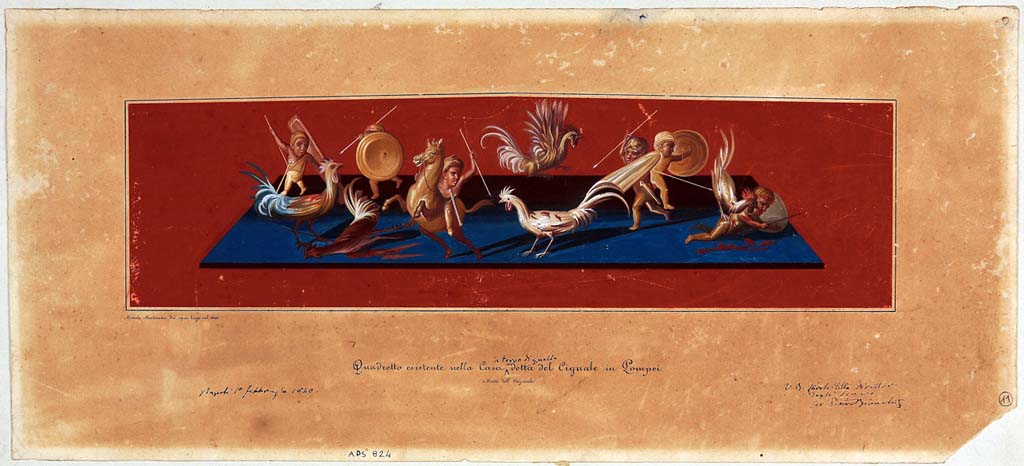
VIII.3.14 Pompeii. Painting by Michele Mastracchio, 1840, showing one of the atrium predellas, now completely faded.
See Helbig, W., 1868. Wandgemälde der vom Vesuv verschütteten Städte Campaniens. Leipzig: Breitkopf und Härtel, (1529).
Now in Naples Archaeological Museum. Inventory number ADS 824.
Photo © ICCD. https://www.catalogo.beniculturali.it/
Utilizzabili alle
condizioni della licenza Attribuzione - Non commerciale - Condividi
allo stesso modo 2.5 Italia (CC BY-NC-SA 2.5 IT)
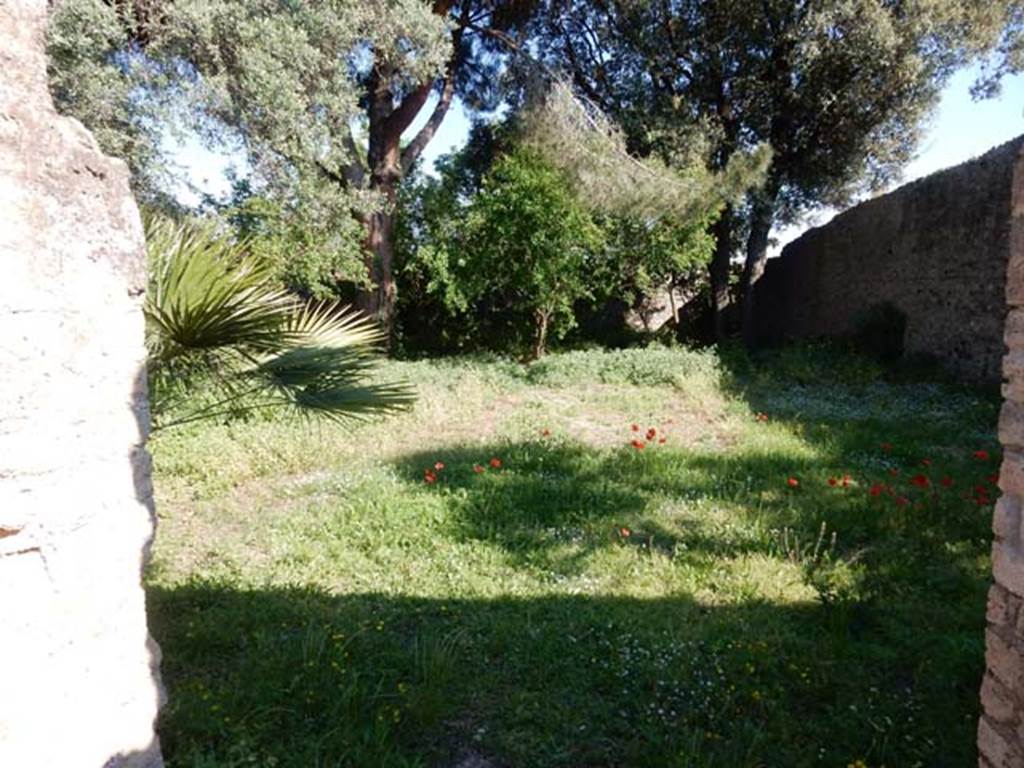
VIII.3.14 Pompeii. May 2016. Looking north from east side of atrium. Photo courtesy of Buzz Ferebee.
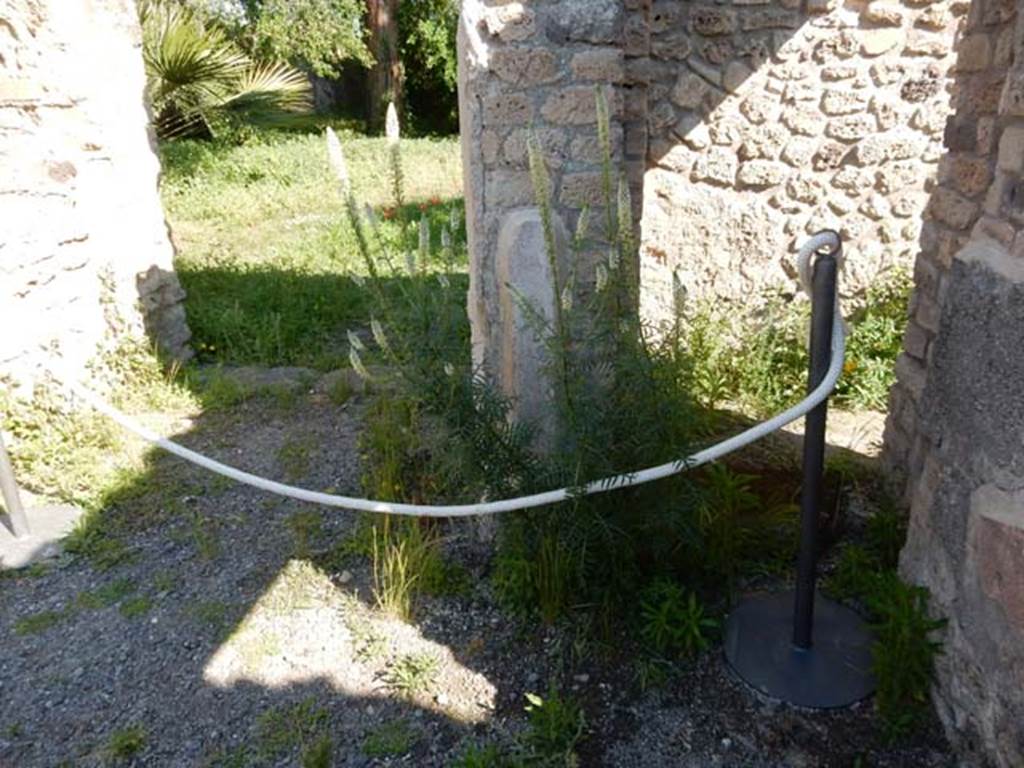
VIII.3.14 Pompeii. May 2016. Looking north from east side of atrium towards doorway to garden area, on left.
On the right is the doorway into the oecus fenestratum. Photo courtesy of Buzz Ferebee.
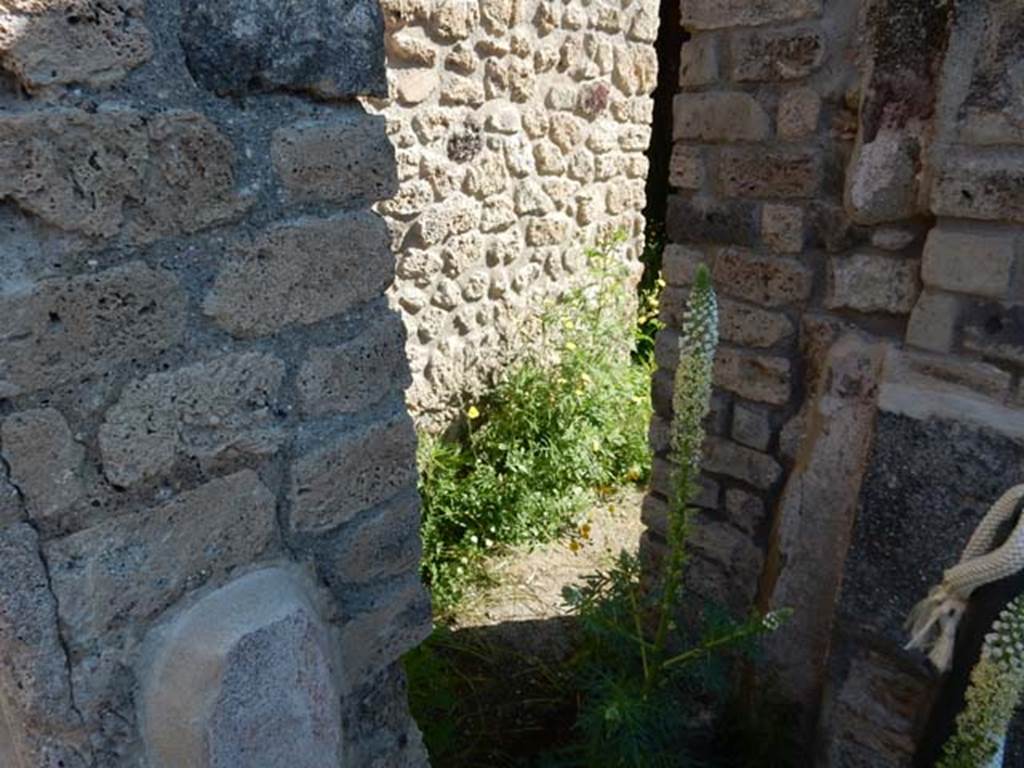
VIII.3.14 Pompeii. May 2016. Doorway to oecus fenestratum. Photo courtesy of Buzz Ferebee.
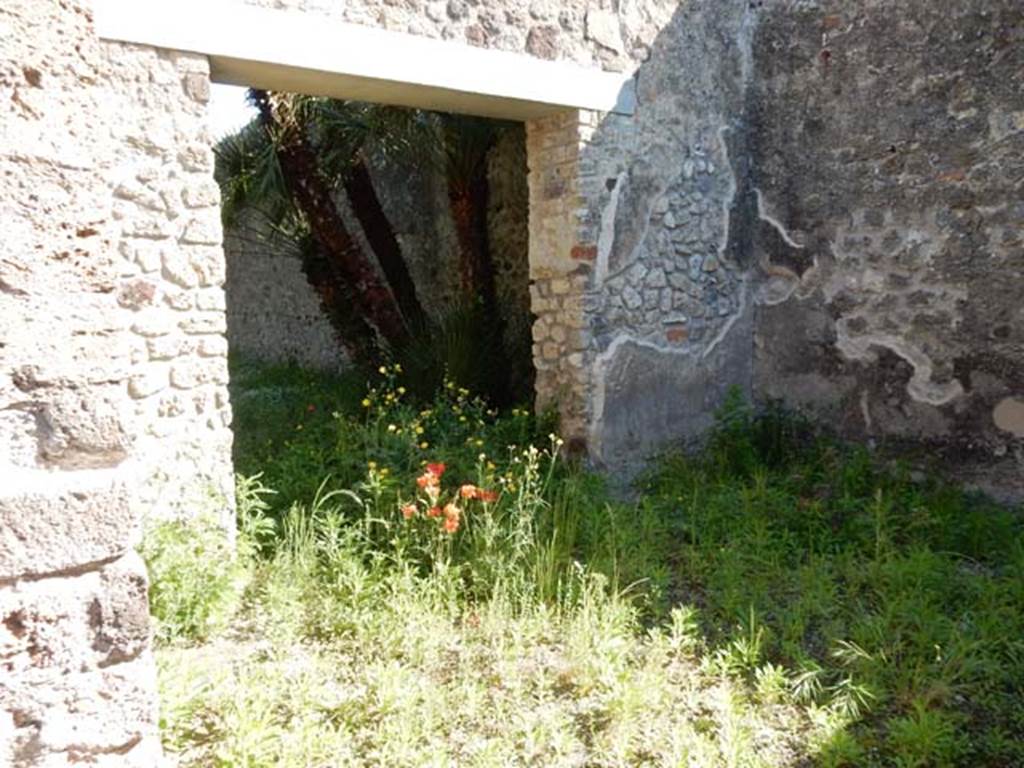
VIII.3.14 Pompeii. May 2016.
Looking towards doorway in north wall of oecus fenestratum, leading to garden area. Photo courtesy of Buzz Ferebee.
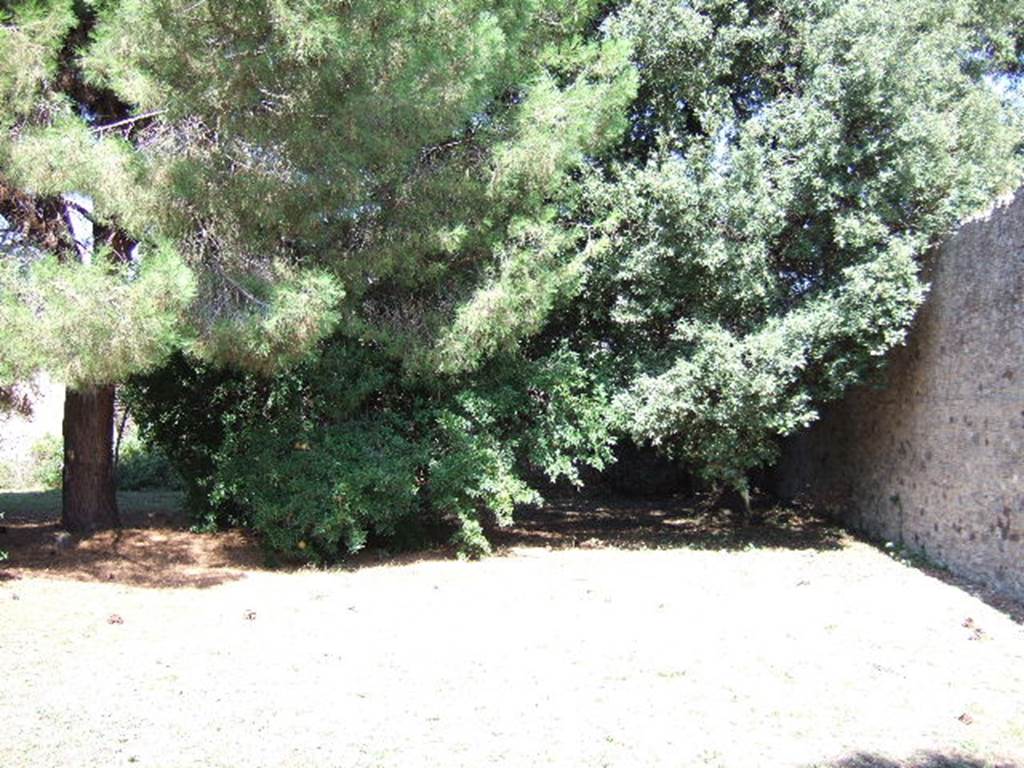
VIII.3.14 Pompeii. September 2005. Looking north from oecus fenestratum, across garden area.
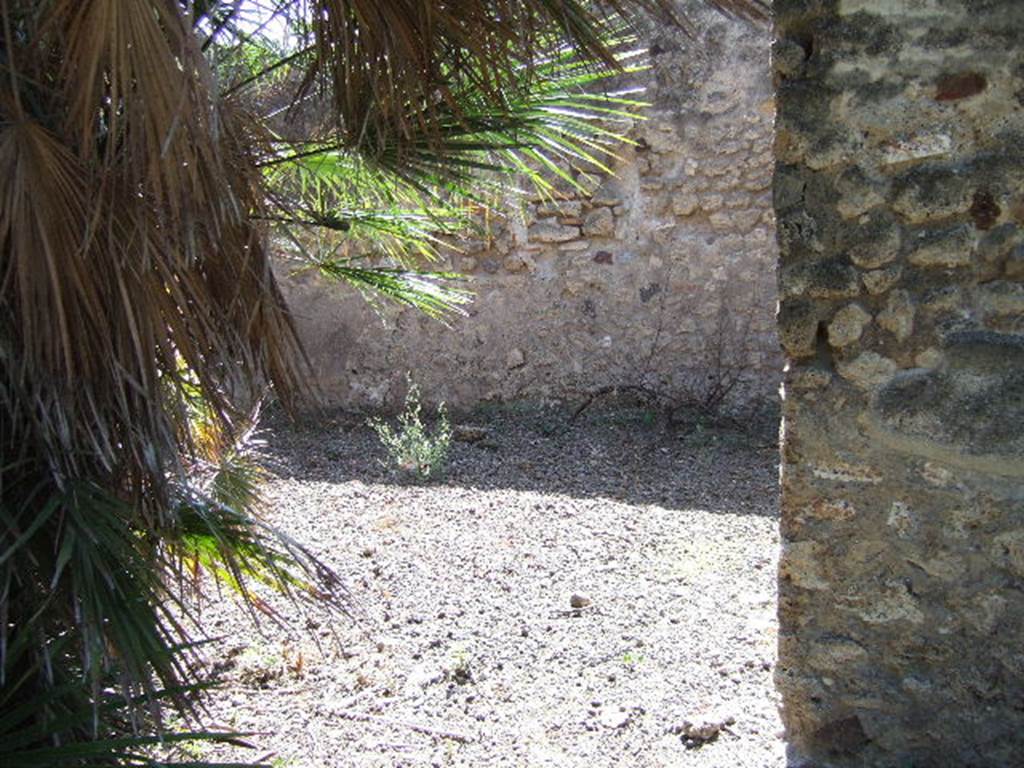
VIII.3.14 Pompeii. September 2005. Looking south into oecus fenestratum on east side of atrium, from garden area.
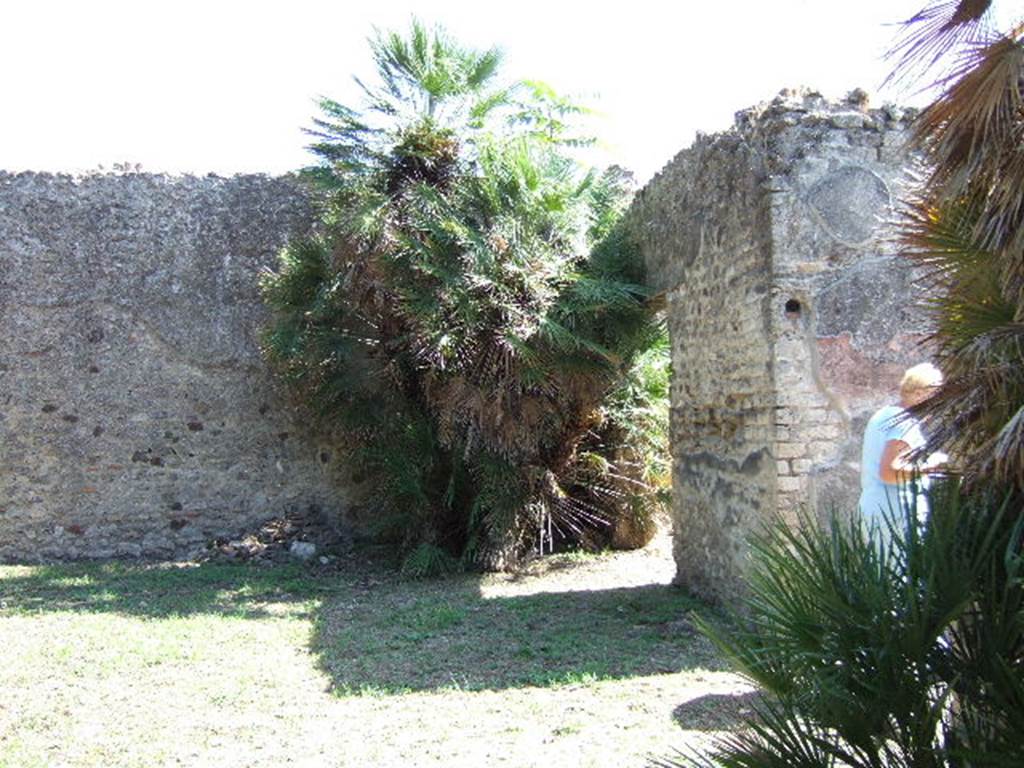
VIII.3.14 Pompeii. September 2005. East side of garden area.
On the right, the rear (north end) of the oecus fenestratum can be seen, together with the east wall of the atrium.
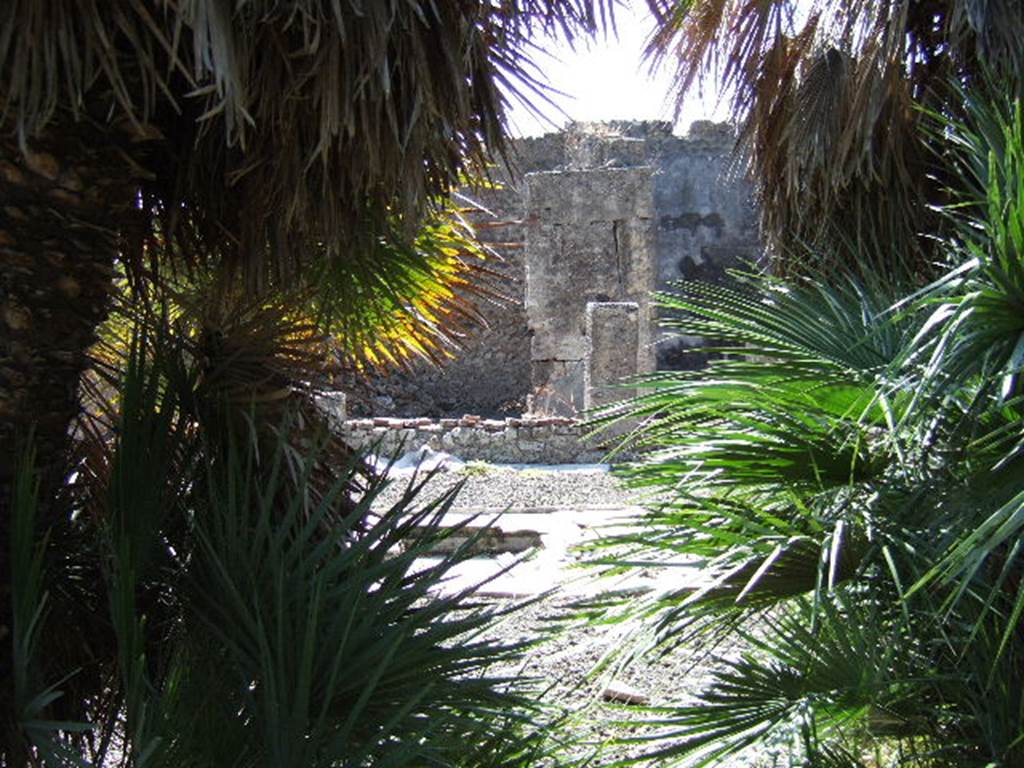
VIII.3.14 Pompeii. September 2005. Looking south from garden across atrium.
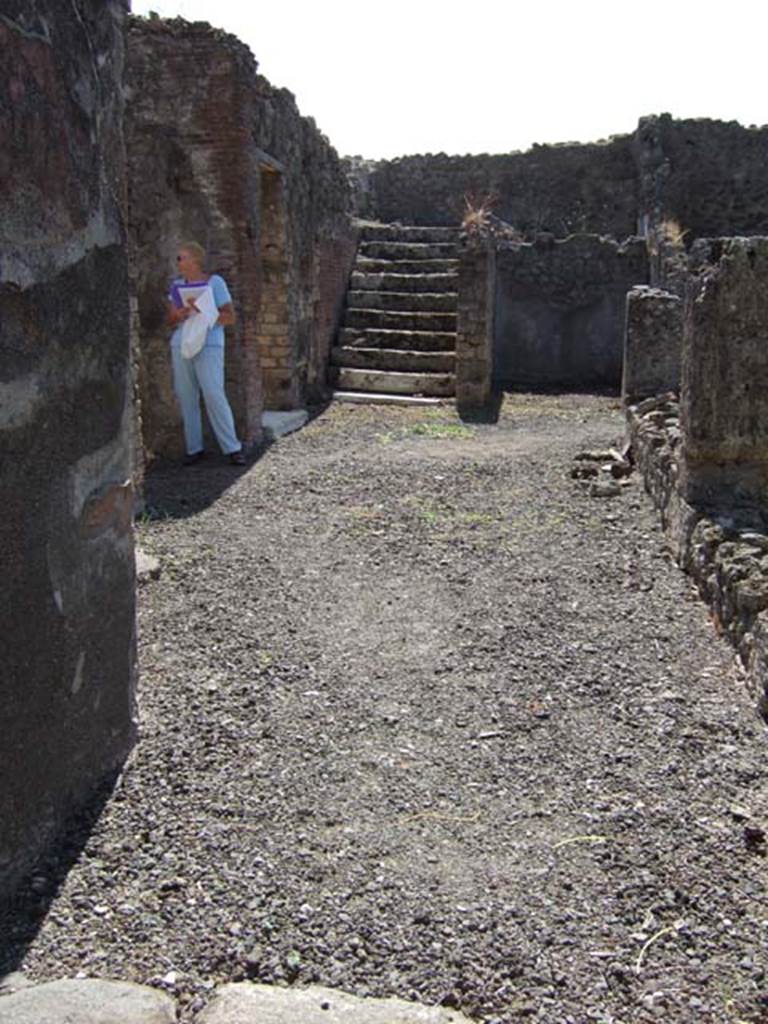
VIII.3.14 Pompeii. September 2005.
Looking south along east side of atrium towards kitchen doorway and steps in south-east corner.
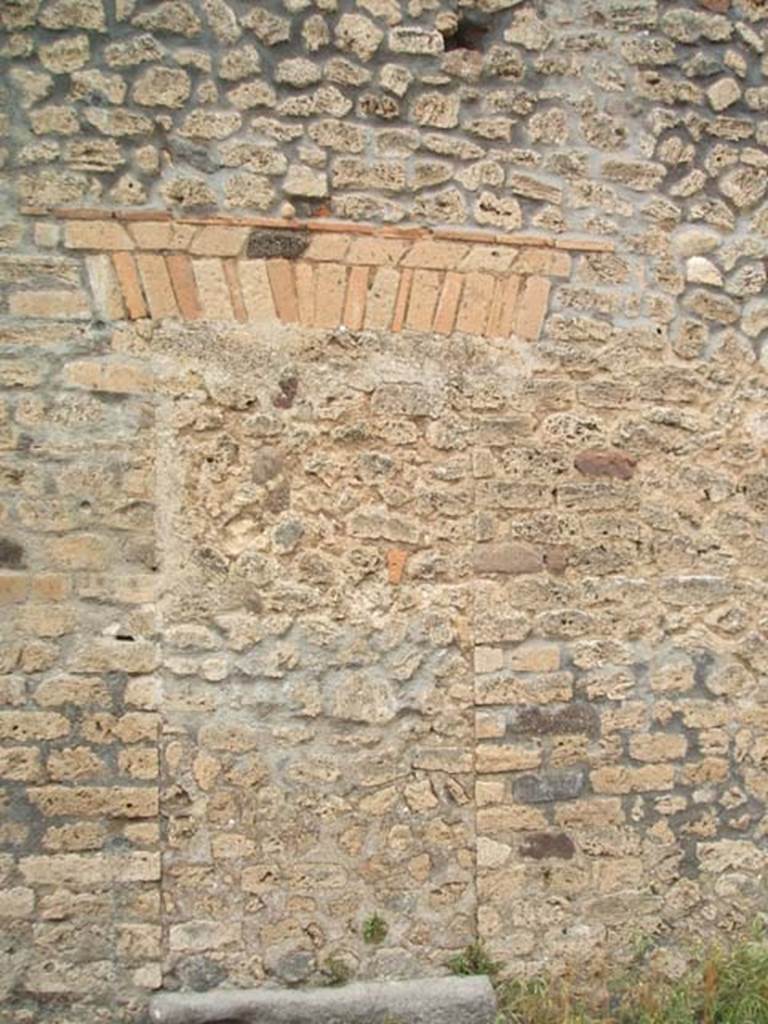
VIII.3.14 Pompeii. May 2005.
Blocked doorway in exterior wall of Casa della Regina Carolina, looking west.
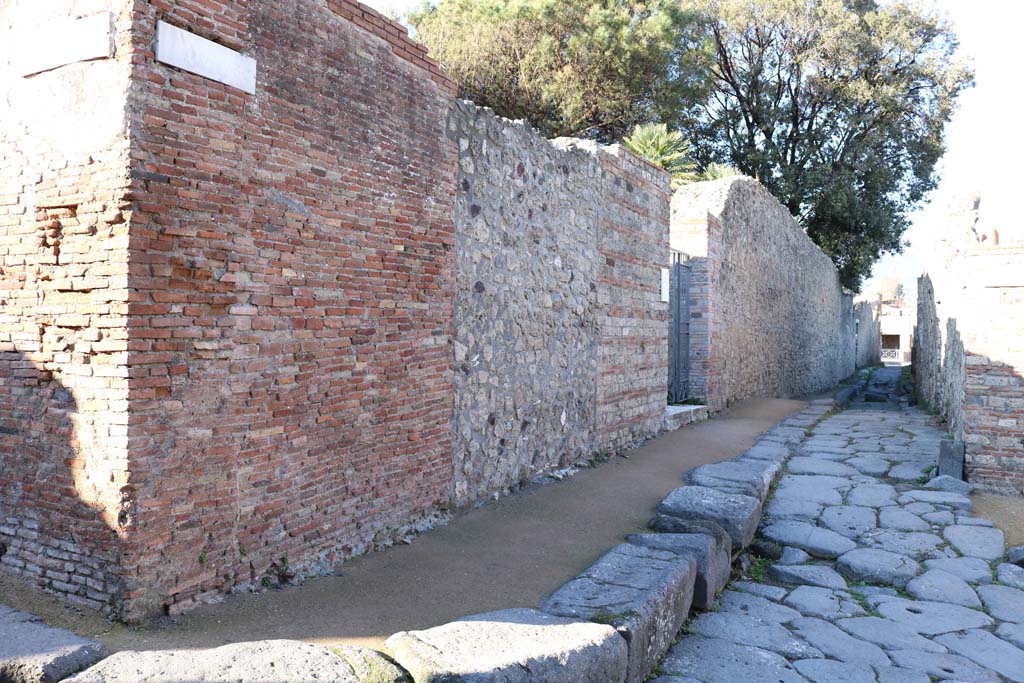
Vicolo dei Dodici Dei, Pompeii, looking north. December 2018.
Looking north towards VIII.3.14, entrance doorway, centre right,
from junction with Via della Regina, on left. Photo courtesy of Aude Durand.
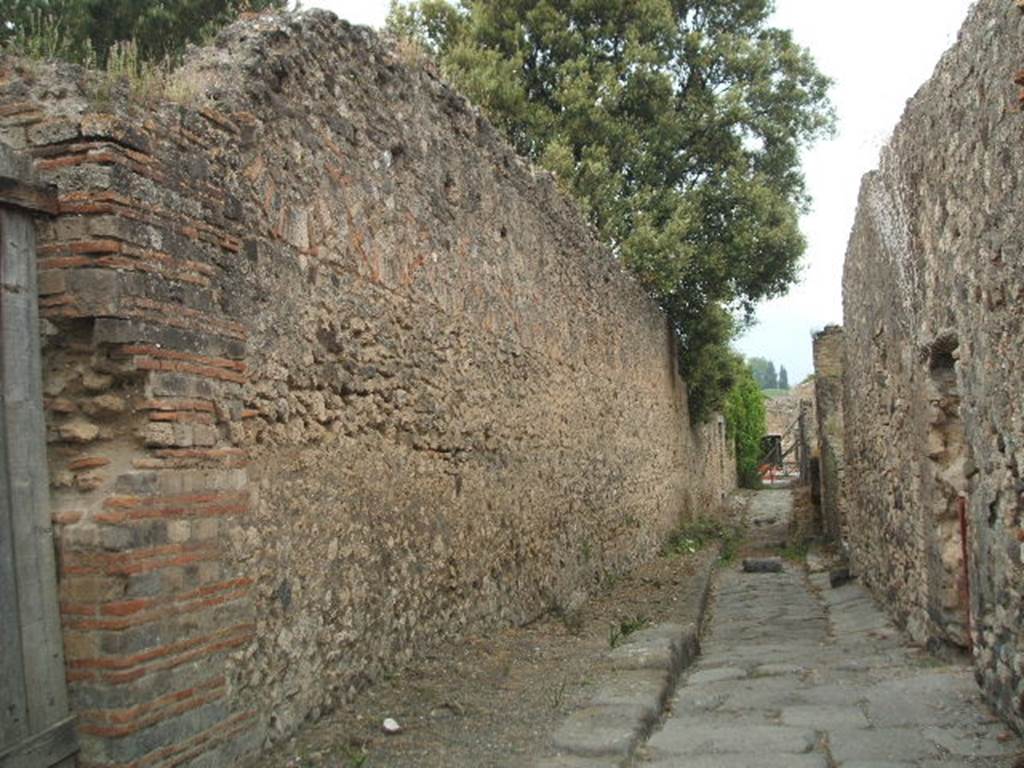
VIII.3.14 Pompeii, on left. Vicolo dei Dodici Dei, looking north. VIII.6, on right.
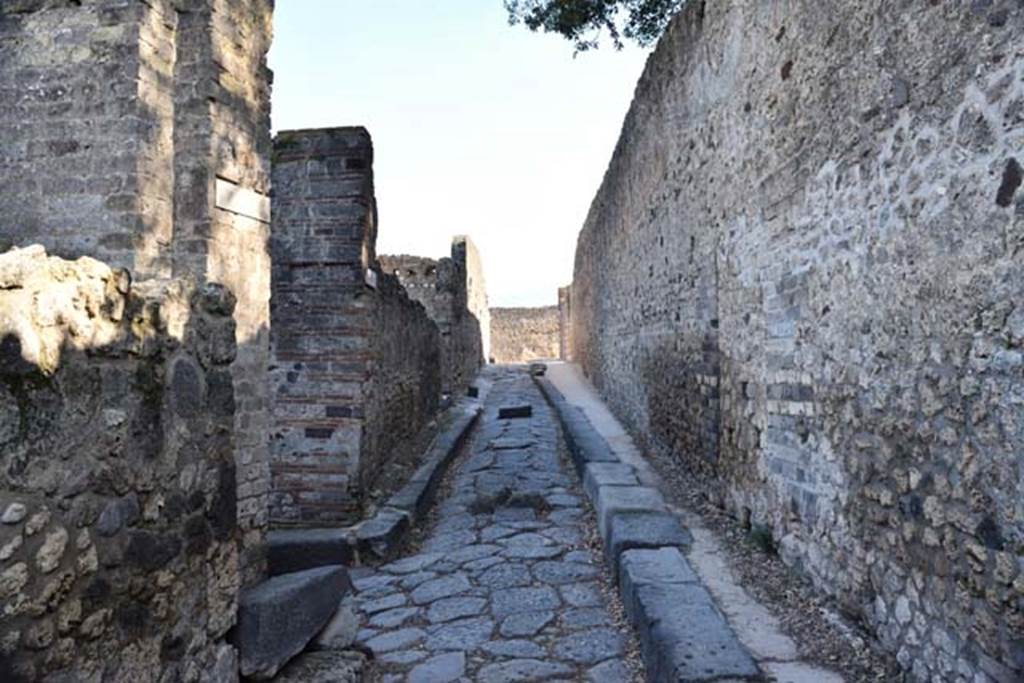
VIII.3.14 Pompeii, exterior wall is centre left. April 2018. Looking south between VIII.5 and VIII.3 on Vicolo dei Dodici Dei.
The junction with Vicolo della Parete Rossa, is seen on the
left. Photo
courtesy of Ian Lycett-King.
Use is subject to Creative
Commons Attribution-NonCommercial License v.4 International.
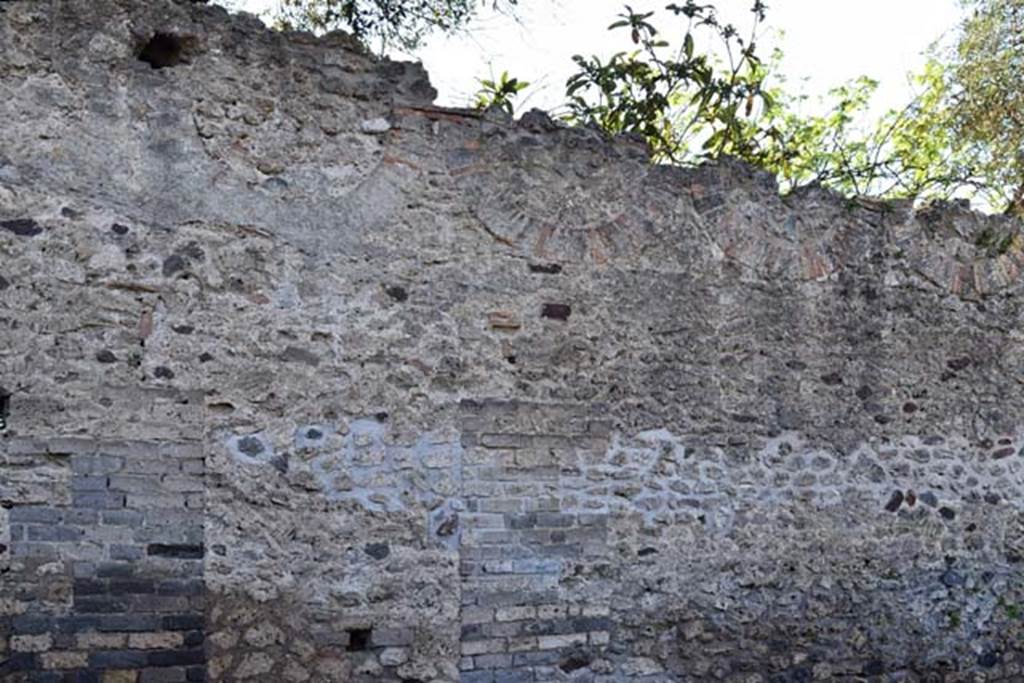
VIII.3.14 Pompeii. April 2018. Looking west to exterior wall
in Vicolo dei Dodici Dei. Photo courtesy of Ian Lycett-King.
Use is subject to Creative
Commons Attribution-NonCommercial License v.4 International.
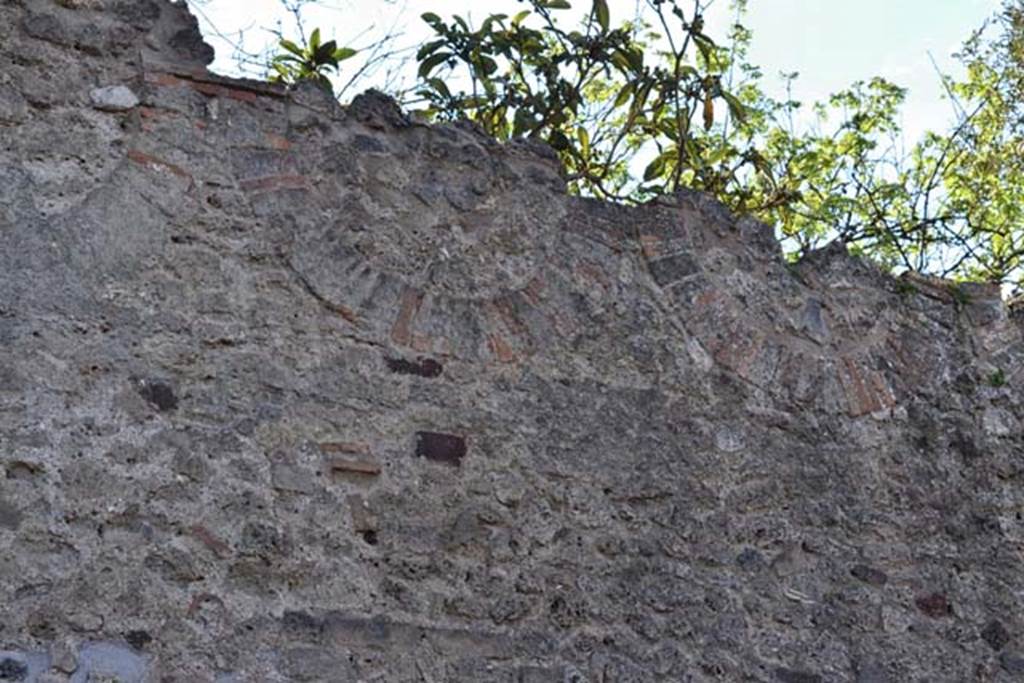
VIII.3.14 Pompeii. April 2018. Detail of west wall in Vicolo
dei Dodici Dei. Photo courtesy of Ian Lycett-King.
Use is subject to Creative
Commons Attribution-NonCommercial License v.4 International.
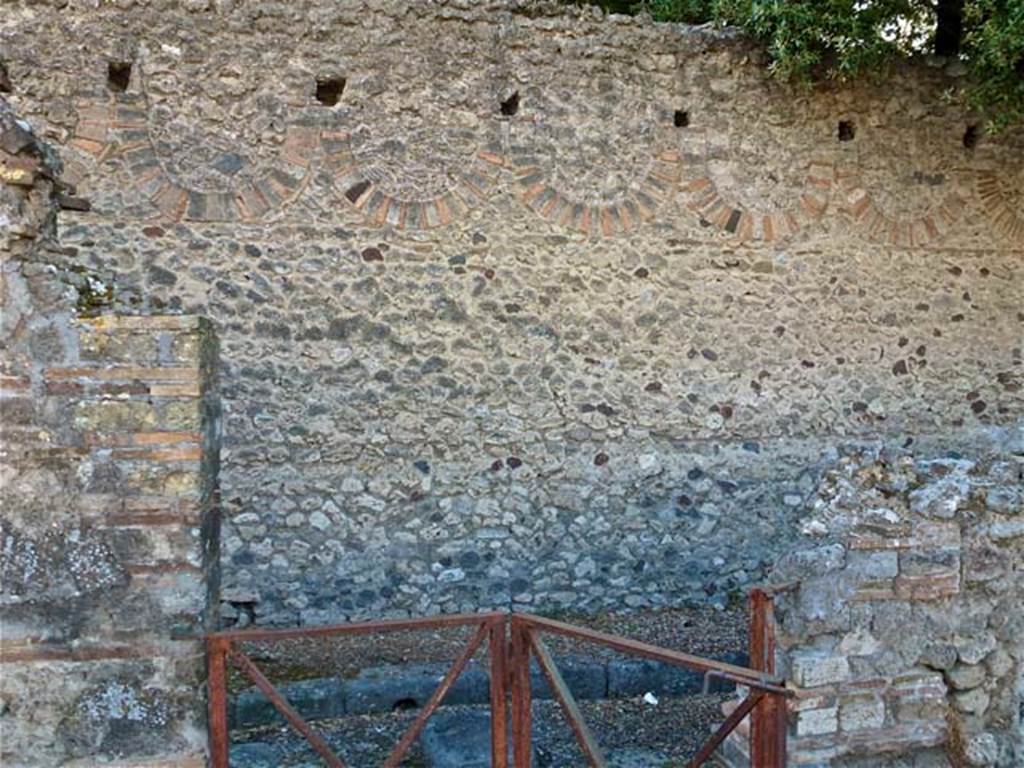
VIII.3.14 Pompeii. September 2011. Looking west to exterior wall in Vicolo dei Dodici Dei, taken from VIII.2.10.
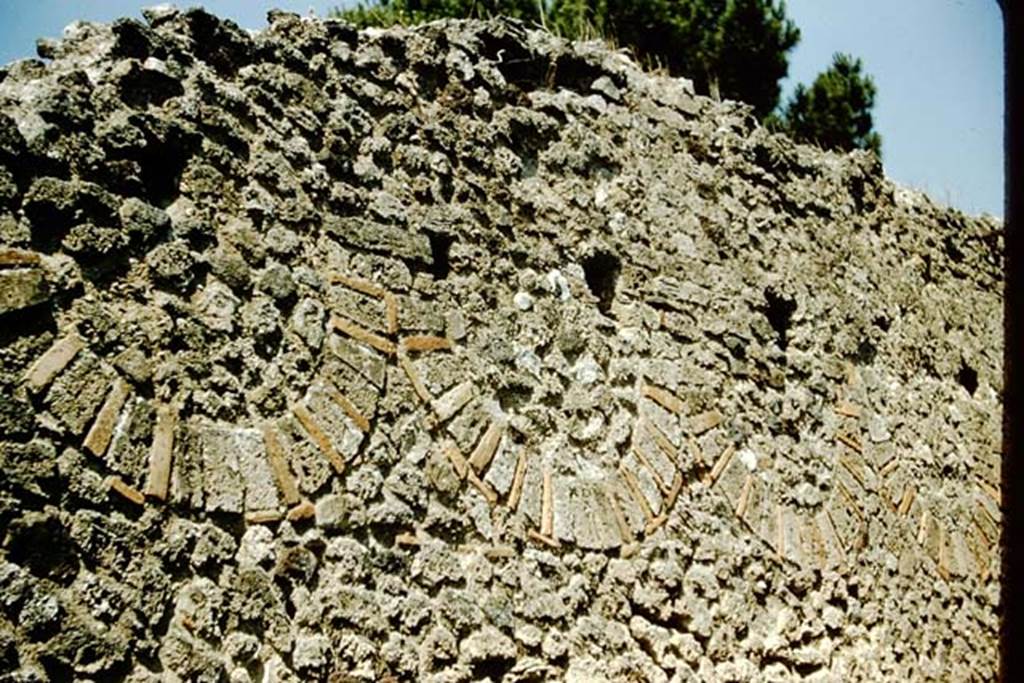
VIII.3.14 Pompeii. 1957. Exterior wall. Photo by Stanley A. Jashemski.
Source: The Wilhelmina and Stanley A. Jashemski archive in the University of Maryland Library, Special Collections (See collection page) and made available under the Creative Commons Attribution-Non-Commercial License v.4. See Licence and use details.
J57f0154
Miscellaneous Items
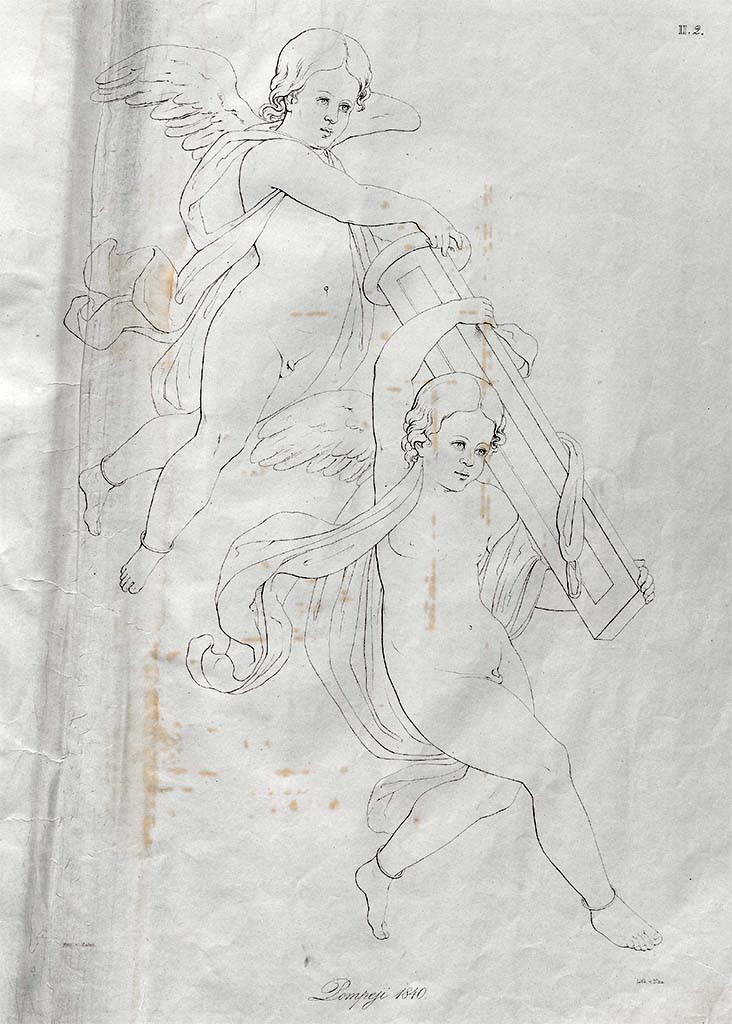
VIII.3.14 Pompeii. April 1840. Drawing by
Zahn of two cupids carrying the quiver of Apollo.
According to Zahn this was discovered in a
house behind the Casa del Cignale, which would seem to mean this one, but
location in the house not mentioned.
The base of the wall was yellow, the
draperies white, yellow-red in the shadowy part, the rings on the feet coloured
gold, the quiver the colour of wood.
See
Zahn, W., 1842-44. Die schönsten Ornamente und merkwürdigsten Gemälde aus
Pompeji, Herkulanum und Stabiae: II. Berlin: Reimer, taf. 2.
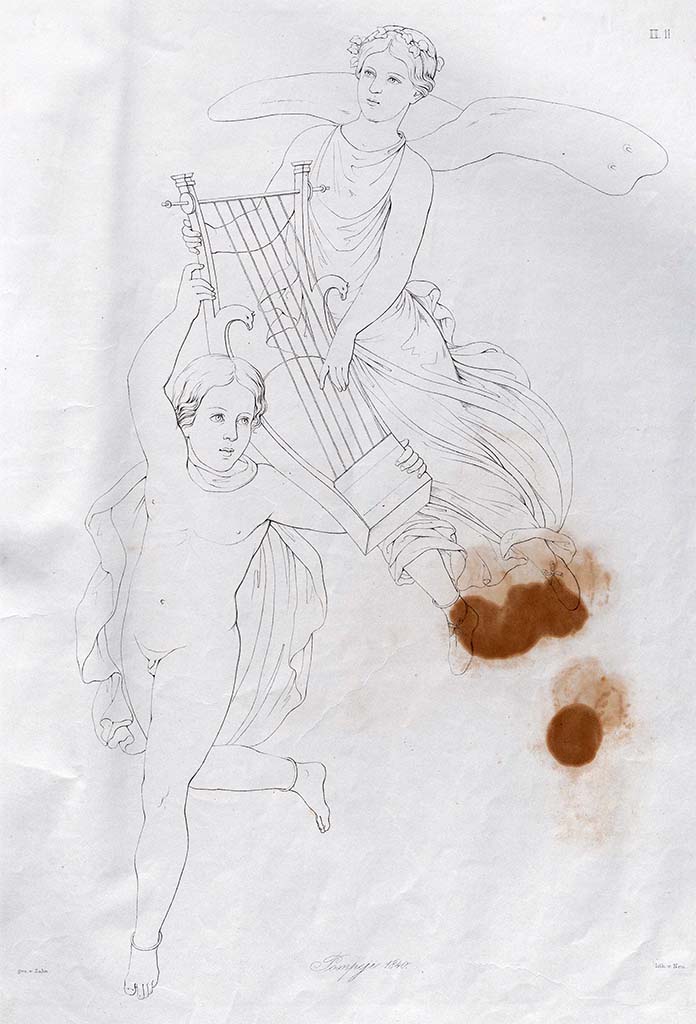
VIII.3.14 Pompeii. April 1840.
Drawing by Zahn of a Cupid and Psyche, carrying the lyre of Apollo
According
to Zahn this was discovered in a house behind the Casa del Cignale, which would
seem to mean this one, but location in the house not mentioned.
This
group was painted on a yellow background, the clothing of Cupid was blue, that
of Psyche was a sort of greenish-yellow, her wings were violet, the rings on
the feet were coloured gold, the lyre was coloured brown (of wood).
See Zahn, W., 1842-44. Die schönsten Ornamente
und merkwürdigsten Gemälde aus Pompeji, Herkulanum und Stabiae: II. Berlin:
Reimer, taf. 11.
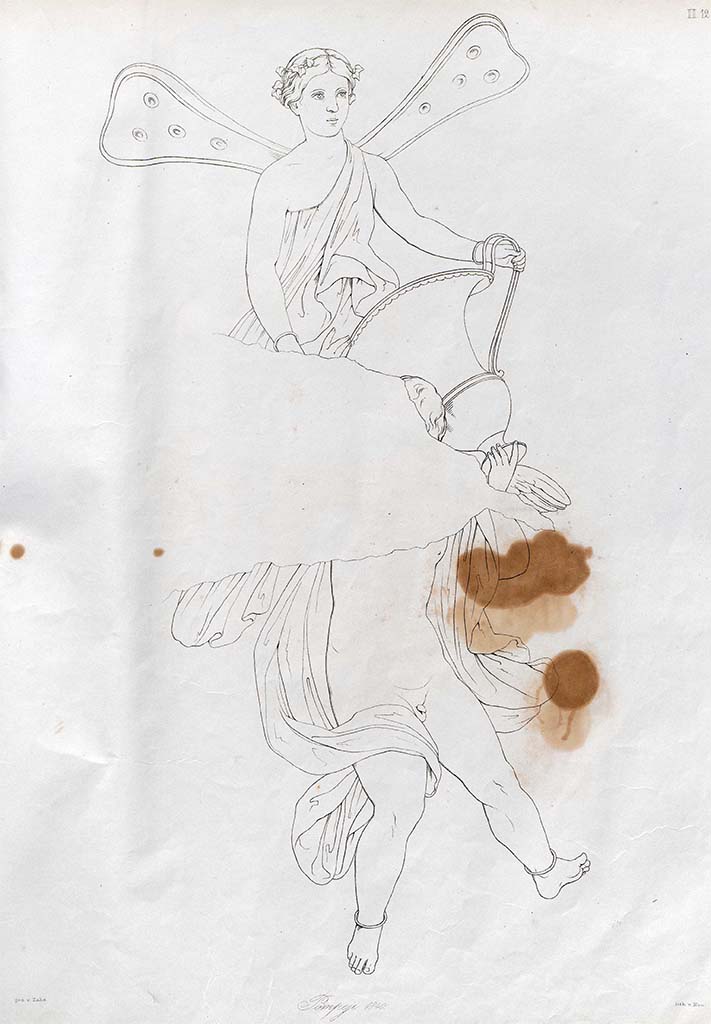
According
to Zahn this was excavated in April 1840 in a house behind the Casa del
Cignale, which would seem to mean this one, but location in the house not
mentioned.
The
base of the wall was yellow, the clothing white with reddish shadows; the vase
was coloured silver; the rings on the feet and arms were coloured gold.
See Zahn, W., 1842-44. Die schönsten Ornamente
und merkwürdigsten Gemälde aus Pompeji, Herkulanum und Stabiae: II. Berlin:
Reimer, taf. 12.
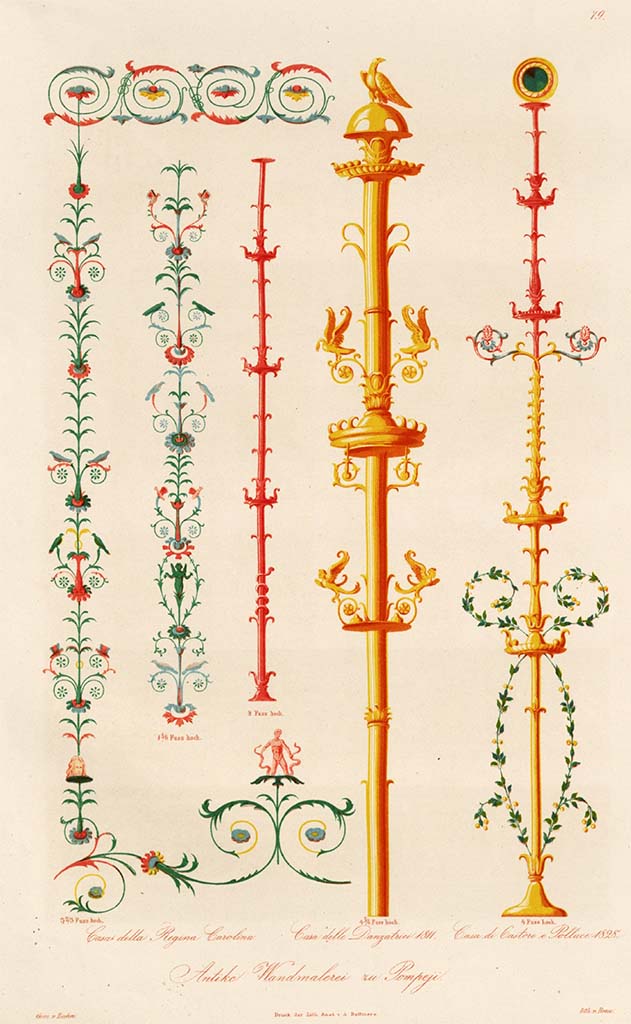
VIII.3.14
Pompeii. Pre-1849. Painting of wall decoration from various places in Pompeii.
On
the left, painted decorations from this house.
Candelabra, in centre, from Casa della Danzatrice,
excavated 1811.
Candelabra,
on right, from VI.9.6/7, excavated 1828.
See Zahn W., 1849. Ornamente aller klassischen
Kunst-Epochen nach den Originalen in ihren eigenthümlichen Farben. Berlin:
Reimer, Taf. 79.
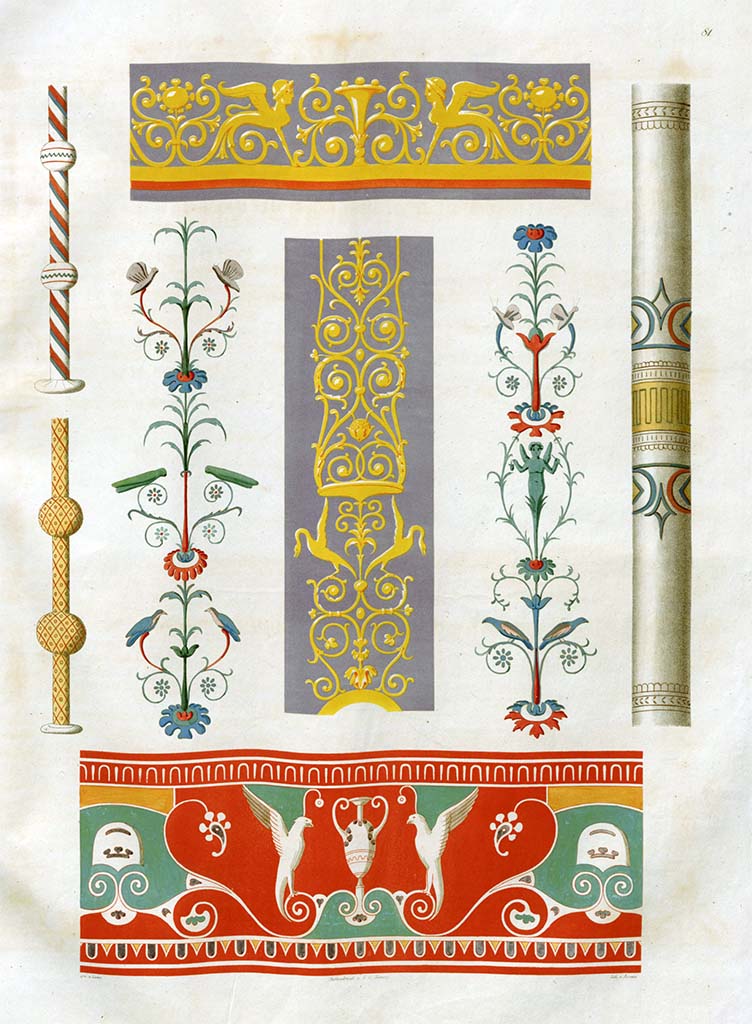
VIII.3.14
Pompeii. Pre-1828. Paintings by Zahn, according to him –
The
two decorations with different colours, see Pl.57 and an entire wall in Pl. 89 are
from this house.
The
two decorations on the blue background are from VI.1.7.
The
bottom decorations are in Naples Museum.
The
columns are from near the Herculaneum Gate.
See Zahn, W., 1828. Die
schönsten Ornamente und merkwürdigsten Gemälde aus Pompeji, Herkulanum und
Stabiae: I. Berlin: Reimer, taf. 81.
![VIII.3.14 Pompeii. Between 1819 and 1832, sketch by W. Gell of decoration from this house.
See Gell, W. Pompeii unpublished [Dessins de l'édition de 1832 donnant le résultat des fouilles post 1819 (?)] vol II, pl. 31 verso.
Bibliothèque de l'Institut National d'Histoire de l'Art, collections Jacques Doucet, Identifiant numérique Num MS180 (2).
See book in INHA Use Etalab Licence Ouverte](8%2003%2014%20p2_files/image128.jpg)
VIII.3.14 Pompeii. Between 1819 and 1832, sketch by W. Gell of decoration from this house.
See Gell, W. Pompeii
unpublished [Dessins de l'édition de 1832 donnant le résultat des fouilles post
1819 (?)] vol II, pl. 31 verso.
Bibliothèque de
l'Institut National d'Histoire de l'Art, collections Jacques Doucet, Identifiant
numérique Num MS180 (2).
See book in INHA Use Etalab Licence Ouverte
![VIII.3.14 Pompeii. Between 1819 and 1832, sketches by W. Gell of painted decoration.
Also including some from Tomb of Quietus, HGW20 near the Herculaneum Gate.
See Gell, W. Pompeii unpublished [Dessins de l'édition de 1832 donnant le résultat des fouilles post 1819 (?)] vol II, pl. 32.
Bibliothèque de l'Institut National d'Histoire de l'Art, collections Jacques Doucet, Identifiant numérique Num MS180 (2).
See book in INHA Use Etalab Licence Ouverte](8%2003%2014%20p2_files/image129.jpg)
VIII.3.14 Pompeii. Between 1819 and 1832, sketches by W. Gell of painted decoration.
Also including some from Tomb of Quietus, HGW20 near the Herculaneum Gate.
Bibliothèque de l'Institut National d'Histoire de
l'Art, collections Jacques Doucet, Identifiant numérique Num MS180 (2).
See book in INHA Use Etalab Licence Ouverte
![VIII.3.14 Pompeii. Between 1819 and 1832, sketches by W. Gell of painted decoration.
See Gell, W. Pompeii unpublished [Dessins de l'édition de 1832 donnant le résultat des fouilles post 1819 (?)] vol II, pl. 34.
Bibliothèque de l'Institut National d'Histoire de l'Art, collections Jacques Doucet, Identifiant numérique Num MS180 (2).
See book in INHA Use Etalab Licence Ouverte](8%2003%2014%20p2_files/image130.jpg)
VIII.3.14 Pompeii. Between 1819 and 1832, sketches by W. Gell of painted decoration.
See Gell, W. Pompeii
unpublished [Dessins de l'édition de 1832 donnant le résultat des fouilles post
1819 (?)] vol II, pl. 34.
Bibliothèque de
l'Institut National d'Histoire de l'Art, collections Jacques Doucet, Identifiant
numérique Num MS180 (2).
See book in INHA Use Etalab Licence Ouverte
![VIII.3.14 Pompeii. Between 1819 and 1832, drawing by W. Gell of painted decoration.
See Gell, W. Pompeii unpublished [Dessins de l'édition de 1832 donnant le résultat des fouilles post 1819 (?)] vol II, pl. 35.
Bibliothèque de l'Institut National d'Histoire de l'Art, collections Jacques Doucet, Identifiant numérique Num MS180 (2).
See book in INHA Use Etalab Licence Ouverte](8%2003%2014%20p2_files/image131.jpg)
VIII.3.14 Pompeii. Between 1819 and 1832, drawing by W. Gell of painted decoration.
See Gell, W. Pompeii
unpublished [Dessins de l'édition de 1832 donnant le résultat des fouilles post
1819 (?)] vol II, pl. 35.
Bibliothèque de
l'Institut National d'Histoire de l'Art, collections Jacques Doucet, Identifiant
numérique Num MS180 (2).
See book in INHA Use Etalab Licence Ouverte
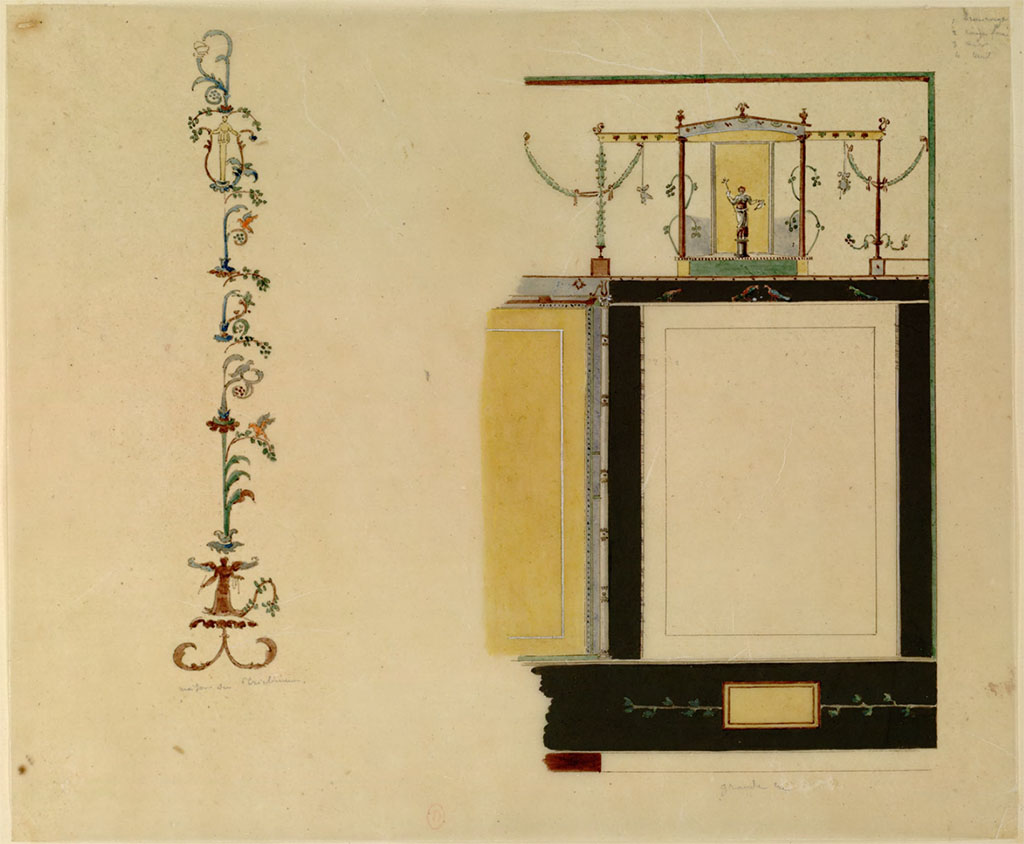
VIII.3.14 Pompeii or VI.1.1, Pompeii. Two painted wall decorations, from different places in Pompeii.
On the left – Maison du triclinium, presumably another name for
VIII.3.14, painted floral candelabra, (possibly from ala.)
On the right, from the “Rue Grande”, (the large road).
See Chenavard, Antoine-Marie (1787-1883) et al. Voyage
d'Italie, croquis Tome 3, pl. 121.
INHA Identifiant
numérique : NUM MS 703 (3). See Book
on INHA
Document placé sous « Licence
Ouverte / Open
Licence » Etalab
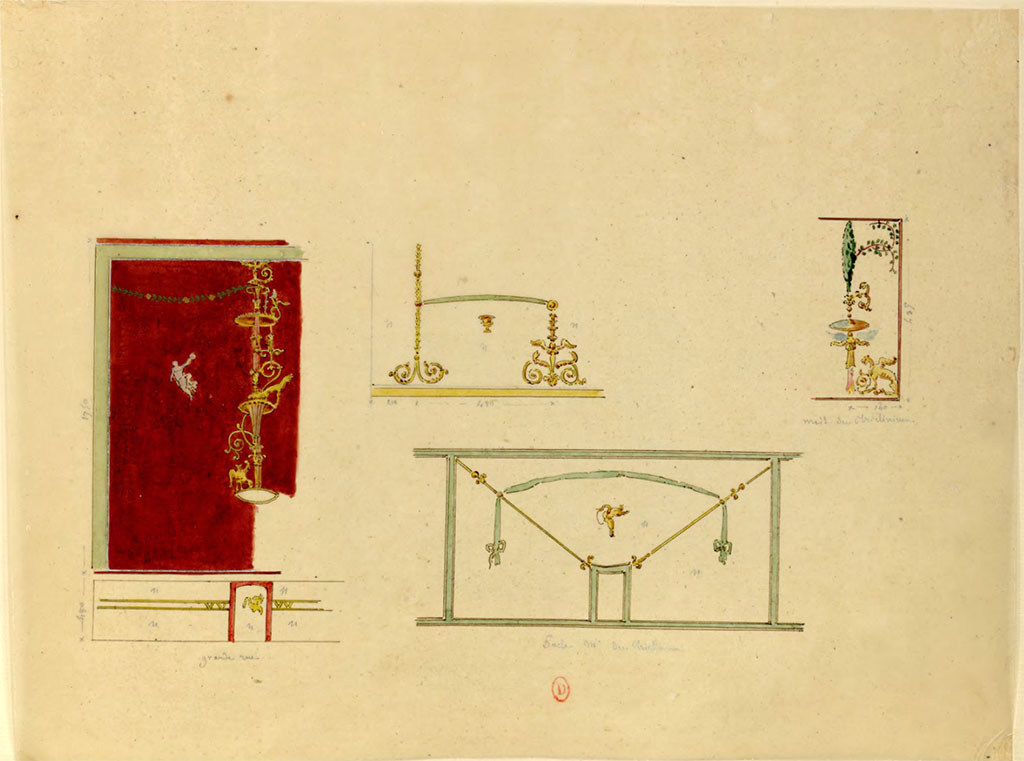
VIII.3.14 or
VI.1.1 Pompeii. May 1823? Paintings by Chenavard of wall decorations,
from different places in Pompeii.
The INHA web site
records : Reproduction de différents motifs de la peinture pariétale, dont deux
empruntés à la Casa della Regina Carolina
On the left, from the “Rue Grande” (large road),
Lower centre, zoccolo of the Maison du triclinium.
Right, Maison du triclinium.
(Note, however, this possibly could be from VI.1.1, which would
explain why the painting from the Rue Grande (Via Consolare) was drawn on the
same page.)
See Chenavard, Antoine-Marie (1787-1883) et al. Voyage
d'Italie, croquis Tome 3, pl. 120.
INHA Identifiant
numérique : NUM MS 703 (3). See Book on INHA
Document placé
sous « Licence Ouverte / Open Licence » Etalab