I.3.25 Pompeii. Casa dei Guerrieri or the House of the Bronzehandlers.
Linked to I.3.26. Excavated 1869.
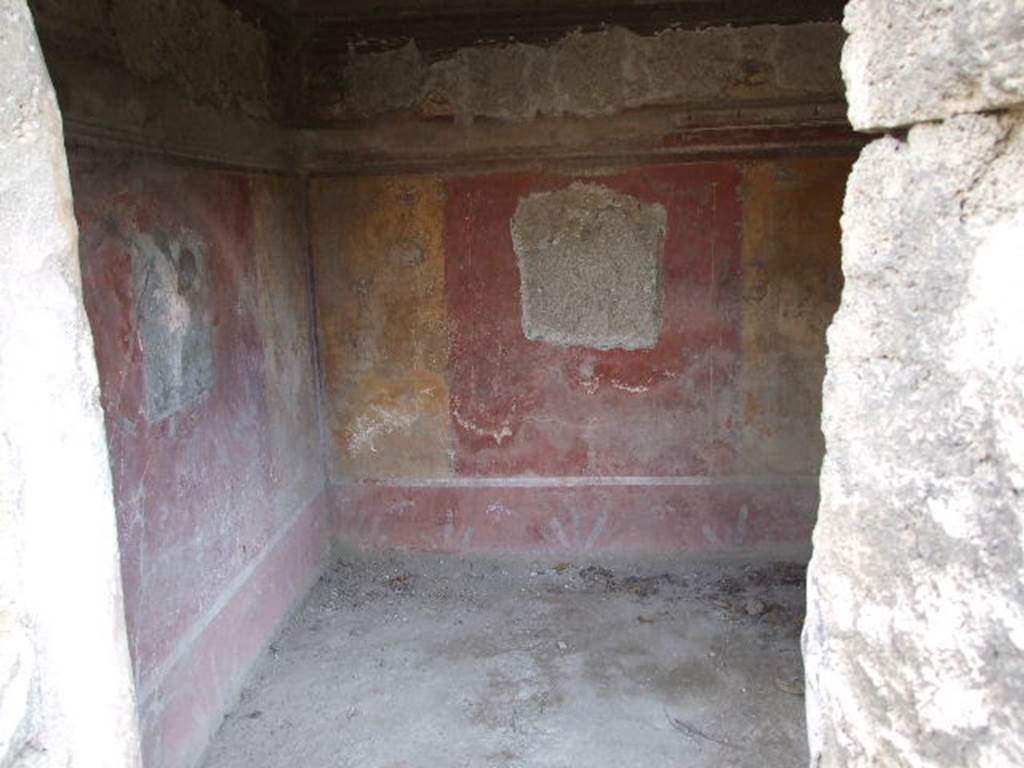
I.3.25 Pompeii. December 2006. Doorway to cubiculum on south side of peristyle, looking towards south-east corner.
According to Trendelenburg, the colours of the surviving two paintings in this room were very faded.
The details from the paintings could not be seen with certainty.
However, the painting to the left of the doorway, on the east wall, represented Andromeda being liberated by Perseus.
In the painting on the south wall, could be seen a young sitting man (perhaps Narcissus? - but according to Sogliano this was Ciparisso –
See Sogliano, A., 1879. Le pitture murali campane scoverte negli anni 1867-79. Napoli: Giannini, p.28, no.109).
The painting on the door (north) wall was destroyed, and the one on the west wall was replaced by a window.
See Trendelenburg
in Bullettino dell’Instituto di
Corrispondenza Archeologica (DAIR), 1871, (p.174-5).
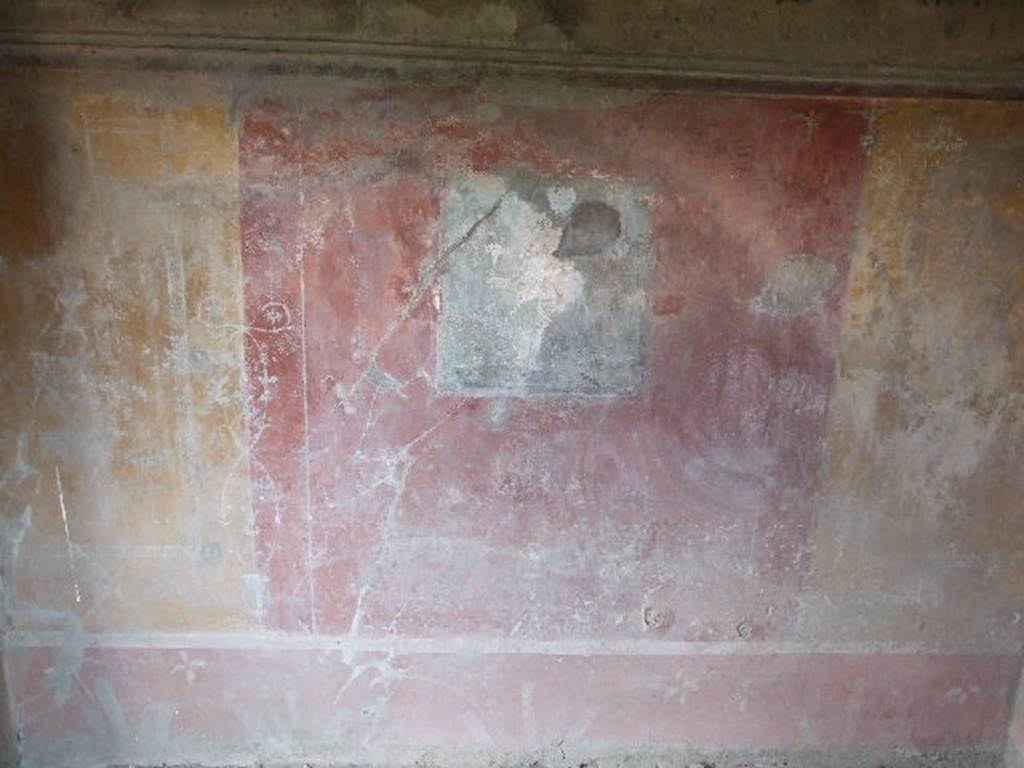
I.3.25 Pompeii. December 2006. East wall of cubiculum.
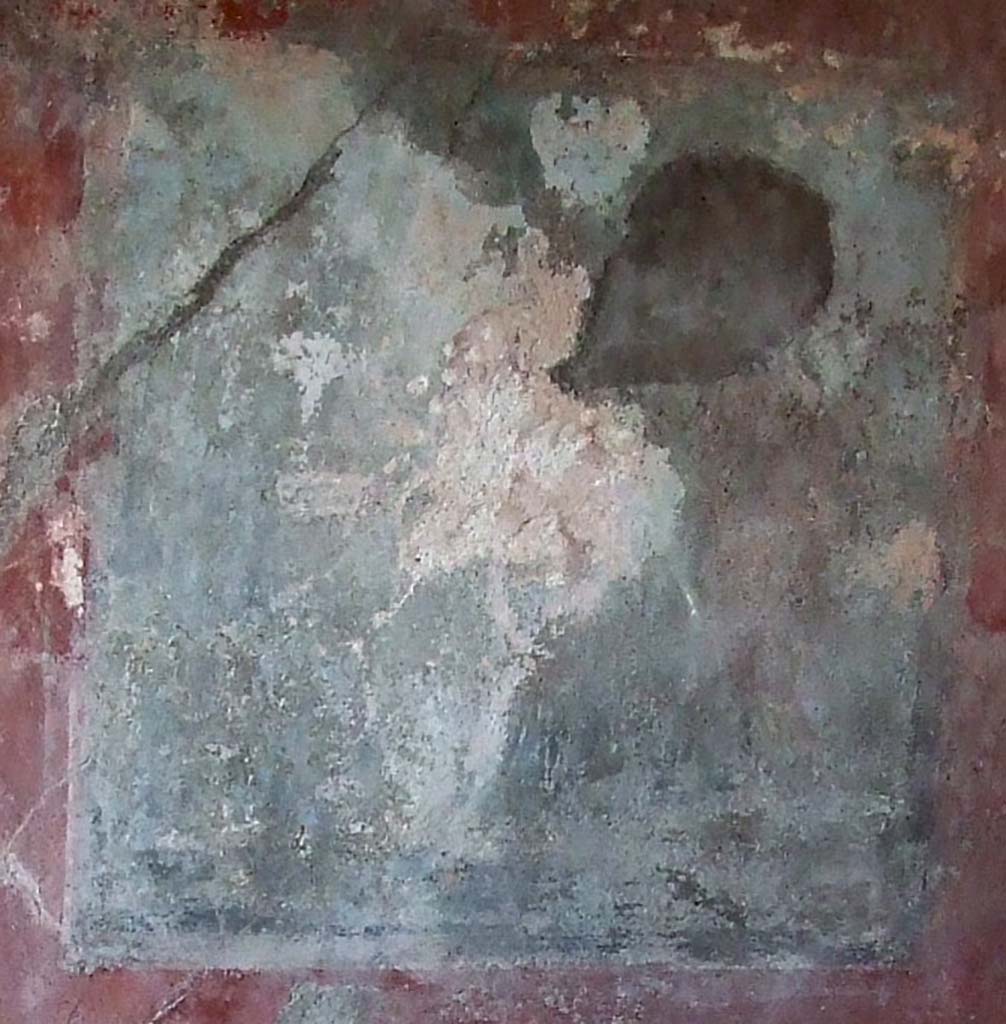
I.3.25 Pompeii. December 2006. East wall of cubiculum with remains of wall painting of Perseus rescuing Andromeda?
See Schefold, K., 1962. Vergessenes Pompeji. Bern: Francke. (T: 168,2).
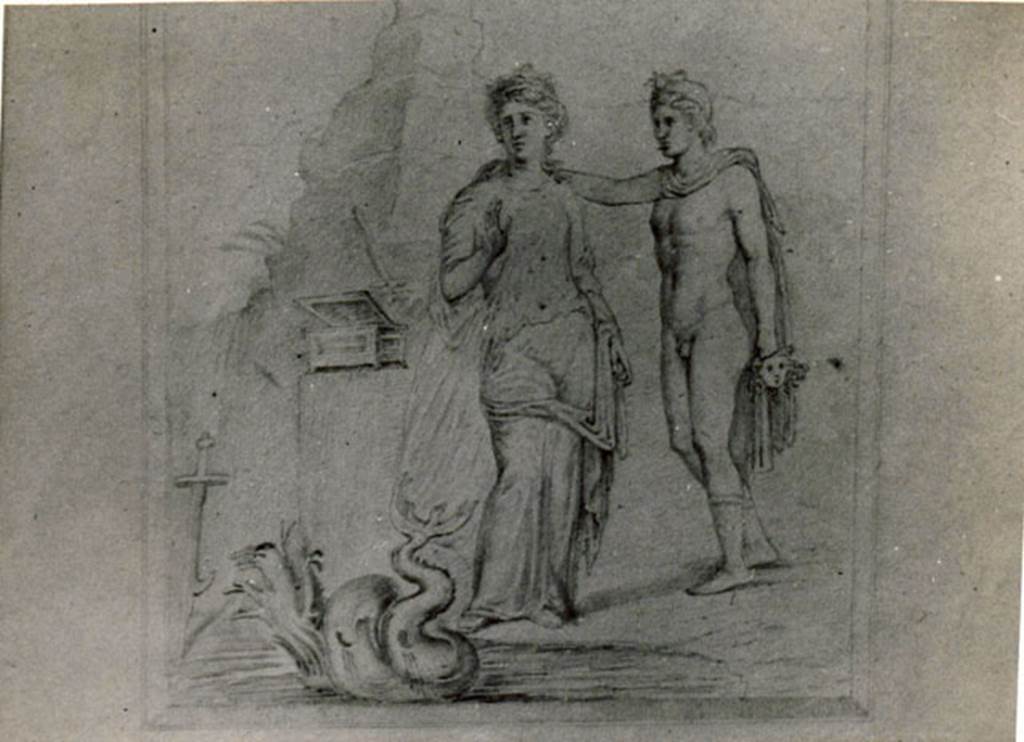
I.3.25 Pompeii. 1935 photograph taken by Tatiana Warscher of an 1871 reproduction of a design belonging to DAI.
Perseus and Andromeda, from the east wall of the cubiculum.
See Warscher, T, 1935: Codex Topographicus Pompejanus, Regio I, 3: (no.67), Rome, DAIR, whose copyright it remains.
See Bragantini, de Vos, Badoni, 1981. Pitture e Pavimenti di Pompei, Parte 1. Rome: ICCD. (p.8).
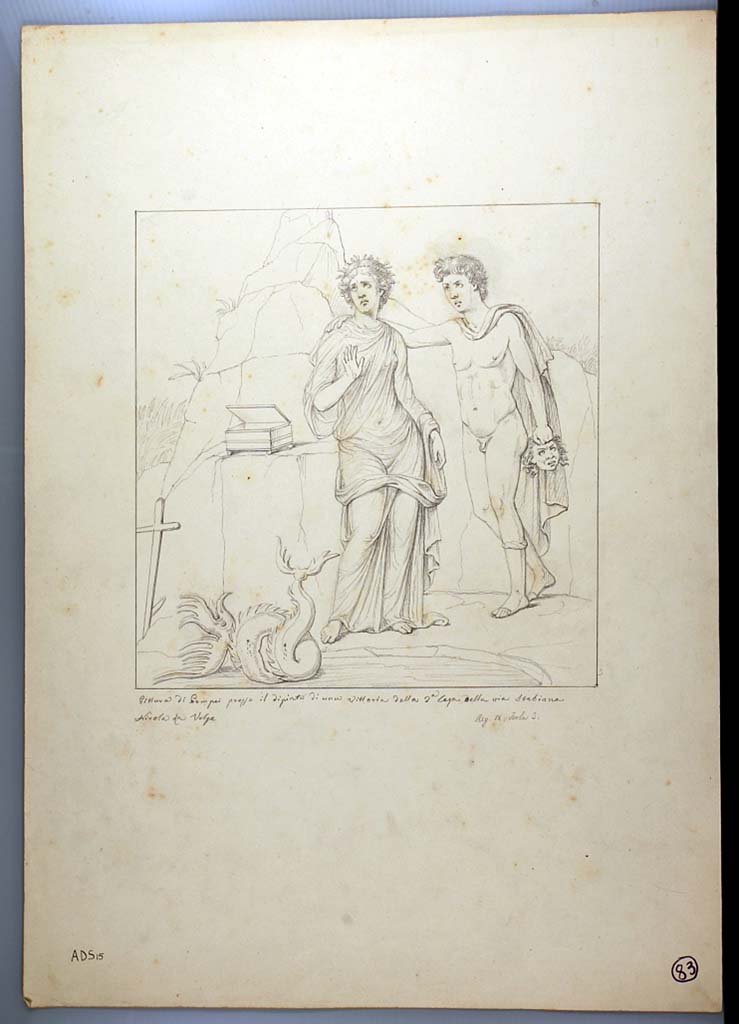
I.3.25 Pompeii. 1870 drawing by Nicola La Volpe of painting of Perseus and Andromeda, seen on east wall of cubiculum.
See Sogliano, A., 1879. Le pitture murali campane scoverte negli anni 1867-79. Napoli: Giannini. (p.91, no.519).
Now in Naples Archaeological Museum. Inventory number ADS 15.
Photo © ICCD. http://www.catalogo.beniculturali.it
Utilizzabili alle
condizioni della licenza Attribuzione - Non commerciale - Condividi
allo stesso modo 2.5 Italia (CC BY-NC-SA 2.5 IT)
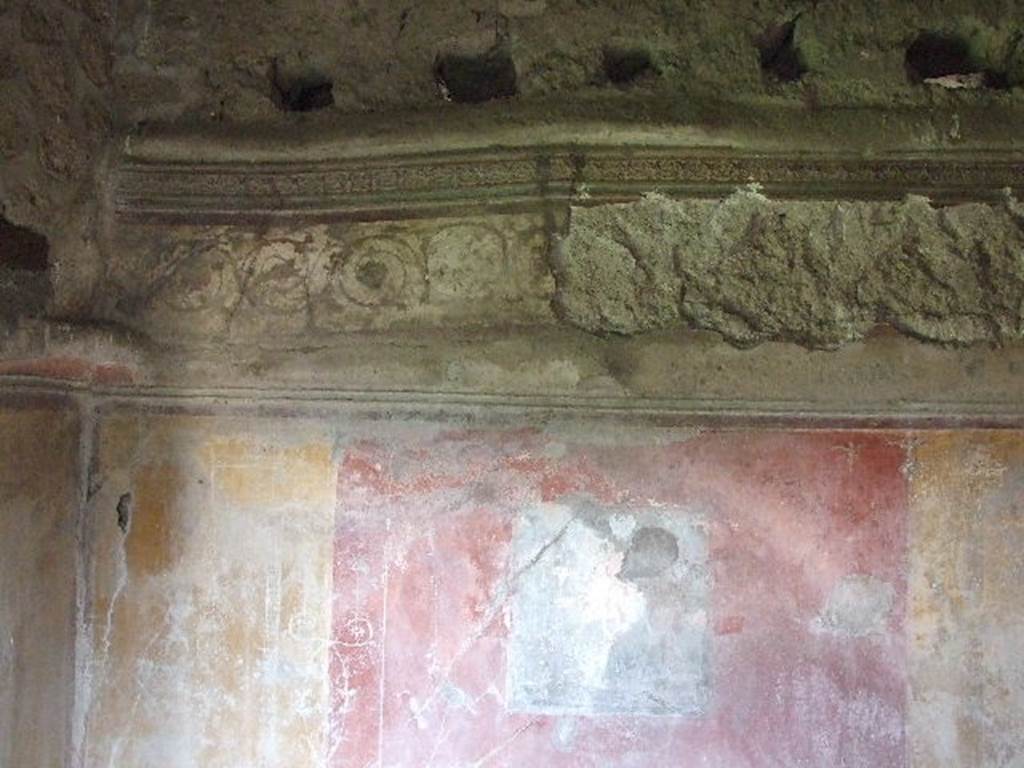
I.3.25 Pompeii. December 2006. East wall of cubiculum, detail of stucco plaster and frieze.
See Schefold, K., 1962. Vergessenes Pompeji. Bern: Francke. (T: 90,1).
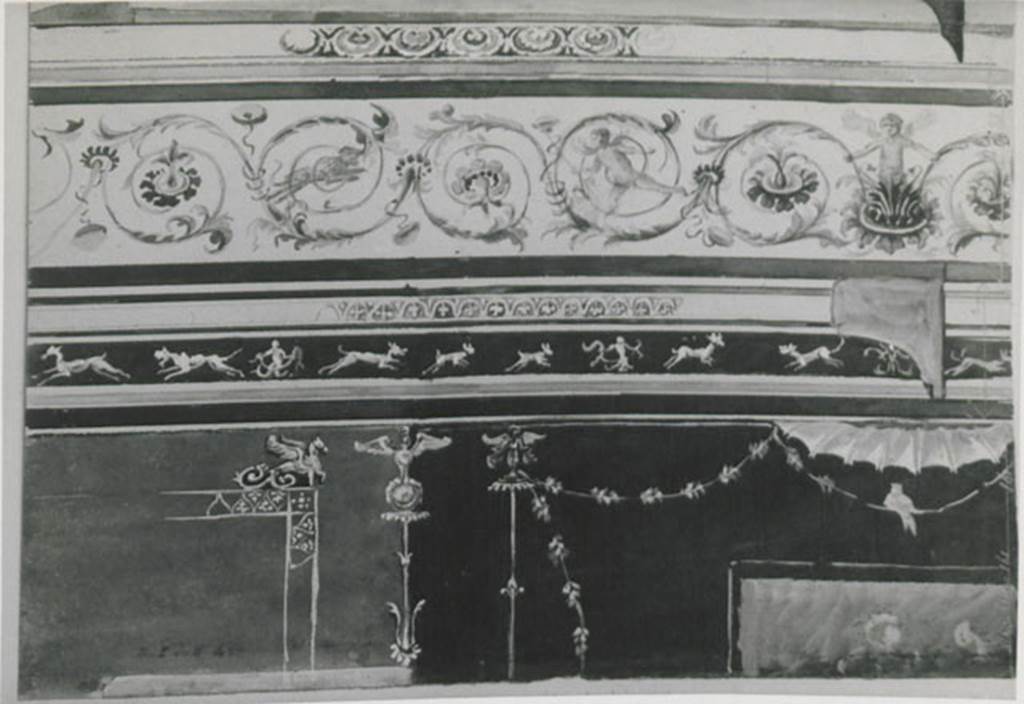
I.3.25 Pompeii. 1935 photograph taken by Tatiana Warscher of a reproduction of a watercolour belonging to DAI.
East wall of cubiculum. On the right must be part of the painting of Perseus and Andromeda.
Warscher appeared to have made a mistake here, as she quoted there was a painting of Cyparissus in the centre.
See Warscher, T, 1935: Codex Topographicus Pompejanus, Regio I, 3: (no.65), Rome, DAIR, whose copyright it remains.
According to Sogliano, in this room two paintings were found –
Cyparissus
(p.28, no.109)
Perseus and
Andromeda (p.91, no.519)
See Sogliano, A., 1879. Le pitture murali campane scoverte negli anni 1867-79. Napoli: Giannini.
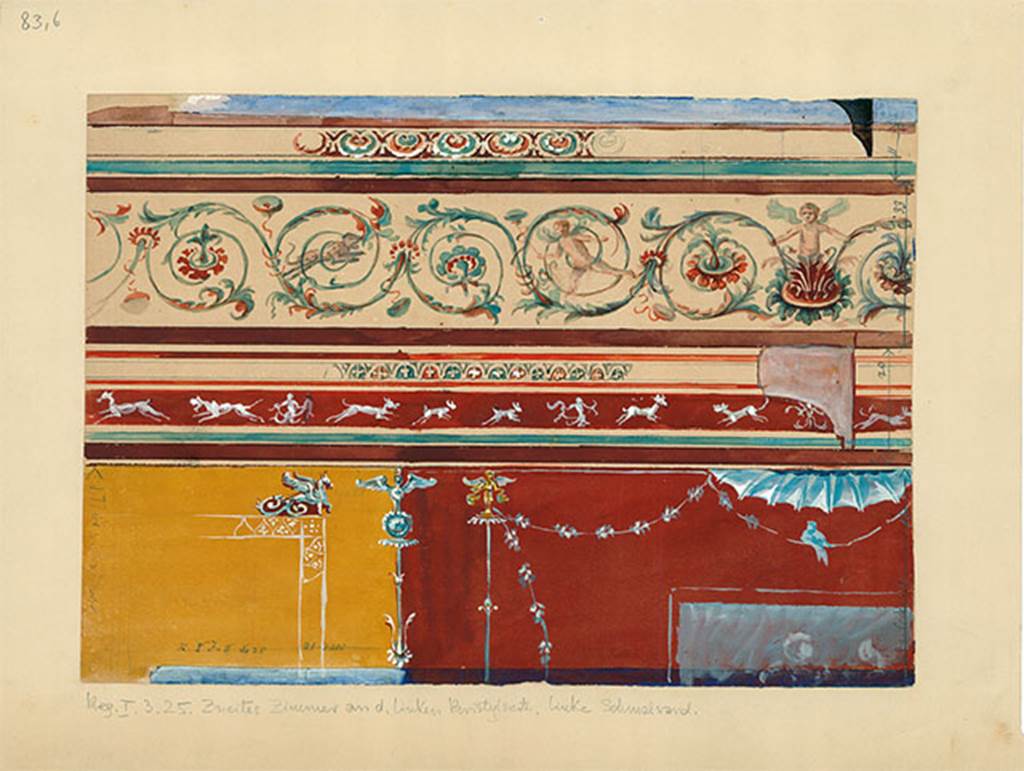
I.3.25 Pompeii. 1880 watercolour of decoration of east wall of cubiculum.
DAIR 83.6. Photo
© Deutsches Archäologisches Institut, Abteilung Rom, Arkiv.
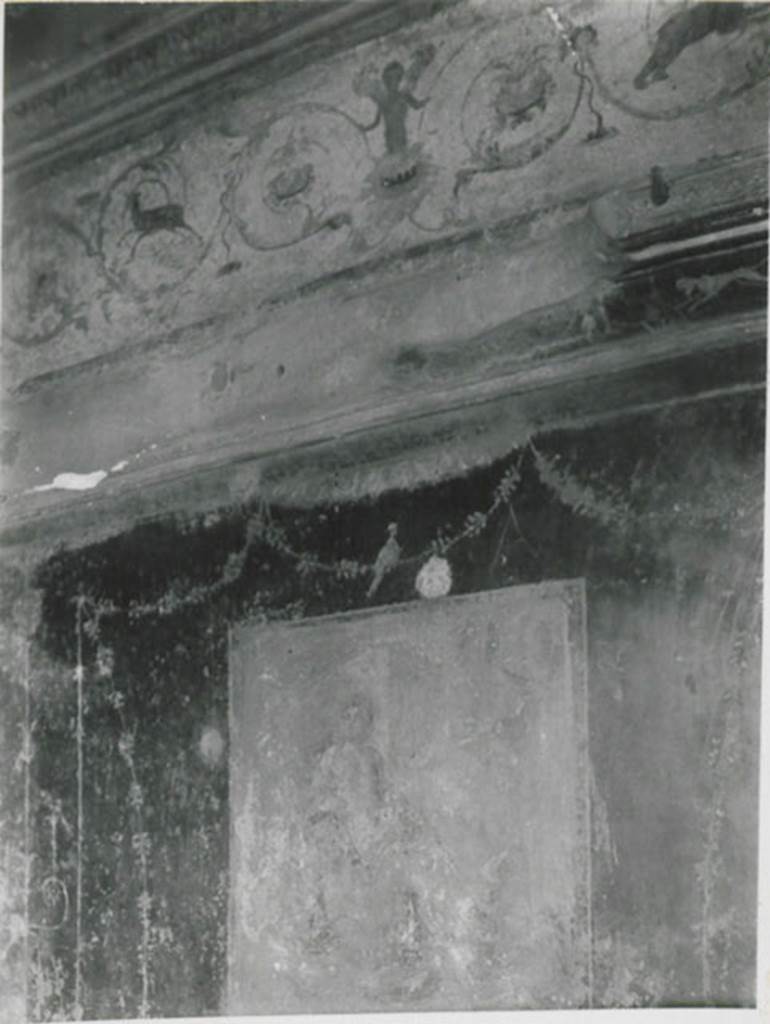
I.3.25 Pompeii. 1935 photograph taken by Tatiana Warscher.
South wall of cubiculum with traces of the painting of Cyparissus.
Warscher appeared to have made a mistake here, as she quoted the painting of Andromeda and Perseus as being on the south wall.
See Warscher, T, 1935: Codex Topographicus Pompejanus, Regio I, 3: (no.66), Rome, DAIR, whose copyright it remains.
According to Sogliano, in this room two paintings were found –
Cyparissus
(p.28, no.109)
Perseus and
Andromeda (p.91, no.519)
See Sogliano, A., 1879. Le pitture murali campane scoverte negli anni 1867-79. Napoli: Giannini.
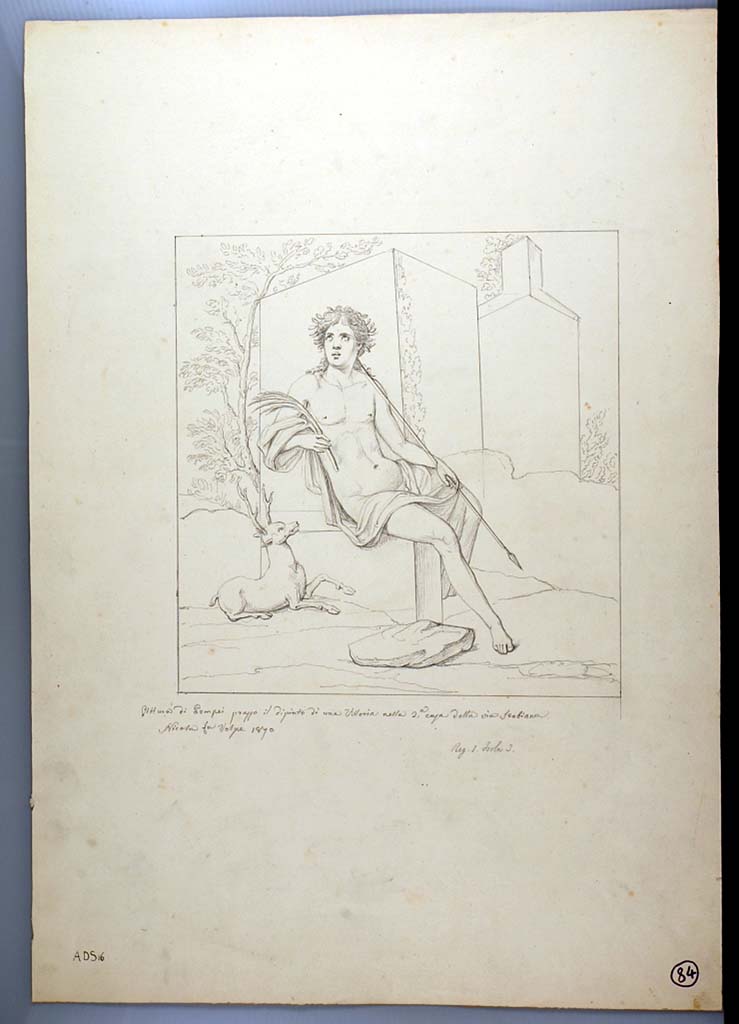
I.3.25 Pompeii. 1870 drawing by Nicola La Volpe of painting of Cyparissus seen in centre of south wall.
The painting was stolen in 1977.
See Sogliano, A., 1879. Le pitture murali campane scoverte negli anni 1867-79. Napoli: Giannini. (p.28, no.109).
Now in Naples Archaeological Museum. Inventory number ADS 16.
Photo © ICCD. http://www.catalogo.beniculturali.it
Utilizzabili alle condizioni della licenza Attribuzione
- Non commerciale - Condividi allo stesso modo 2.5 Italia (CC BY-NC-SA 2.5 IT)
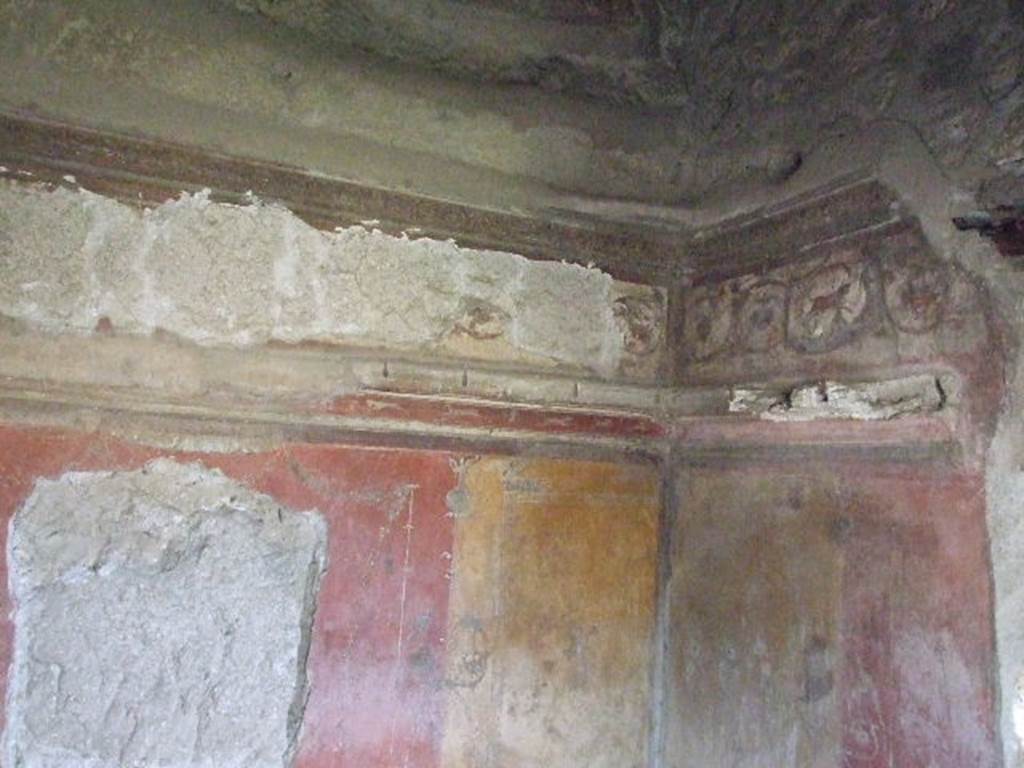
I.3.25 Pompeii. December 2006. Cubiculum. Detail of frieze and plaster stucco in south-west corner.
In the west wall would have been a window overlooking the garden, on right.
The compartments that occupied the middle of each wall, would have been large and decorated with a painting on the red background.
The two other compartments that flanked the red one would have been painted with flying cupids on a yellow background.
A cornice of stucco adorned with various colours ran around the upper wall, and above that was an ornate frieze.
The frieze was decorated with pretty arabesques with cupids and some animals.
See Trendelenburg in BdI, 1871, (p.174-5)
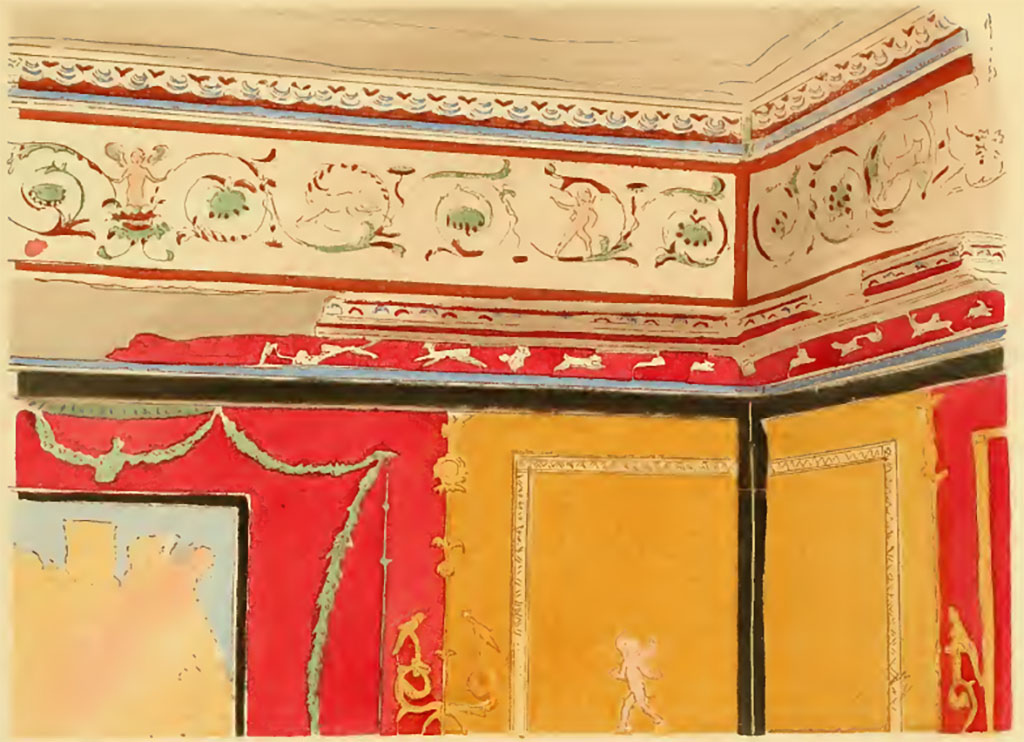
I.3.25 Pompeii. Undated painting by Pierre Gusman of detail of upper wall in the cubiculum, south-west corner.
Described
as - XXI. 1° Frise d'une chambre du quatrième style (Région 1, 2, 25).
See Gusman P., 1924. La Décoration Murale de
Pompei. Paris : Morancé, pl. XXI,1.
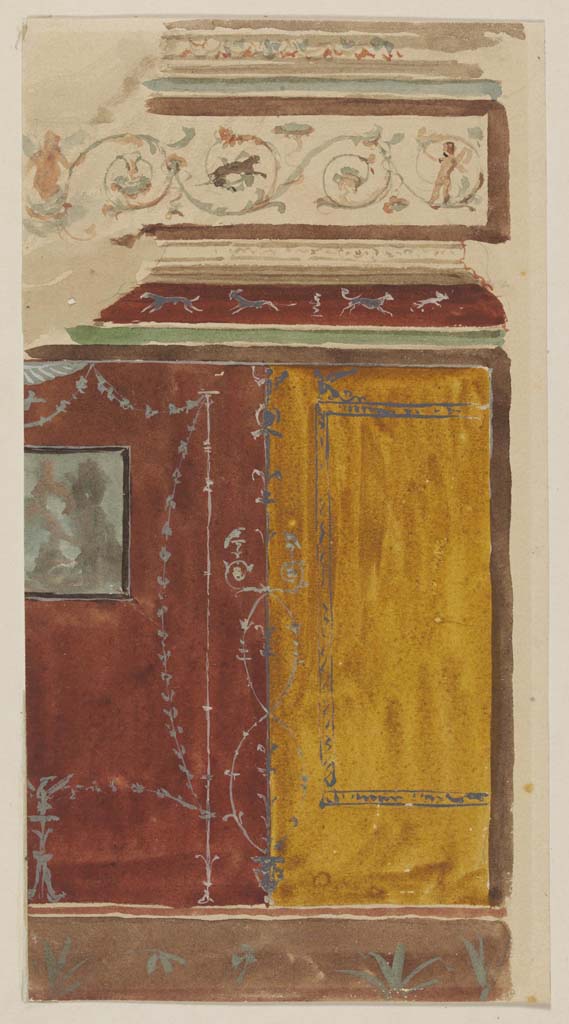
I.3.25 Pompeii. Undated painting by Luigi Bazzani showing west end of south wall of cubiculum.
Photo
© Victoria and Albert Museum. Inventory number 2044-1900.
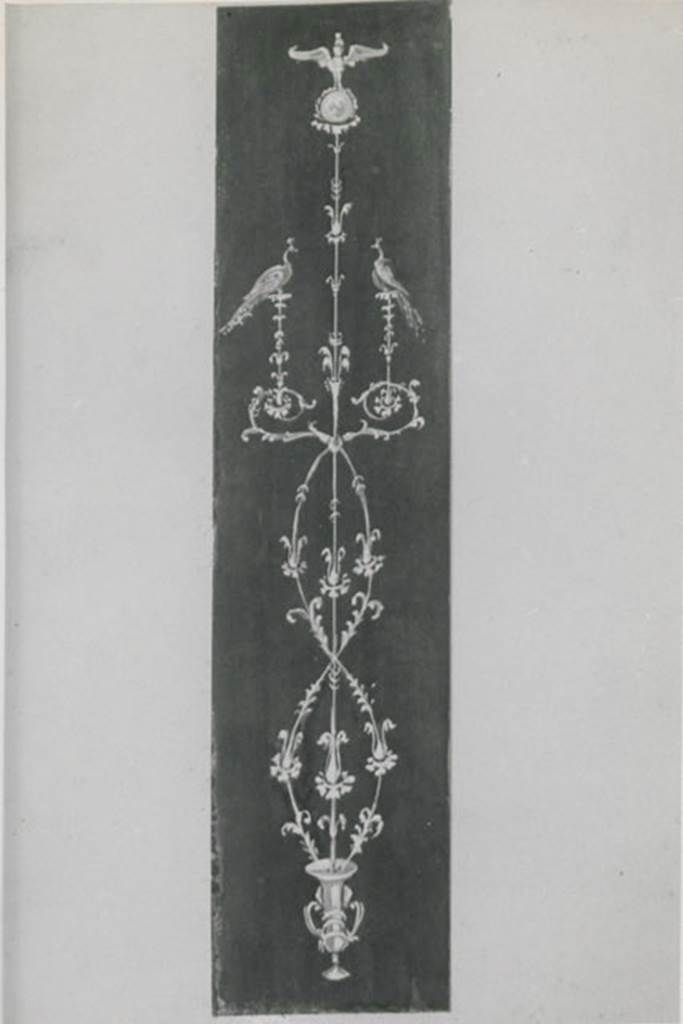
I.3.25 Pompeii. 1935 photograph taken by Tatiana Warscher of a reproduction belonging to the DAI.
According to Warscher, this design probably belonged in the cubiculum on the south side of the peristyle.
See Warscher, T, 1935: Codex Topographicus Pompejanus, Regio I, 3: (no.68), Rome, DAIR, whose copyright it remains.
In Codex Topographicus Pompeianus: Regio I.3, (the copy at DAIR), Warscher included a description of the insula.
This description is included at the end in all parts of I.3 on the website.
“L’isola 3 della
Regio I apparteneva ai quartieri piuttosto poveri, ad’esenzione della casa no.
3 tutto le case sono di dimensioni non grandi.
La casa no. 3
presenta un interesse dal punto di vista della costruzione: il peristilio si
trova ad un livello più alto di quello dell’atrio:
questa
particolarità si riscontra solamente in questa casa.
Noi abbiamo un
esempio inverso nella casa dell’Ancora nera ove l’atrio si trova ad un livello
più alto di quello del peristilio.
Si sente bene
nell’isola in questione la vicinanza dell’anfiteatro da una parte e delle
caserme dei gladiatori dall’altra.
Non c’è dubbio
che le case nos 23, 25 siano state abitato da gladiatori.
(translation: “Insula 3 of Region I belonged to a rather poor neighbourhood, with the exception of house No. 3 all the houses were not large in size.
The house at no. 3 had a special interest from the point of view of construction: the peristyle sits at a level higher than that of the atrium: this particularity was found only in this house. We have a contrary example in the House of the Black Anchor where the atrium was located at a higher level than that of the peristyle.
The nearness of the amphitheatre on one side and the gladiators' barracks on the other suited well the inhabitants of the insula in question.
There was no doubt that the houses numbered 23, 25 had been inhabited by gladiators.”).
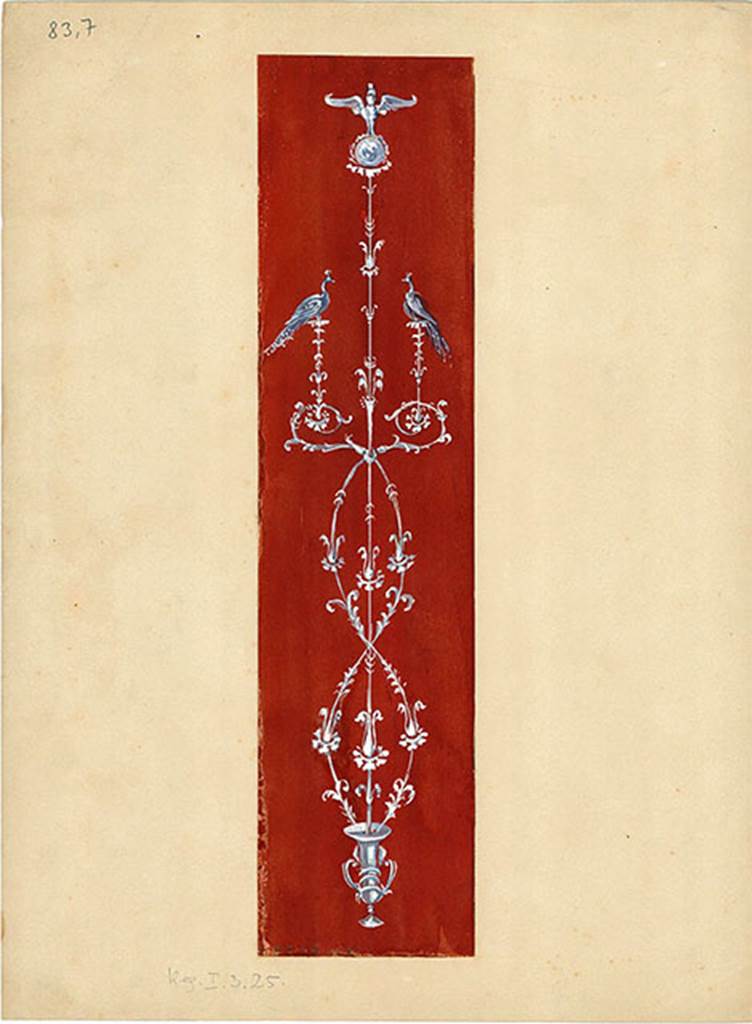
I.3.25 Pompeii. 1880 watercolour of two peacocks on stylized vegetal branches rising from a vase from cubiculum on the south side of the peristyle
DAIR 83.7. Photo
© Deutsches Archäologisches Institut, Abteilung Rom, Arkiv.