VII.6.7 Pompeii. House.
Excavated 1762, 1841 and 1910. Bombed in 1943.
According to Garcia y Garcia Region VII, Insula VI was one of the insulae most devastated over the years since its excavation.
He calls it the “Cinderella” of Pompeii. Between the years 1759 and 1762 it was vandalised and stripped by the Bourbons, then re-interred.
Then came the slow and non-systematic uncovering again before the final destruction in September 1943.
The area was ignored and abandoned during the years following the war, which reduced the insula to a heap of bricks and masonry.
See Garcia y
Garcia, L., 2006. Danni di guerra a Pompei. Rome: L’Erma di Bretschneider. (p.102).
According
to Fiorelli –
Following are two
brick pillars, which line the doorway of a house, in which we can see residues
of very ancient constructions, and of which was discovered the tuscanic atrium,
having to the left a cubiculum and an ala, on the right the porter’s room
underneath of a wooden stairway, followed by a cupboard/storeroom and by
another ala, perhaps in here was the domestic lararium. Opposite is the tablinum,
which has a cubiculum on the right, and on the other side an oecus, both in
communication with areas not yet excavated.
(Seguono due pilastri laterizii, che costeggiano la
porta di una casa, in cui notansi residui di costruzioni molto antiche, e della
quale e scoperto l’atrio tuscanico, avente a sinistra un cubicolo ed un’ala, a
destra la cella dell’ostiario sottoposta ad una gradinata di legno, seguita da
un’apotheca e da un’altra ala, nella quale era forse il sacrario domestico. Di
fronte sta il tablino, che a destra ha un cubicolo, ed all’altro canto un
oecus, entrambi in communicazione con localita non ancora scoverte.)
See Pappalardo,
U., 2001. La Descrizione di Pompei per
Giuseppe Fiorelli (1875). Napoli: Massa Editore. (p.159)
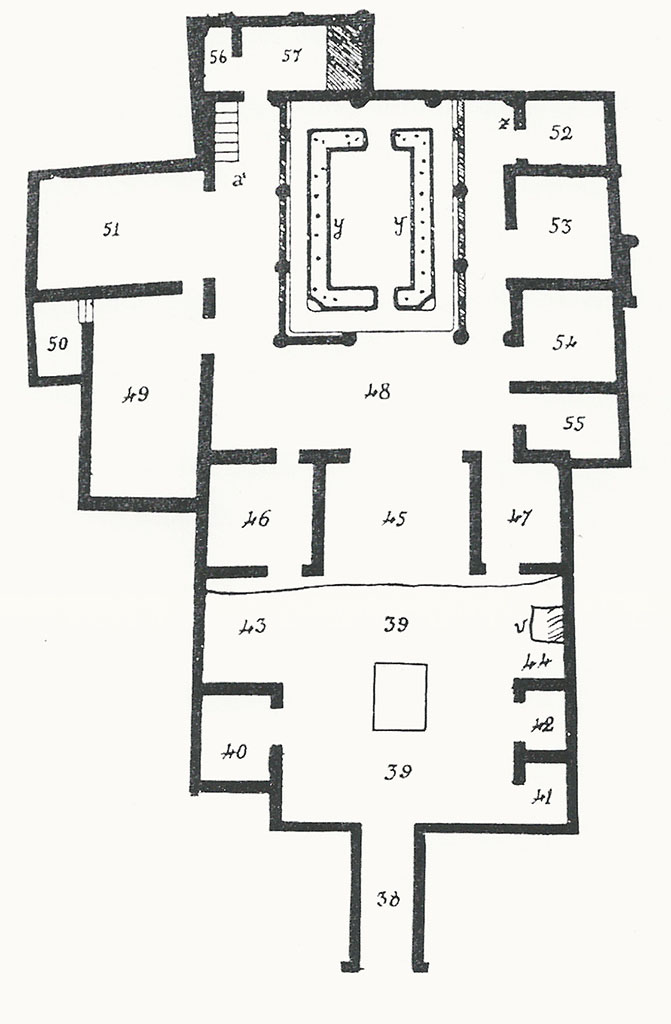
VII.6.7 Pompeii. 1910 plan by Spano.
See Notizie degli Scavi di Antichità, 1910,
fig. 1, p. 437.
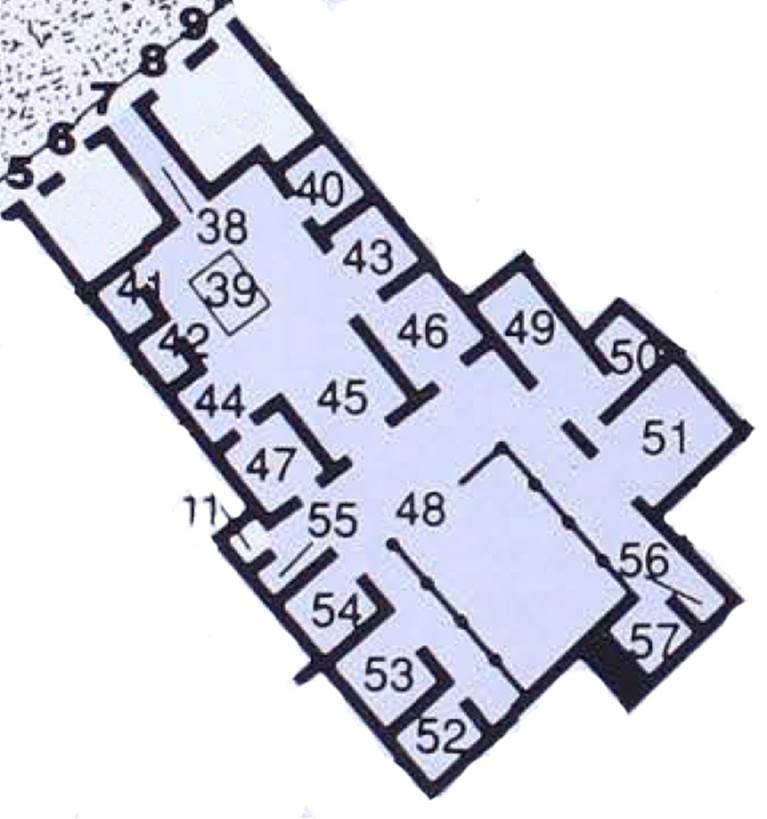
VII.6.7 Pompeii. Plan based on PPM.
See Carratelli, G. P., 1990-2003. Pompei: Pitture e Mosaici: Vol. VII.
Roma: Istituto della enciclopedia italiana,
p. 176.
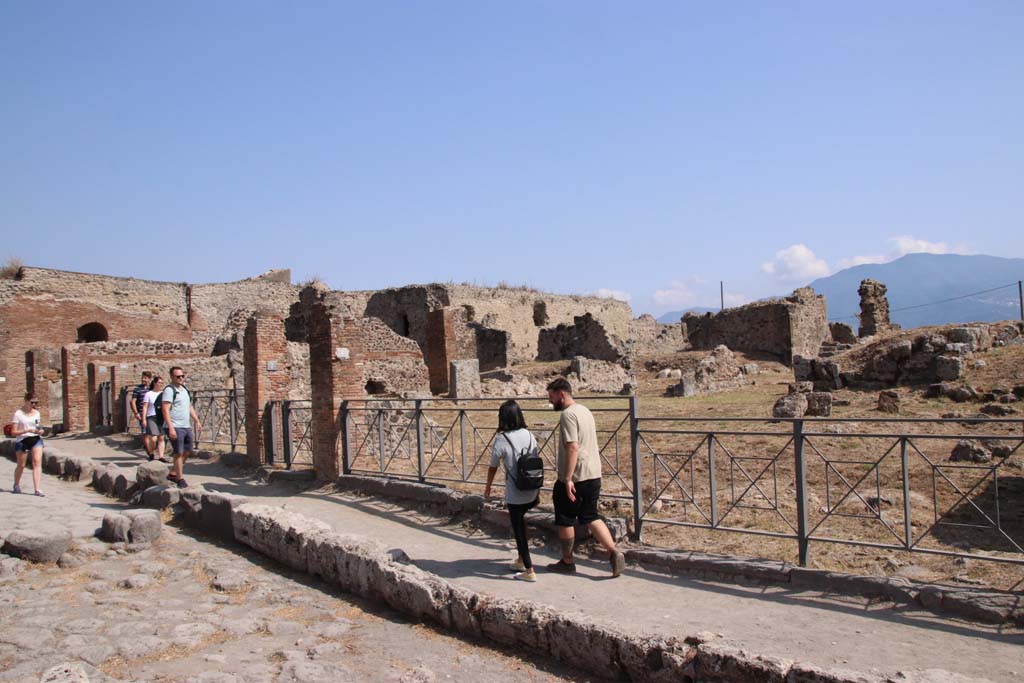
In the centre and right of the photo, would
be the areas of VII.6.6, VII.6.5 and VII.6.4. Photo courtesy of Klaus Heese.
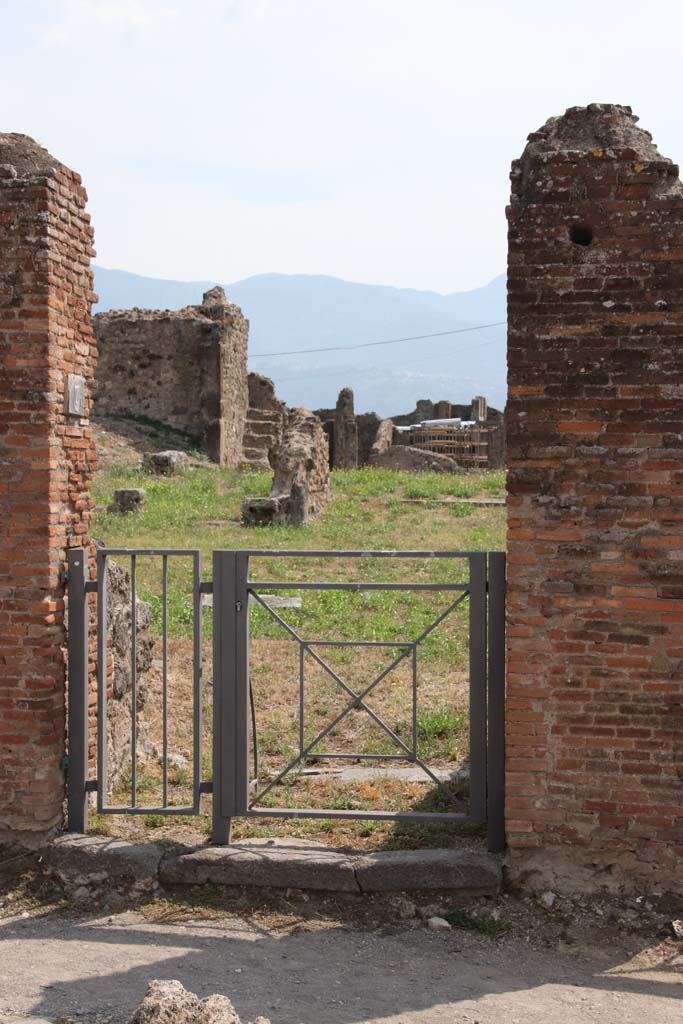
VII.6.7
Pompeii. September 2021.
Looking
south through entrance doorway. Photo courtesy of Klaus Heese.
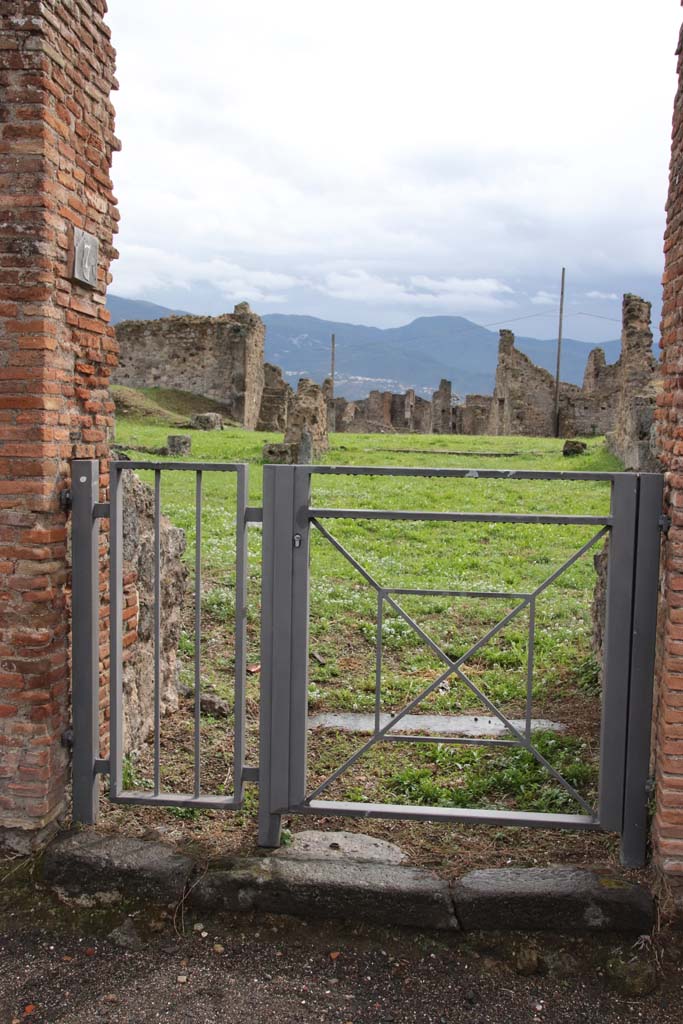
VII.6.7
Pompeii. October 2020.
Looking
south through entrance doorway. Photo courtesy of Klaus Heese.
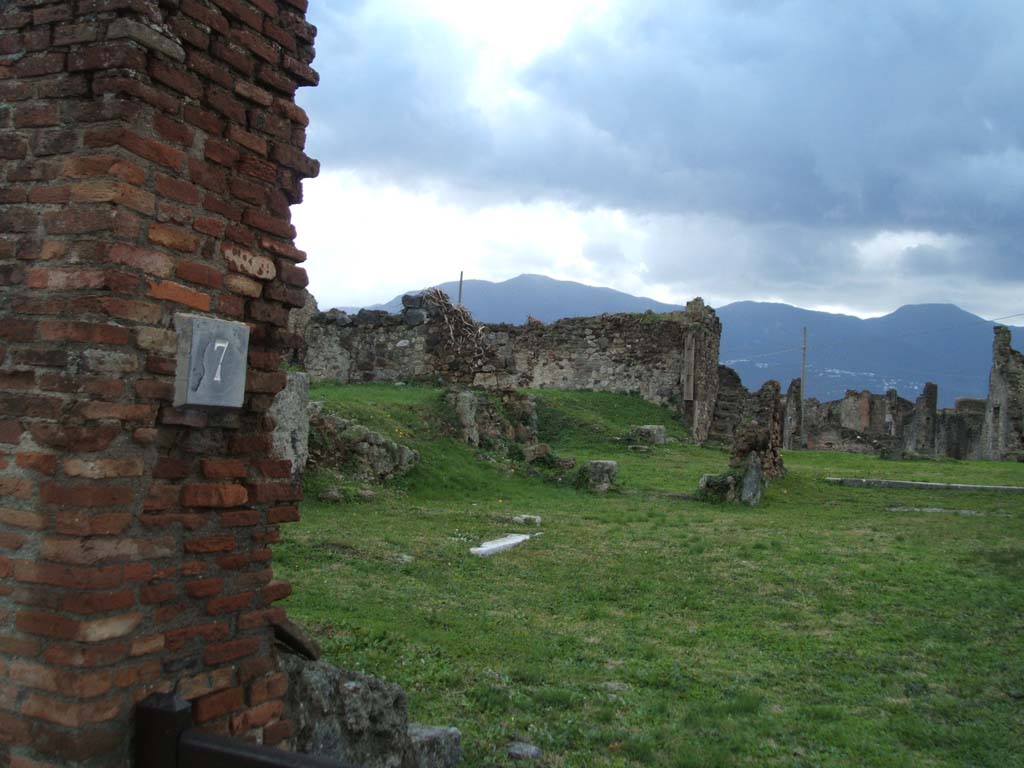
VII.6.7 Pompeii. December 2004. Looking south-east across site of atrium and remains of tablinum.
This area was hit by a bomb in September 1943.
According to Garcia y Garcia, the prothyron, the atrium, four rooms around the atrium, the south and west sides of the peristyle, and two cubicula to the west of the peristyle were all destroyed, with the total loss of all their 4th style decoration, including two small painting of landscapes.
See Garcia y Garcia, L., 2006. Danni di guerra a Pompei. Rome: L’Erma di Bretschneider. (p.102 & fig 233 showing area demolished by bombing).
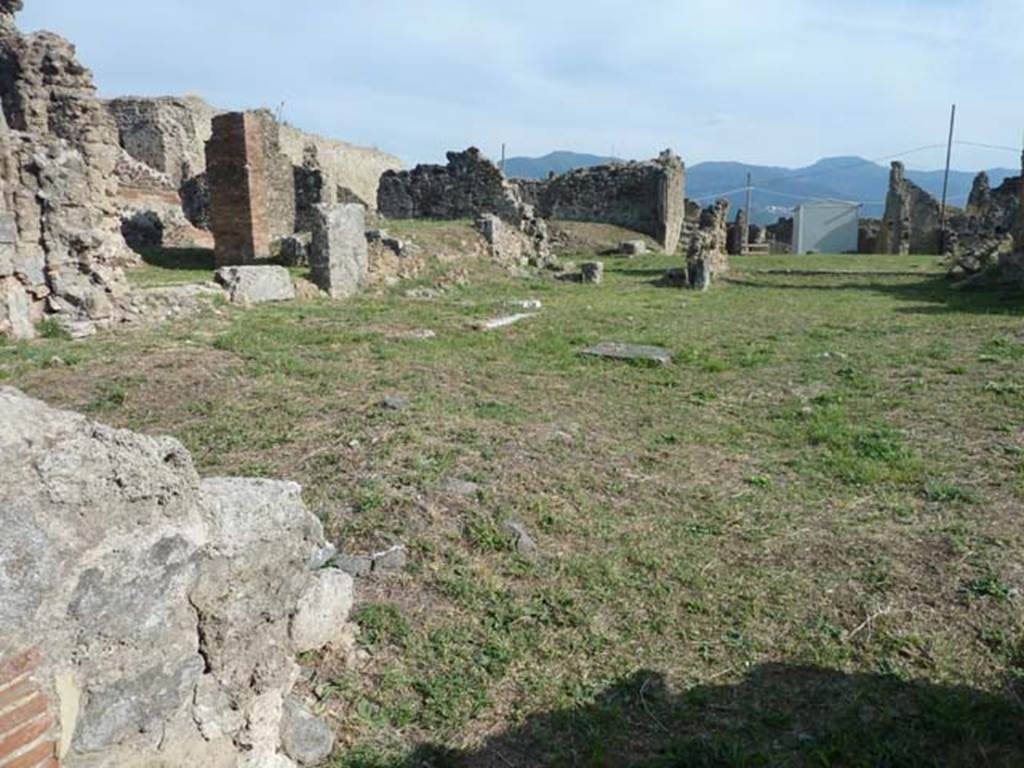
VII.6.7 Pompeii. September 2015. Looking south-east across site of atrium and remains of tablinum, in the upper right.
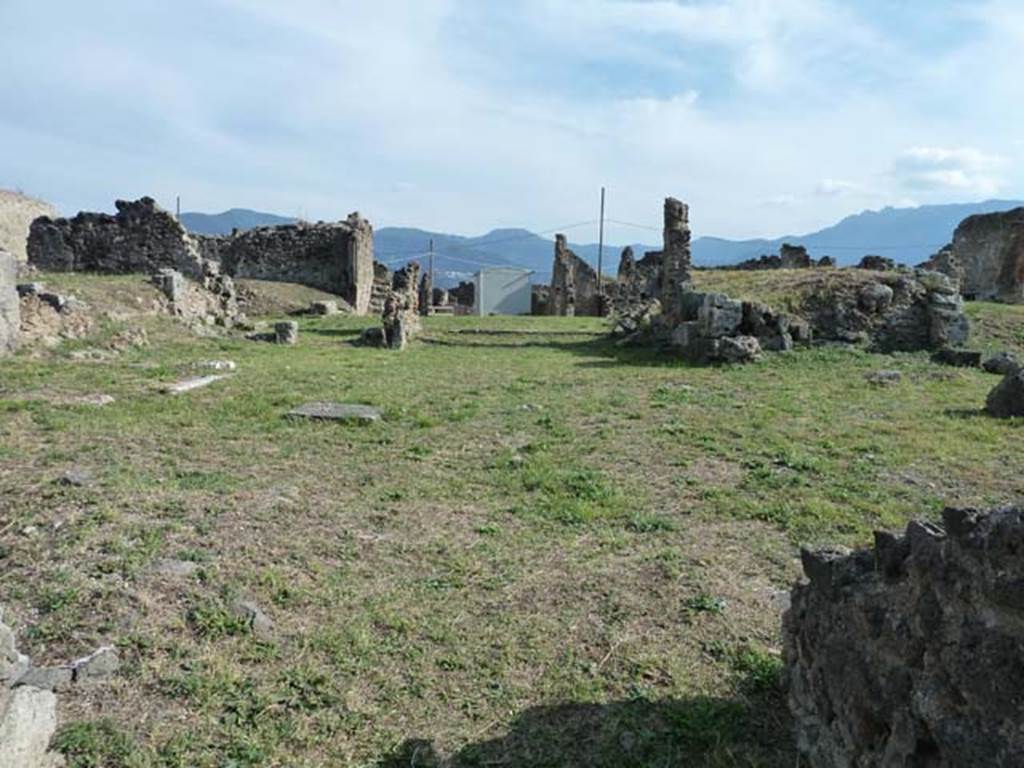
VII.6.7 Pompeii. September 2015. Looking south across site of atrium from entrance doorway.
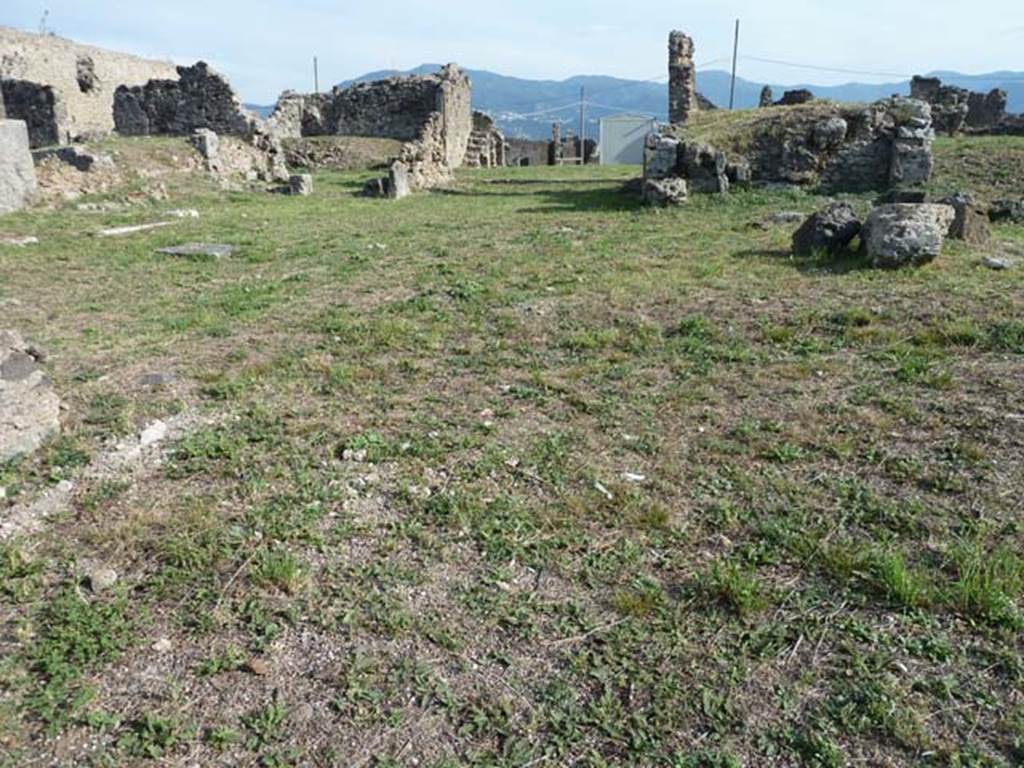
VII.6.7 Pompeii. September 2015. Looking south from site of shop at VII.6.6, across atrium and rooms on either side of VII.6.7.
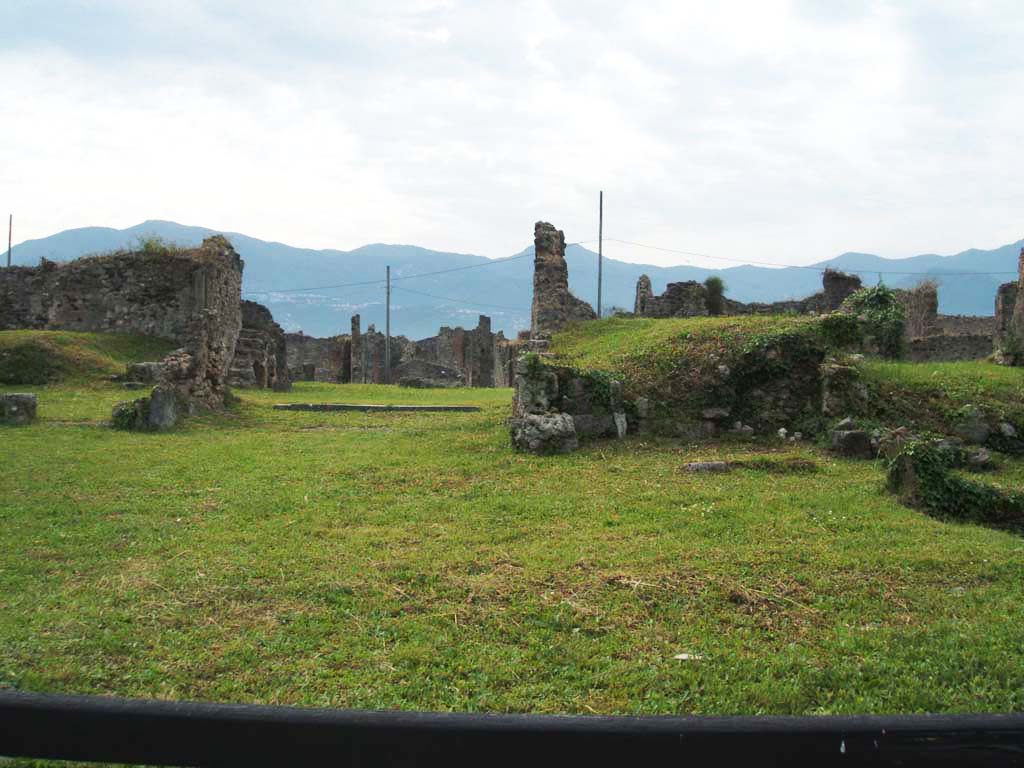
VII.6.7 Pompeii. May 2005. Looking south from site of shop at VII.6.6, into atrium of VII.6.7.
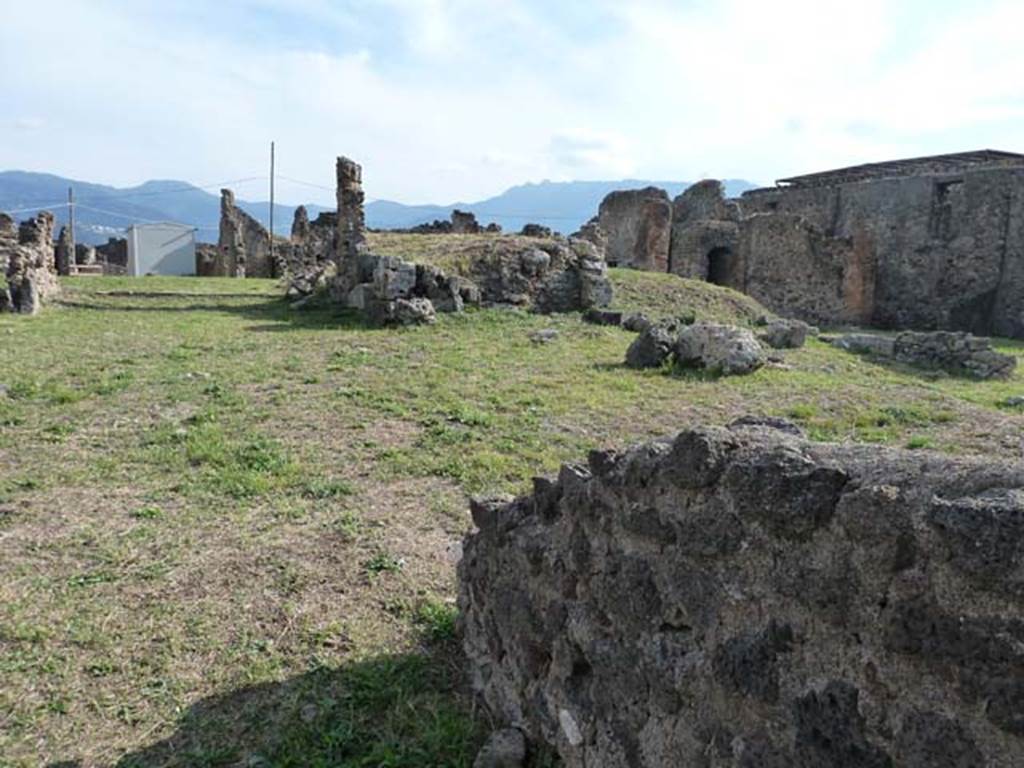
VII.6.7 Pompeii. September 2015. Looking south-west across site of atrium from entrance doorway.
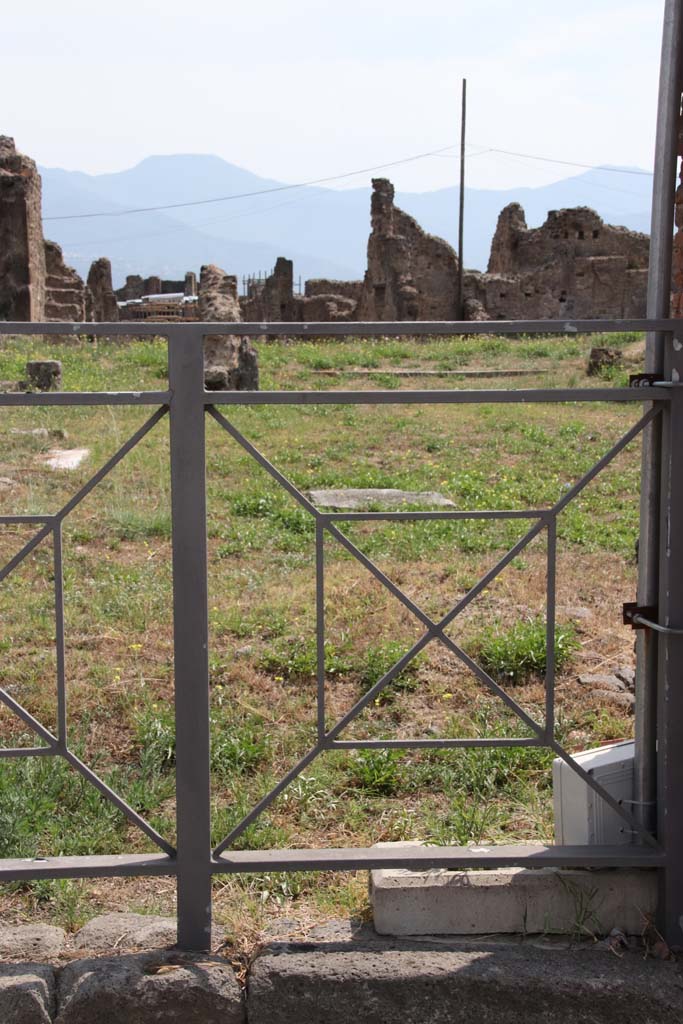
VII.6.7 Pompeii. September 2021.
Looking south-west
towards tablinum, from west side of shop doorway at VII.6.8.
Photo
courtesy of Klaus Heese.
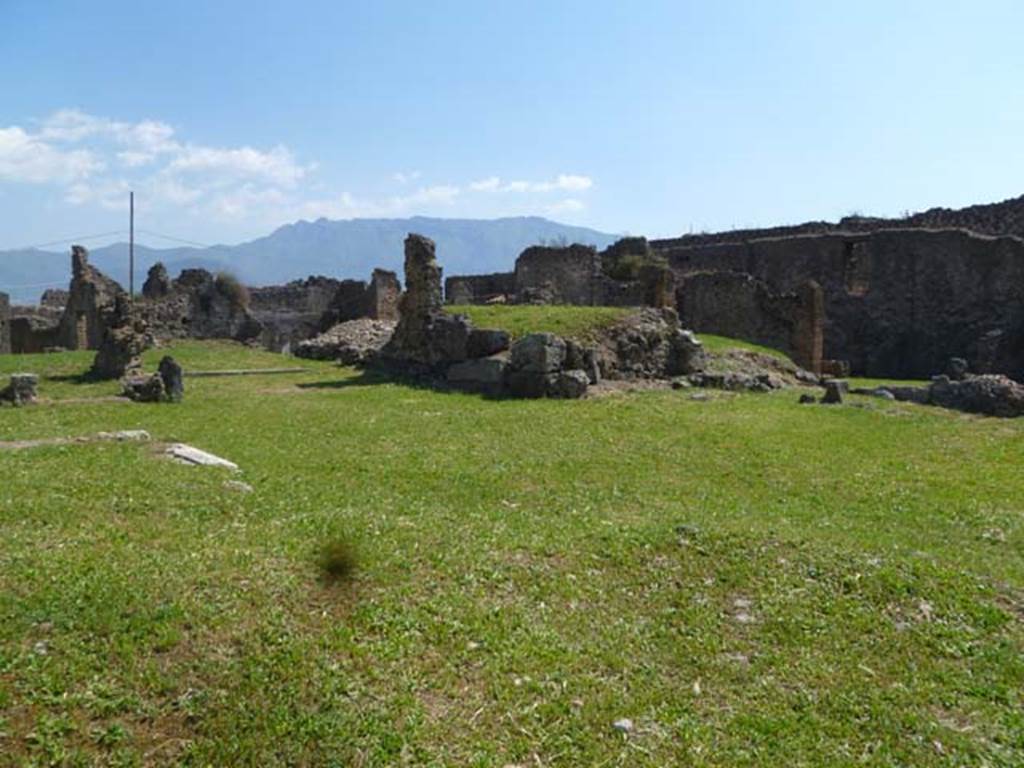
VII.6.7 Pompeii. May 2011.
Looking south-west across site of atrium, from around the area of room 40, lower left. Photo courtesy of Michael Binns.
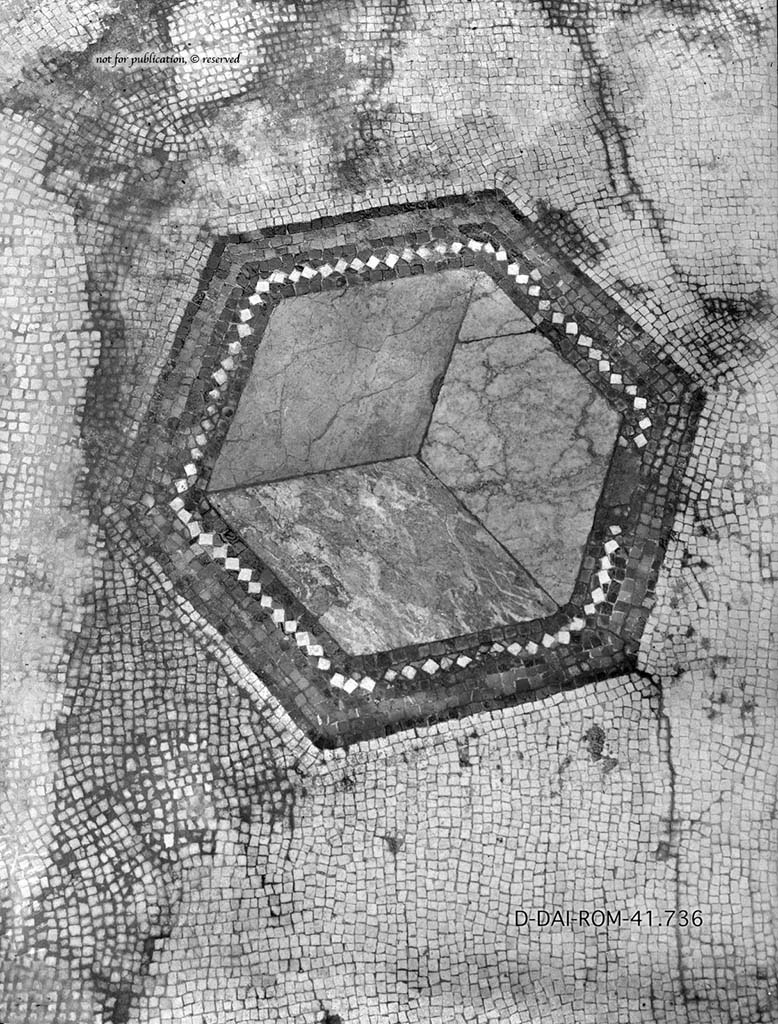
Cubiculum
40, flooring of white mosaic, with a hexagon in the centre formed by three
diamonds of coloured marble, with border of black, white and red bands.
DAIR 41.736. Photo © Deutsches Archäologisches Institut,
Abteilung Rom, Arkiv.
See Pernice, E.
1938. Pavimente und Figürliche Mosaiken: Die Hellenistische Kunst in
Pompeji, Band VI. Berlin:
de Gruyter, (p.89-90, and taf. 41,2 above).
According to Notizie degli Scavi, 1910, p.454-461, - (Note: this can be read
in italian, at the end of the photos).
Doorway VII was the entrance to a house. The doorposts/jambs
were made with pieces of tiles; there is a lava threshold between them, followed by a small vestibule, after which
is the threshold of the door, also of lava. The house consists of three main
parts, of atrium, of tablinum and of peristyle; the first two parts exactly
on the axis between them, the third slightly shifted to the east. It was built
in ancient time, as is apparent from the blocks of Sarno stone used in the
construction, and by the doorways, tall and tapered; however
it was later remodelled in various parts.
Fauces 38 had cocciopesto flooring, somewhat
inclined towards the street, and the walls retained small remains of plaster,
but were worn out in the surface. The corners towards the atrium were lined
with wood. (As is observed also in other houses, see Notizie 1910, Fasc. 8,
page 316.)
The Atrium 39 was tuscanic. It also had
flooring of cocciopesto with wide band of Opus Segmentatum around the impluvium
which was almost square in shape, with the base formed from the same Opus
Segmentatum.
Around the atrium several rooms opened,
mostly with limestone jambs, and which, although preserved only at the bottom,
show from their general effect to have been high and tapered.
The first doorway on the left introduced you
to room 40; it had a threshold of travertine with holes for the interlocking of
the wooden jambs, for the hinges and a last one for the door bolt (pessulus). The room had painted walls, decoration of which only the red zoccolo
remained, divided into squaring by white dashes/hyphens; flooring of white mosaic
with double black band around and with a hexagon in the centre formed by three
diamonds of coloured marble, with border with black, white and red bands.
In the northern wall was a small bricked up
doorway, which would have given into the rear of the shop of VIII (VII.6.8), so
that in a more ancient time it was in direct communication with this House, as
it also proves a high bricked doorway existed in the northern wall of the
atrium to the right of the fauces. Opposite to the described room, room 41, at
the extreme right of the western side, was a small room with scarce remains of
plaster, which, at least today, is shown unadorned, and with the western wall
strongly inclined forward.
Following, was room 42, a storeroom/cupboard
with tapered doorway, which was exactly opposite and facing to the doorway to
room 40.
On both sides, at the rear, were the alae 43
and 44.
The first (43 on the east side) had corroded
plaster on the walls, a very coarse floor, consisting of pieces of marble
encrusted in the soil and carried a trace of wooden jambs to the left of the
entrance, with marble bearing fitted with the hole for the interlocking of
that.
The facing west ala, 44, had the same
flooring, remains on the walls of large red rectangles, marble bearing on the
right of the doorway, which supported the wooden jamb. Leaning against the facing
wall (western), were two high masonry steps, perhaps leftovers from a
sacrarium.
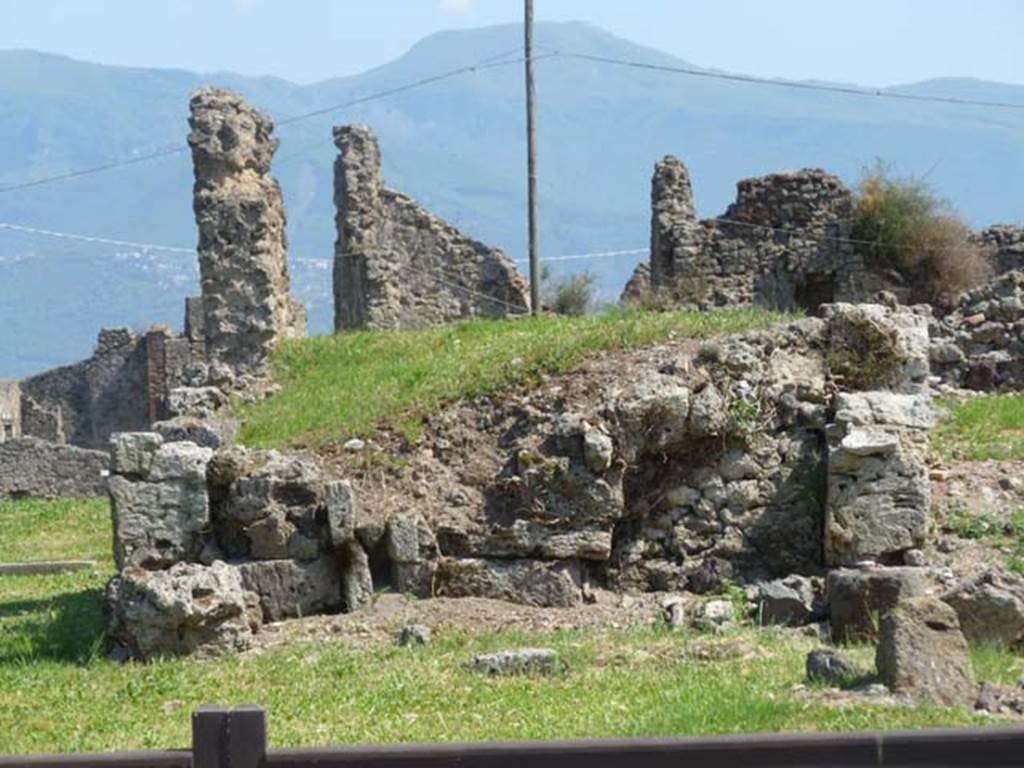
VII.6.7 Pompeii. May 2011. Looking south towards site of remains of rooms on the west side of the tablinum and atrium.
This area could be approximately the site of the right ala.
According to Boyce, in the right ala of the atrium stood a large masonry podium, which Fiorelli thought may have been the base of a Lararium.
See Boyce G. K., 1937. Corpus of the Lararia of Pompeii. Rome: MAAR 14. (p.67. no.288).
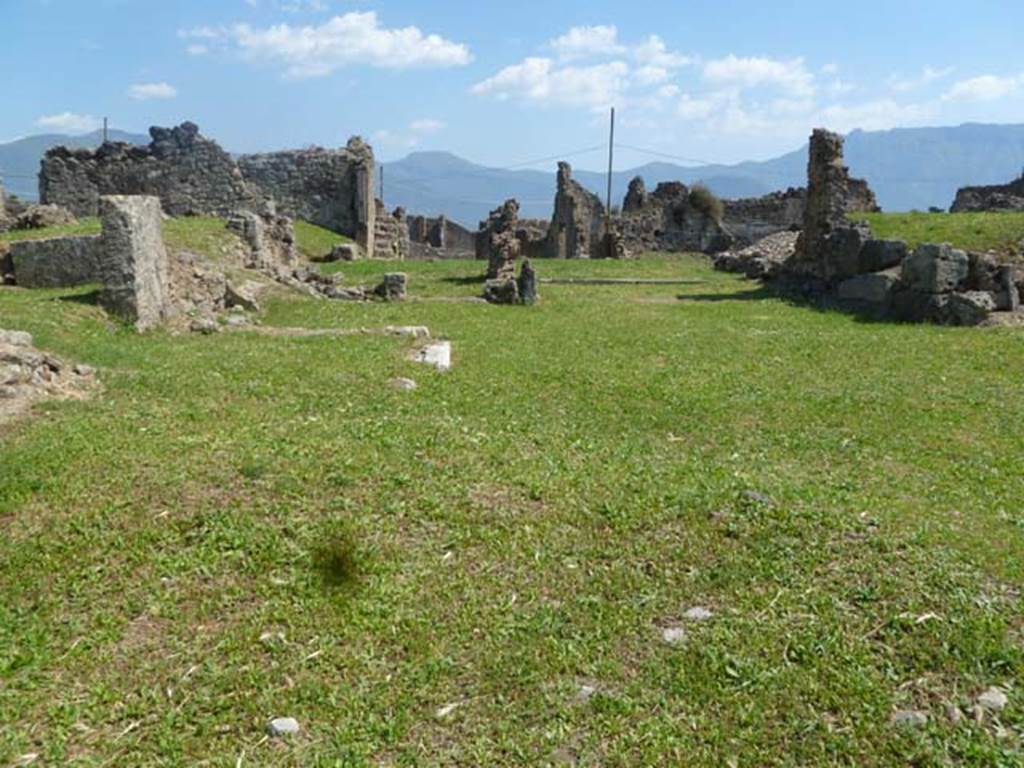
VII.6.7 Pompeii. May 2011.
Looking south across site of atrium, through tablinum, to site of peristyle. Photo courtesy of Michael Binns.
According to Della Corte, and inedited, was the following black inscription written on the neck of a one-handled jug, found on 8th August 1910 -
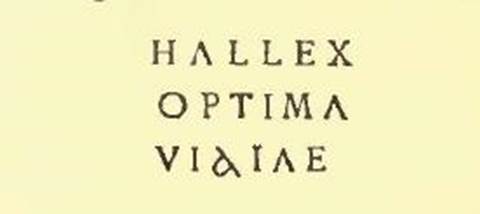
See Notizie degli Scavi, 1914, (p.112).
Notizie degli Scavi, 1910,
p.454-461
The tablinum, 45, was vast, it had
flooring of signinum, exhibiting parallel rows of white tesserae placed at
equal intervals, a meandric line at the place of the threshold on the side of
the atrium, and a square in the middle with a circle within decorated in turn
with lines forming diamonds. The walls retain scarce remains of corroded
plaster. The pillars at the entrance had wooden jambs, of which the marble
bearings were conserved.
On either side of the tablinum were two
rooms, 46 and 47, both with narrow entrance, high and tapered on the atrium
side and with another doorway onto the peristyle.
The first room, 46, had well-decorated
walls, but of which only traces were preserved. The mosaic floor with a white
background, would have had a picture in the centre, or a precious decoration, which
was probably taken off at the time of the first excavation. Around, on the white
background, straight black bands, formed rectangles variously arranged.
The other room (47) similarly had the walls
decorated with painting, which was evidenced by the remains of the red painted
zoccolo. It appears that the flooring
was of cocciopesto. In the wall that this room linked through to the tablinum
were two windows.
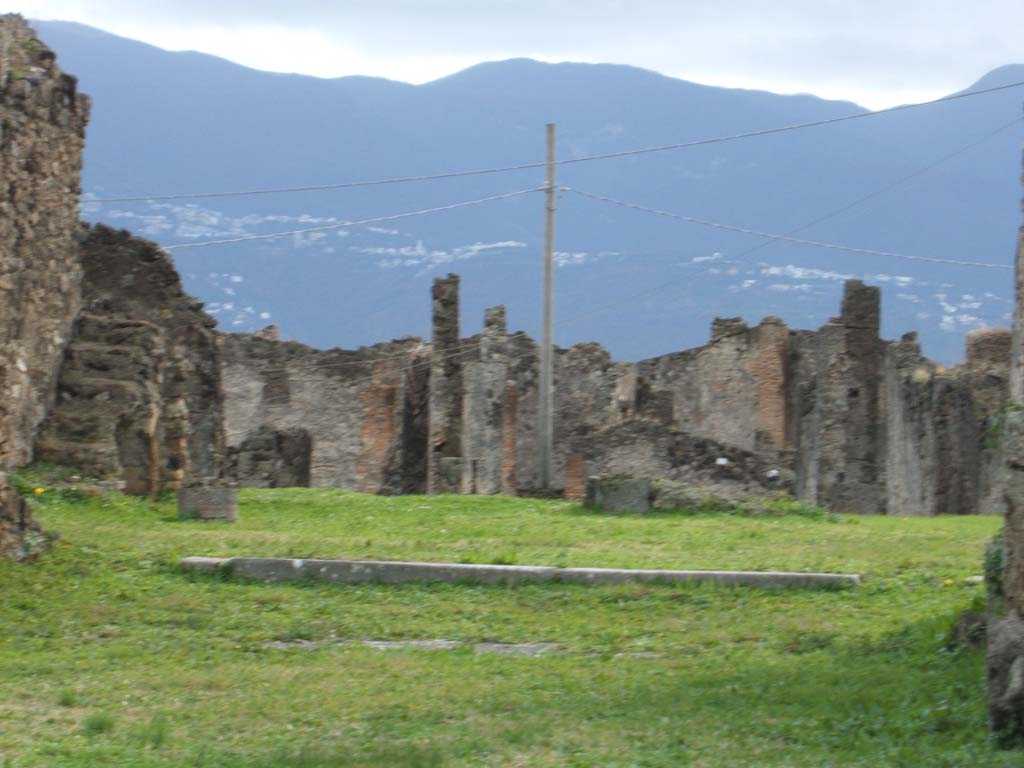
VII.6.7 Pompeii. December 2004. Looking south across site of tablinum and peristyle, and towards remains of VII.6.28.
Notizie degli Scavi, 1910,
p.454-461
The Peristyle 48 (Fig. 7 – Page 457) onto
which the tablinum opened almost in all its width with a doorway with a travertine
threshold, and the door-jambs at one time covered with wood, had the portico
around all sides except at the south, where, instead
there was a wall decorated with three semi-columns (Fig. 7, letter a). The
columns, made of tiles and plaster, were smooth; with a high red zoccolo, while
at the top they were white. They were all missing their capitals. There were
three per side, repeating twice at the corners, and instead of being arranged
at equal intervals, they were spaced away from each other a little depending on
the width of the doorways that opened around the portico.
At the first column to the right of the
western walkway was a semi-column in the wall. Of the semi-columns of the
southern wall only part of the zoccolo remains. In one was preserved, the white
vertical stripes, with which they wanted to imitate the decorative relief. It
is not known whether the columns supported a roof or a terrace. Between the
columns was a pluteus in rough masonry, interrupted near the doorway of the
tablinum, instead replaced by another lower pluteus near the entrance doorway
in 51.
In the internal wall of the pluteus, was the
usual gutter, which was of cocciopesto, in which, in addition to collecting the
water of the terrace, also drained some small courses opened through the
pluteus, courses by which, according to me, other water could not flow other
than that used to do the cleaning of the floor of the portico. This flooring
was of cocciopesto.
The west wall preserved a mediocre painted
decoration, consisting of a very high black zoccolo/plinth (higher up, the wall
was white), partitioned into squares by green bands.
The area or small garden preserved two
masonry beds y (and fig. 7, letter b,)
0.26m high, painted in red, with within the plant soil, in which, were
made the usual explorations, we found the holes left by the roots from the
plants, and indicated in relief with dots and in Fig. 7 by means of dry twigs
stuffed into the holes. (See figure 7 on page 457).
Of the southern wall of the peristyle, only
the lower part was preserved, and on this was shown a wooden pluteus, formed by
crossing bands several times, as was seen in many other paintings of this kind.
Without a doubt, however, this pluteus indicated the front closure of a garden
depicted on the entire wall, with a painting which one would have wanted to
give the illusion that a real garden would follow from the small peristyle. It
was, in short, a representation of opera
topiaria, a kind of painting, of which we will have occasion to speak more extensively
(ss V. Page 470).
At the extreme right end of this wall was a
rectangular niche, perhaps a sacrarium.
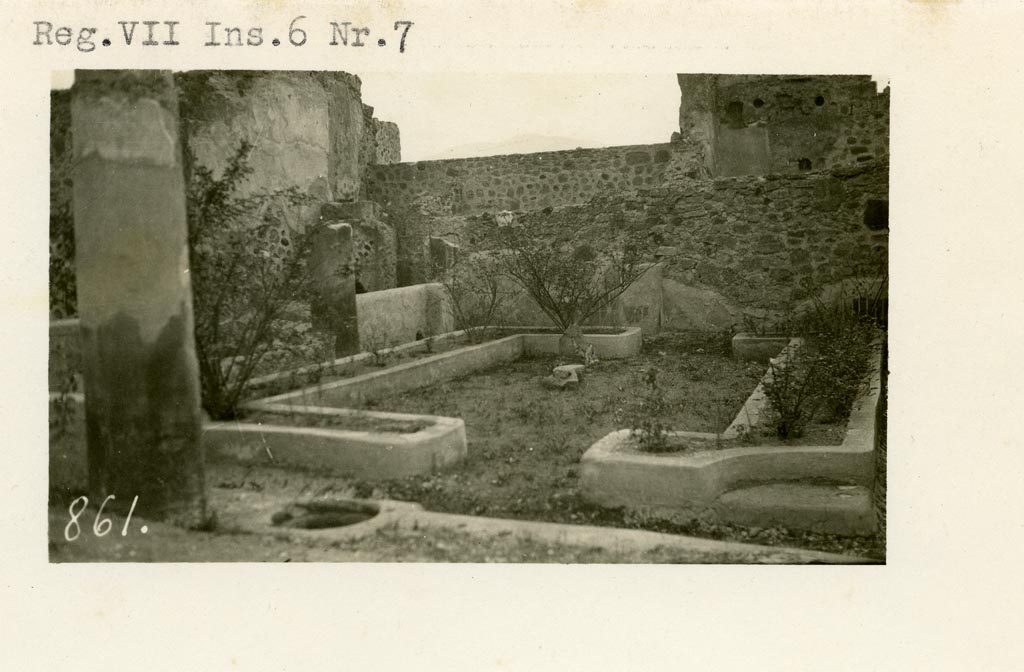
VII.6.7 Pompeii.
Pre-1937-39. Peristyle garden.
Looking south from north-west corner across two U-shaped masonry flower beds formed by low walls (0.26m. high).
Photo courtesy of American Academy in Rome, Photographic Archive. Warsher collection no. 861.
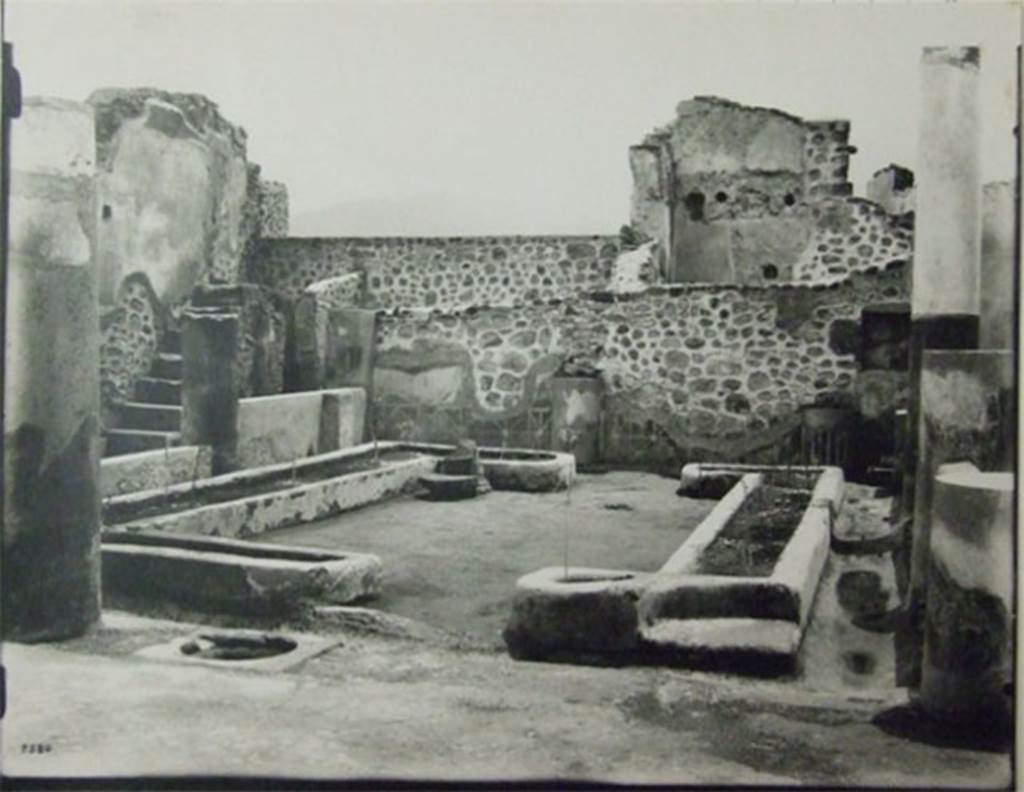
VII.6.7 Pompeii. About 1910. Peristyle garden.
Looking south from north-west corner across two U-shaped masonry flower beds formed by low walls (0.26m. high), originally painted red and filled with soil.
According to Jashemski, the garden at the rear of the tablinum was enclosed on the east, north and west by a portico supported by 7 columns, red below and white above. All lacked capitals at the time of excavation. The rear (south) wall was divided into panels by engaged columns, similar to the columns of the portico. The columns were connected by a low wall, except for a wide entrance to the garden opposite the tablinum: the wall was lower in front of the large room (51) on the east (Jashemski’s plan numbered this room as (b). The panels appear to have been painted with garden paintings. A water channel outlined the garden. There was a cistern opening near the middle column on the north side. Spano found root cavities in the soil of the U-shaped masonry flower beds, but they were not emptied of lapilli, measured or studied. Twenty-eight cavities are indicated on his plan. In the south wall, near the south-east (?) corner of the peristyle was a square niche.
On page 362, no.76, Jashemski wrote – at the time of excavation only the lower part of the rear (south) wall of the garden at the back of the house still had plaster, this was painted to represent a wooden fence (see also Jashemski, vol.1: fig.44 on page 30) which led Spano to believe that there had been a garden painting above. Nothing remains today, for this house was destroyed in 1943.
See Jashemski, W. F., 1993. The Gardens of Pompeii, Volume II: Appendices. New York: Caratzas. (p.184) and (362, no.76).
Her sources included – Spano, Notizie degli Scavi, (1910) pp. 456-457; Boyce G. K., 1937. Corpus of the Lararia of Pompeii. (p. 67 no. 289)
The area was devastated in the 1943 bombing.
The staircase on the east side is the only part still visible in situ.
At the rear of the staircase can be seen two small rooms, the latrine and the kitchen.
According to Boyce: the square niche on the south wall of the peristyle, near the south-west (?) corner, was coated with successive layers of stucco in red green and yellow.
See Boyce G. K., 1937. Corpus
of the Lararia of Pompeii. Rome:
MAAR 14. (p.67. no.289).
Photograph courtesy of Soprintendenza Speciale per i Beni Archeologici di Napoli e Pompei. (Negative C359)
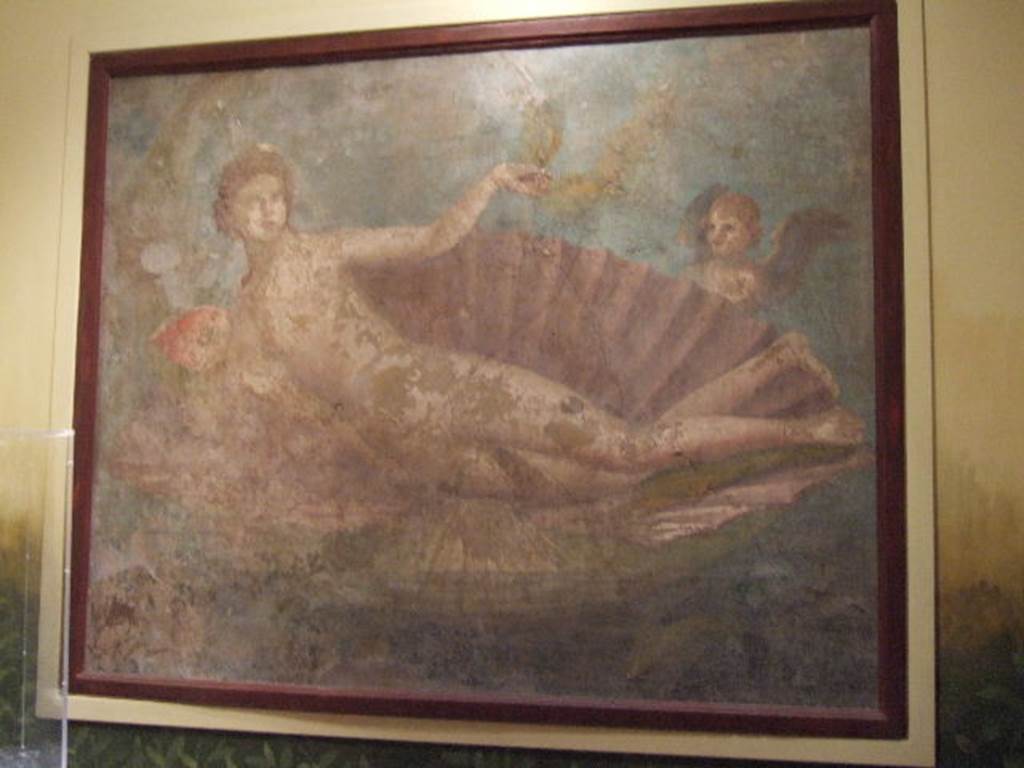
VII.6.7 Pompeii. Found 6th March 1762 on the south wall of the peristyle. Wall painting of The Birth of Venus in a shell on the sea.
Now in Naples Archaeological Museum. Inventory number 27704.
See Pagano, M. and Prisciandaro, R., 2006. Studio sulle provenienze degli oggetti rinvenuti negli scavi borbonici del regno di Napoli. Naples: Nicola Longobardi, (p. 40).
See De Caro, S., Ed., 2000. The Secret Cabinet in the National Archaeological Museum of Naples. Napoli: Electa. (p.26).
See Richardson, L., 2000. A Catalog of Identifiable Figure Painters of Ancient Pompeii,
Herculaneum. Baltimore: John
Hopkins. (p. 94 and p. 103).
See Siotto, E. Considerazioni su un intervento recente al
“quadro” parietale della Venere nella Conchiglia; in Rivista di Studi
Pompeiani XVII, 2006, (p.79-87).
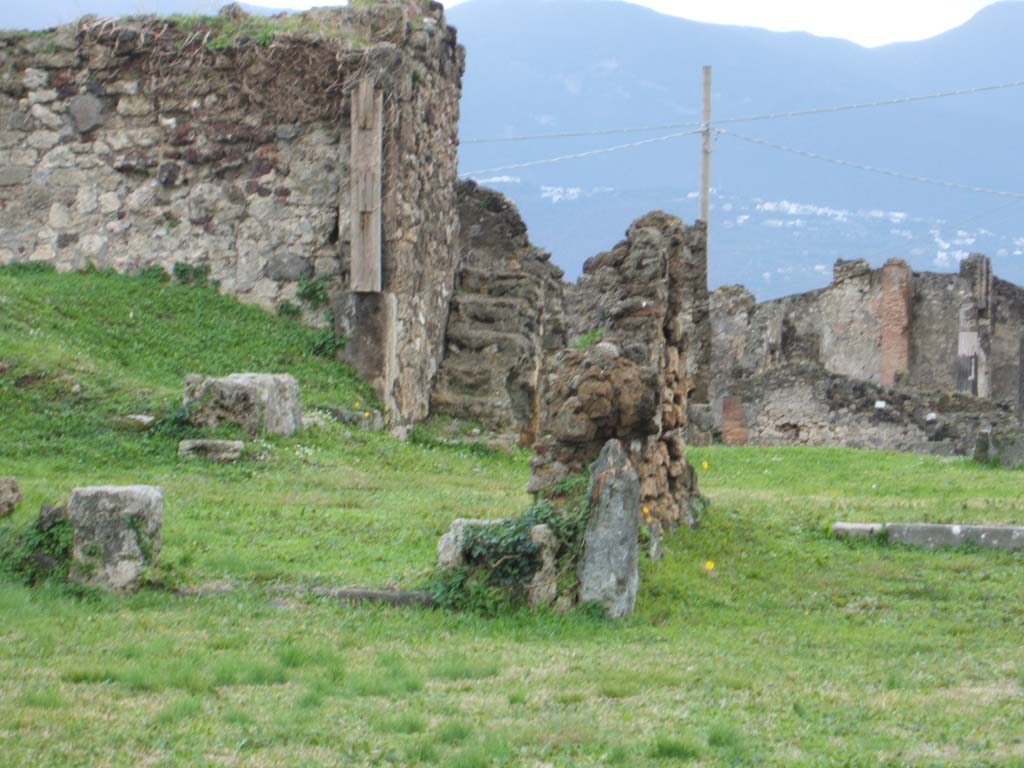
VII.6.7 Pompeii. December 2004. Looking south across remains of tablinum and the oecus on its east side, in forefront of photo.
At the rear can be seen the stairs (centre) and the site of the peristyle, through the tablinum.
The column against the wall on the left, would appear to be in the doorway of Room 51.
On the immediate left would be the area of room 49, a triclinium.
According to Blake, commenting on the damage done by the winter weather, stated that –
“The vase/kantharos which once formed the threshold of a triclinium opening off the peristyle of VII.6.7 disappeared almost completely during the winter of 1928”.
See Blake, M., (1930). The pavements of the Roman Buildings of the Republic and Early Empire. Rome, MAAR, 8, (p.12).
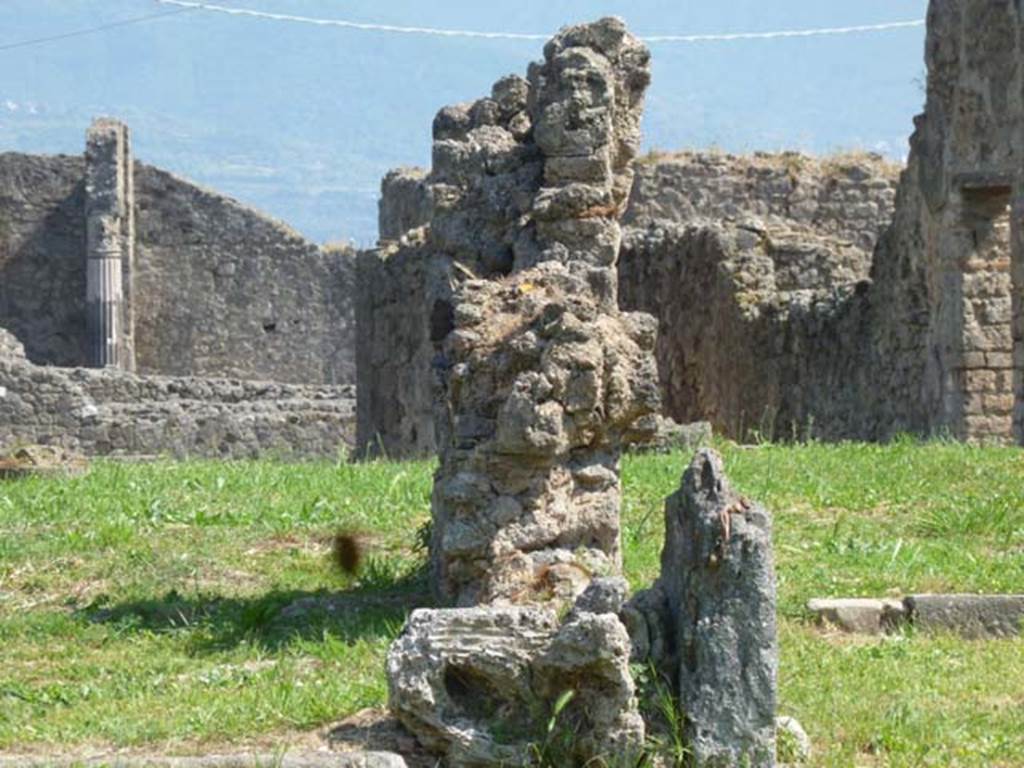
VII.6.7 Pompeii. May 2011.
Looking south across site of atrium towards remains of dividing wall between oecus on east side of tablinum, on left.
On the right would be the east side of the tablinum, looking towards site of garden area, and towards VII.6.28. Photo courtesy of Michael Binns.
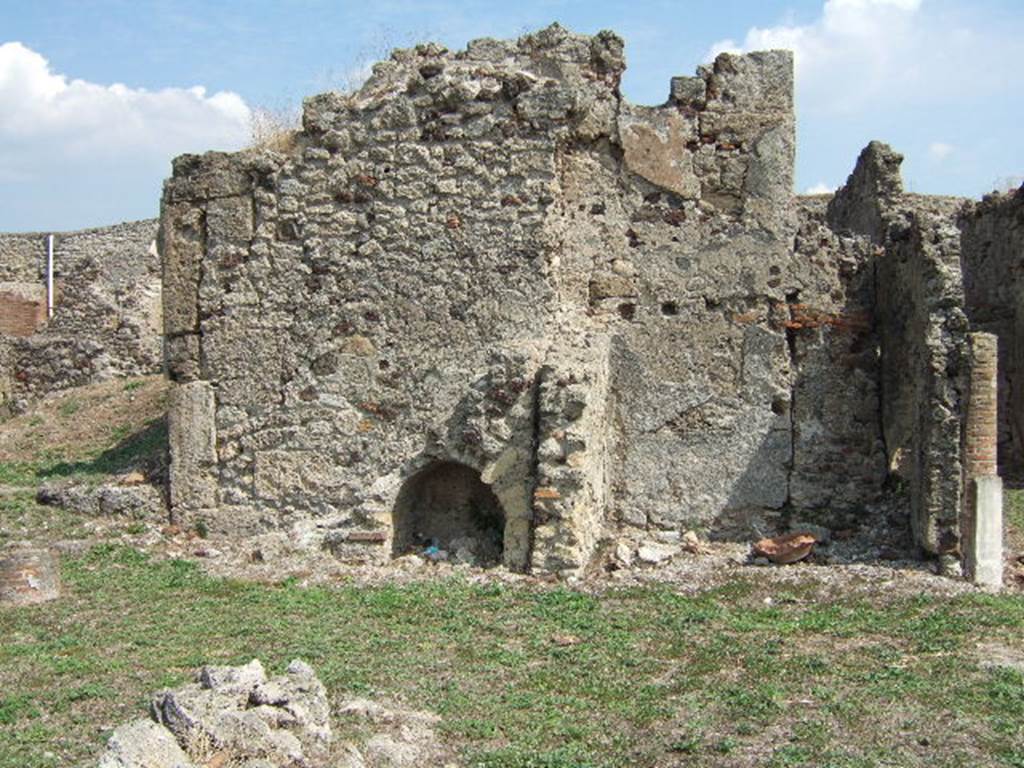
The east wall of the latrine of VII.6.7 is centre left, and VII.6.28 on the right, behind the column.
According to Spano in NdS, at the rear of the eastern walkway (of the peristyle) there was a brick staircase with an arch below.
This staircase led up to some rooms existing above the ground floor rooms numbered 56 and 57.
The entry to these two rooms was through a small doorway on the right of the staircase.
Of these two rooms, number 56 was the latrine, and number 57 was the kitchen.
See Spano in Notizie degli Scavi, 1910, (p.460)
Notizie
degli Scavi, 1910, p.454-461
Under the
portico opened several rooms.
The first on
the left, 49, was rectangular in shape, it was vast, with a floor of signinum,
whose design was almost entirely destroyed, and preserved traces of painted
decoration on the walls, a trace consisting of a portion of black zoccolo/plinth
partitioned in squaring by means of white lines. The entrance had a lava
threshold, and on the right of it was a large window that gave onto the
peristyle. Given the shape of the room and its proximity to the kitchen, 57, it
is likely to have been a triclinium.
To the right of
the east wall are some steps in masonry. On them it was probable that a wooden
staircase was placed, by which to
climb to an upper floor. This stairway would partially have covered the small
room, 50, with cocciopesto floor, which likewise was also entered from
the described triclinium.
The room 51
follows, which opens onto the peristyle almost in all its width, and from whose
entrance doorway, it seems, that our predecessors in the excavation had removed
the threshold, probably of marble. The room was large and rectangular in shape;
it had a mosaic floor, and a recess for the side of a bed in the far right end
of the northern wall, a bed, therefore, which was put along the wall of the
room, thus was known the location. The mosaic of the floor was white, with
double black band around and inlaid with random pieces of dark marble here and
there. In the centre most probably was a decoration or a picture that could have
been removed. Nothing existed of the painted decoration other than remains of a
large yellow rectangle and of a yellow zoccolo.
A smaller cubiculum, but not less elegant, opened into the opposite walkway, in 52. To the left of the small entrance there was a large window z, made entirely of wood, of which remained a very bright trace, with low masonry pluteus. The division of the doorway from the window was made by means of a wooden pillar. The entrance had a lava threshold, on the left with iron hinge preserved and on the right, the hole of the other hinge, which was lost.
The small room had the facing wall partitioned by two yellow rectangles with a violet/peacock blue cornice around, separated by a large yellow band, on which was a painted candelabra, which intruded onto the frieze, which was white. The larger side walls had three painted rectangles each, of which the two opposite and closest to the facing wall were yellow, while the others were violet/peacock blue. This apparent irregularity indicated how the bottom of the small room was reserved for containing the bed. In the white frieze of the facing wall was a lunette (small window), accompanied externally in a semicircle of holes for the support beams of a vault. This, however, most likely, was as long as the space destined for the bed, that is, that of the two yellow rectangles opposite, where the remaining front was covered by a platform, as they explain/show in many other Pompeian cubicula, for example those noted in the House known as the House of the Silver Wedding. At the vault, which was always set lower than the platform, were suspended curtains by which an alcove was formed with the bed inside. The side violet/peacock blue rectangles were partitioned by a yellow band with a painted candelabra. In the middle of each of these rectangles is or was or there was a very small rectangular square. Of these were preserved the two of the front/facing wall, each of which exhibited a vista of small buildings gathered together, devoid of any importance whatsoever; also preserved was the last on the right of the northern wall, where you can see a painted representation of two hares or dogs chasing to the right.
The frieze was preserved only in the front/facing wall, where, as I have said, it had the form of a lunette and was white. It was decorated with bands and swirls and with two garlands. At the top, in correspondence with the painted high candelabra dividing the rectangles, was a painted flying yellow Cupid, with arms symmetrically carried forward, bearing with his hands something which I could not distinguish, and which transforms lower down into two scrolls. The black zoccolo, is partitioned into panelled squares by means of white lines, squares in correspondence of the rectangles and the lines dividing these, so as to result in two wider, with a narrower one in the middle. The first of these exhibited the usual plants; the second a yellow suspended basket, with arched handle, laden with fruit, with hanging ribbons. The mosaic floor had a white background, double black band around, and in the middle a square exhibiting a star resulting from eight white diamonds with black band around, each comprising a smaller, red diamond. At the four inner corners of the square, were four white squares, each with another red smaller, in the middle. Near the threshold, the mosaic showed the representation of a kantharos of white, red and black colour.
Another room
followed to the north, 53, with a wide entrance, originally with wooden doorjambs,
but it seemed without door shutters, with a threshold of Signinum showing a band
with double rows of semicircle arches against each other, in white tesserae widely
placed.
The room was
square, and each wall showed three large rectangles, of which the
central was violet/peacock blue, with yellow side ones, partitioned by large
white bands among them. A frieze, with a
white background, was decorated with variously arranged bands and swirls; the
black zoccolo had wide and narrow paintings, according to what they corresponded
to, the rectangles or to the dividing bands.
The first offered two grazing geese, facing each other, with two garlands above them; the second the usual plants. In front of each central rectangle, two slender green Ionic columns supporting a flat green entablature.
At the sides,
and only in the front/facing wall, two candelabra, red and yellow, encroaching
on the frieze, where they ended with a circular plate, on which rises
something, which together with the plate were covered with a red cloth.
The middle
rectangles, preserved only on the north and west walls, showed in the centre, a
winged Cupid, bearing an object in each hand, and ending below in two scrolls (volutes - a motif dear to Hellenistic
and Hellenistic-Roman decorative art); all in yellow. The Cupid of the wall in
front/facing had a small basket in the lowered right hand, and in the other an
object that seemed to look like a bird; the Cupid of the north wall had a shepherd’s
crook in his left hand and in the other an object that is not distinguishable.
In each side rectangle was an elongated, tiny painting, showing a Bull or a Sea
Horse, on a green background, which were more or less
preserved or destroyed.
The floor was
of Signinum, decorated with white tesserae, placed at equal distances, and thus
forming parallel rows in each sense. To the right of the entrance, at the top,
was a window.
The next room,
to the north, 54, had an entrance with lave threshold, originally with wooden
doorposts, and had a wide window onto the peristyle, to the left of it. The
room was square and showed only very scarce remains of painted decoration; The
floor was of signinum, decorated with pieces of white tesserae, arranged in
parallel rows.
Another room 55, follows to the north, with flooring of cocciopesto and unadorned walls.
At the bottom
of the eastern walkway, rises a masonry staircase (fig,7, letter “e”) with arch
below. By this, one climbed up to some small rooms, above the rooms on the
ground floor at 56 and 57, into which you entered through a small doorway to
the right of the staircase.
Of these rooms,
the first (56) was a latrine, the second (57) was a kitchen.
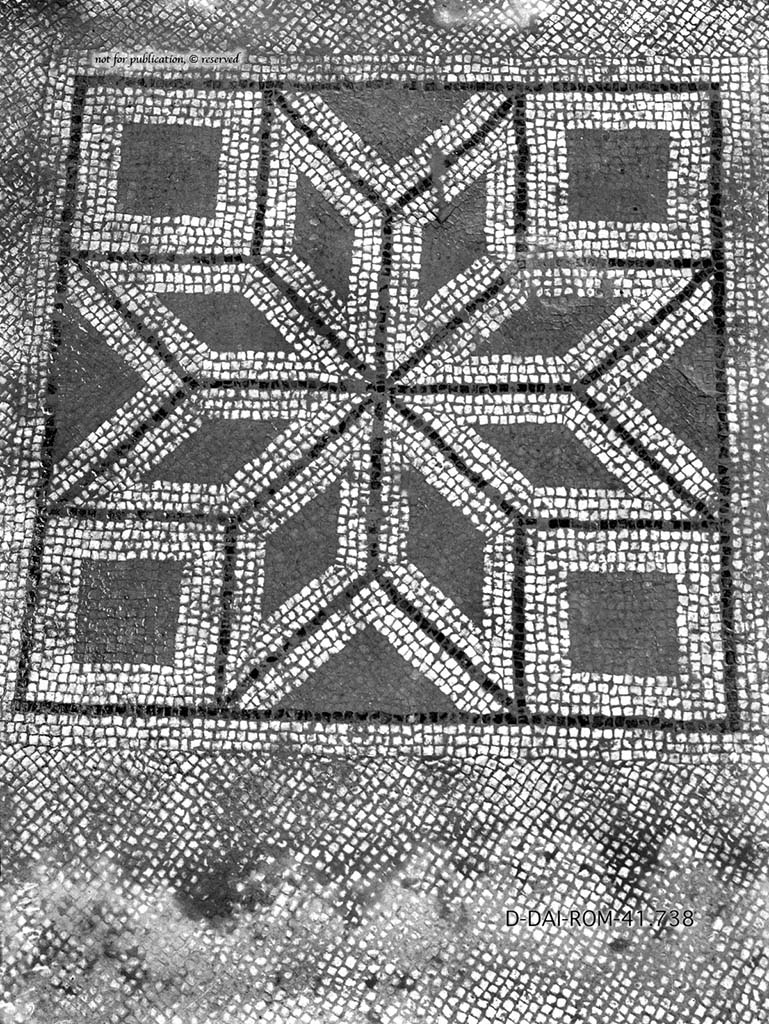
VII.6.7
Pompeii. c.1930.
DAIR 41.738. Photo ©
Deutsches Archäologisches Institut, Abteilung Rom, Arkiv.
See Pernice, E.
1938. Pavimente und Figürliche Mosaiken: Die Hellenistische
Kunst in Pompeji, Band VI. Berlin: de Gruyter, (p.89-90, and taf. 41,4 above).
According to PPM –
“The floors were for the
most part in cocciopesto, lavapesta intermingled with
brick, or white mosaic with emblemata already
removed during the explorations of the Bourbon age (cf. PAH 1,2, p.144, 10
April 1762) and today no longer found, although documented by Pernice.
Among the lost motifs are the hexagon with prospective
cube of tiles in the cubiculum (40), or the 8-pointed star resulting from the
combination of its many diamond-shapes inserted into a square in the cubiculum
(52), a room also known for the lowered vaulted cover on the alcove and flat
ceiling on the rest of the room, or finally the kantharos outlined in black,
red, yellow and white tesserae, placed in the threshold of the triclinium and
destroyed by the roots of spontaneous vegetation in the winter of 1928.”
( I pavimenti erano per lo piu in cocciopesto, lavapesta
con frammisti laterizi che ne ravvivavano il colore o a mosaico bianco con
emblemata gia asportati durante l’esplorazione di eta borbonica (cfr, PAH 1,2, p.144,
10 aprile 1762) e oggi non piu riscontrabili, anche se documentati da Pernice.
Tra i motivi perduti ricordiamo l’esagono con cubo
prospettico di piastrelle nel cubicolo (40), o la stella a 8 punte risultante
dalla combinazione di altrettanti rombi inserita in un quadrato nel cubicolo
(52), ambiente notevole anche per la copertura a volta ribassata sul’alcova e
piana sulla restante parte della stanza, o, infine, il kantharos delineato in
tessere nere, rosse, gialle e bianche, posto nella soglia del triclinio e distrutto
dalle radici della vegetazione spontanea nell’inverno del 1928.
See Carratelli,
G. P., 1990-2003. Pompei: Pitture e
Mosaici. VII,7, Roma: Istituto della enciclopedia italiana, (p. 176.)
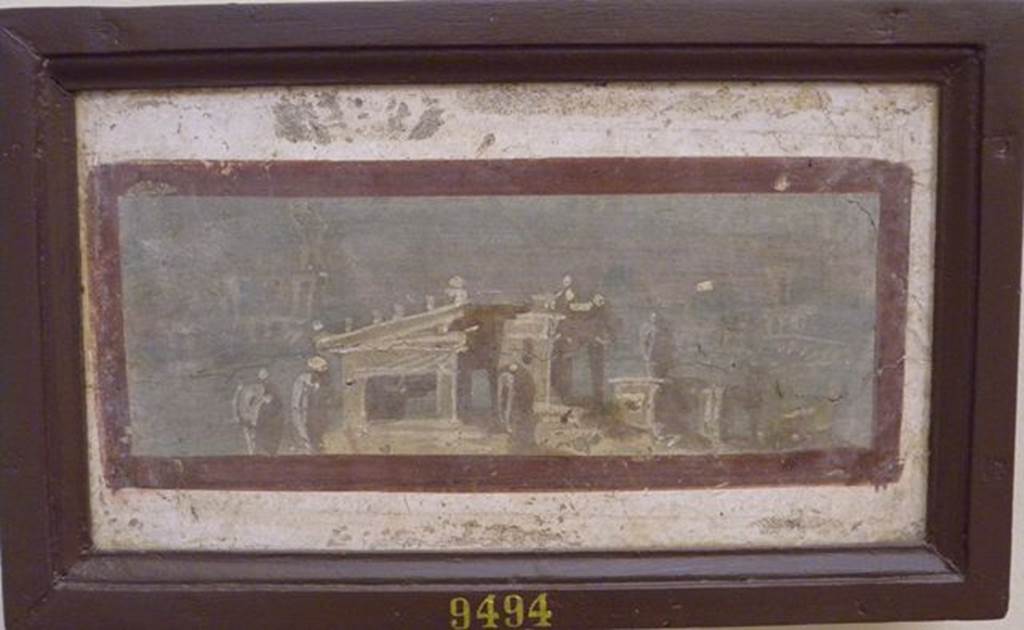
VII.6.7 Pompeii. 17th January 1762.
“Found within 30 paces from where we found the Diana (VII.6.3)”. Wall painting of shrine within an enclosure.
Now in Naples Archaeological Museum. Inventory number 9494.
See Pagano, M. and Prisciandaro, R., 2006. Studio sulle provenienze degli oggetti rinvenuti negli scavi borbonici del regno di Napoli. Naples: Nicola Longobardi. (p40).
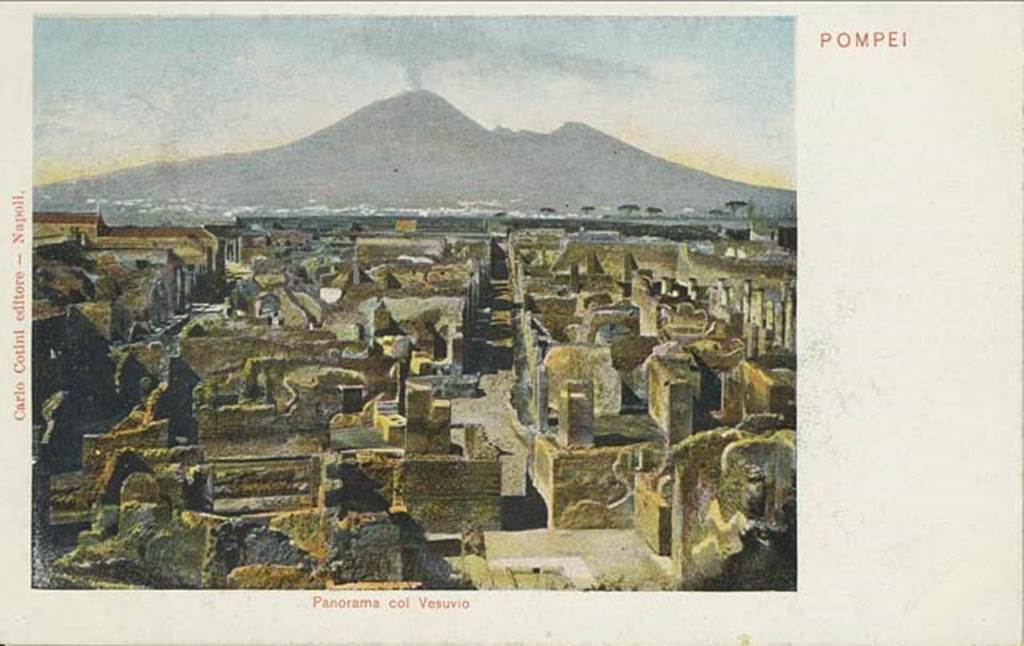
VII.6.7 Pompeii. Late 19th century postcard. Looking north from above atrium and impluvium of VII.6.7.
The entrance doorway would have been the one on the right of the centre of the photo.
This shows the north wall of the atrium and the impluvium in its centre, and the rear of VII.6.4, 5 and 6.
The entrance doorway leading into the atrium of VII.6.3 can be seen on the left. Photo courtesy of Rick Bauer.
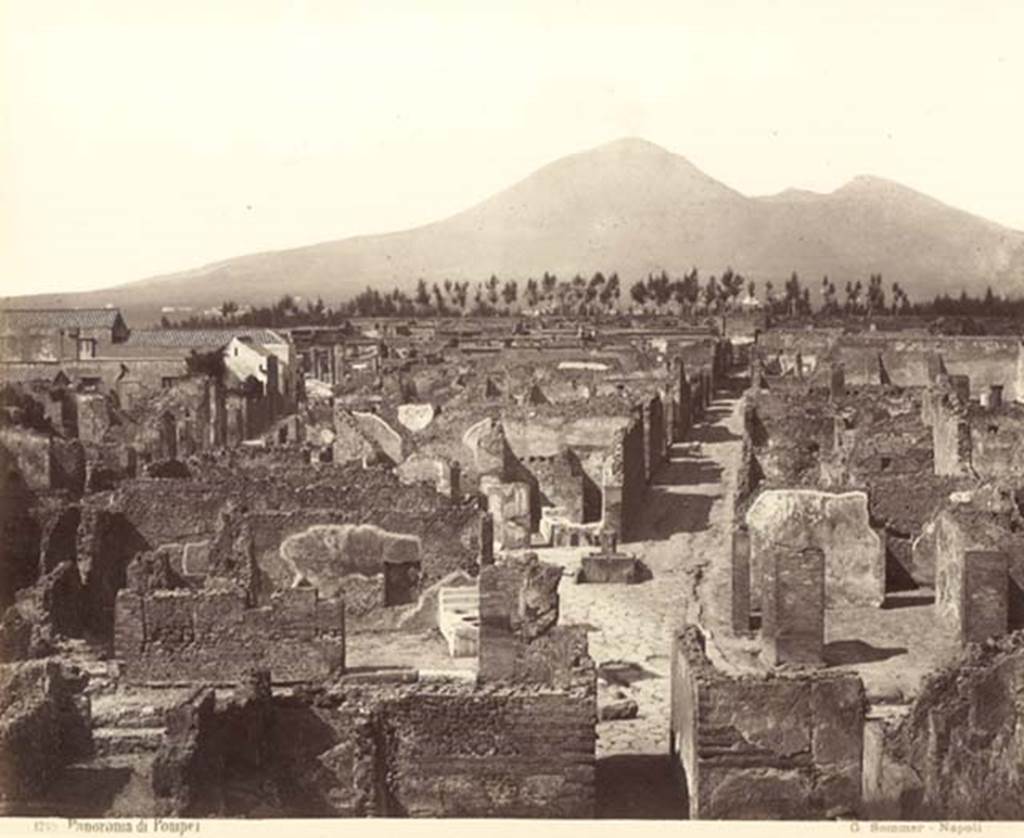
VII.6.7 Pompeii. c.1880-1890. G. Sommer no. 1259. Looking north from above atrium of VII.6.7.
The entrance doorway would have been the one on the right of the centre of the photo.
This shows the north wall of the atrium, and the rear of VII.6.4, 5 and 6. Photo courtesy of Rick Bauer.
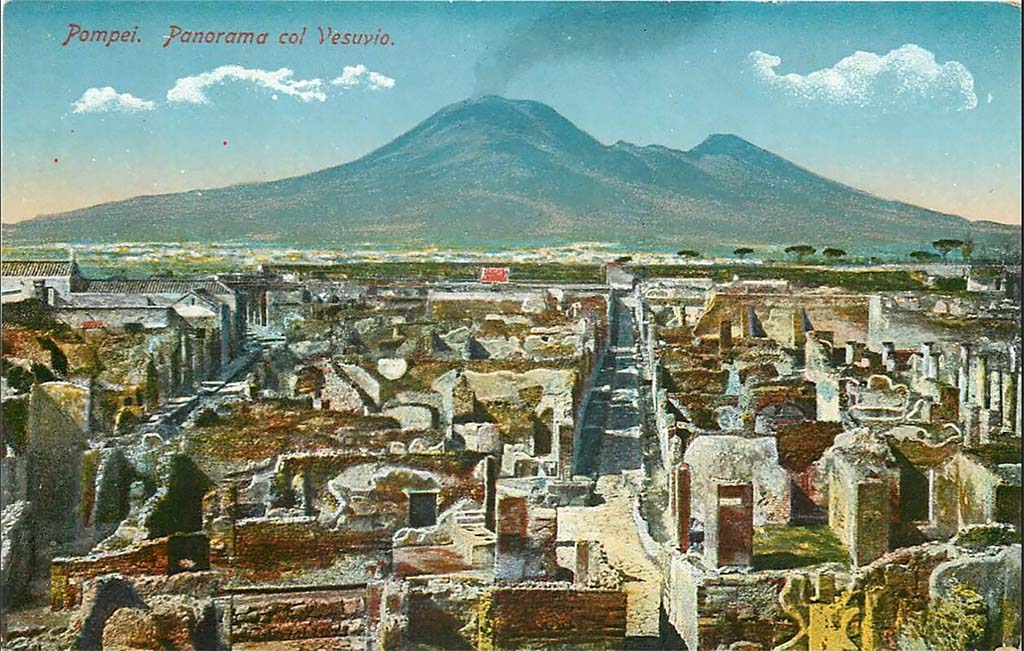
VII.6.7 Pompeii. Undated postcard. Looking north from above atrium of VII.6.7.
The entrance doorway would have been the one on the right of the centre of the photo, opposite Via Consolare.
This shows the north wall of the atrium, at the rear of VII.6.4, 5 and 6. Photo courtesy of Drew Baker.
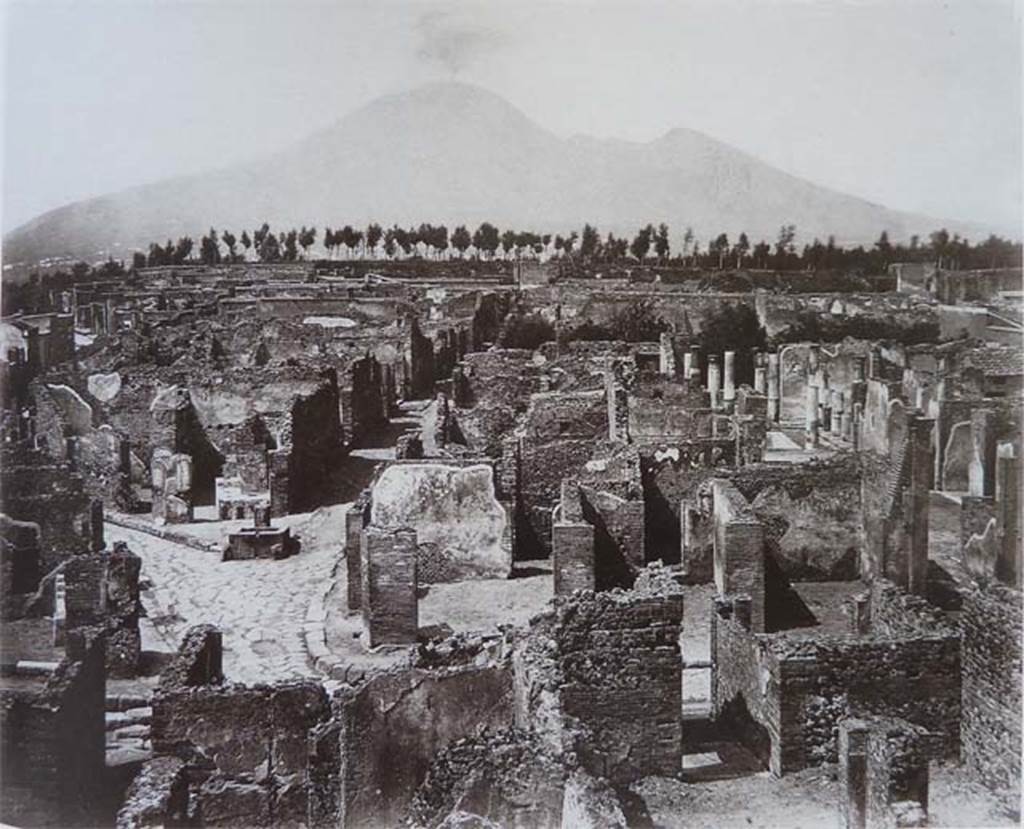
VII.6.7 Pompeii. Abt. 1870. Looking north from above atrium of VII.6.7 on left, and atrium of VII.6.11 on right.
The entrance doorway of VII.6.7 would have been the one on the left of the photo.
This would have led into the atrium, on the left of the entrance upon entering there would have been a cubiculum.
This can be seen here on the right of the entrance, in the middle of the lower part of the photo.
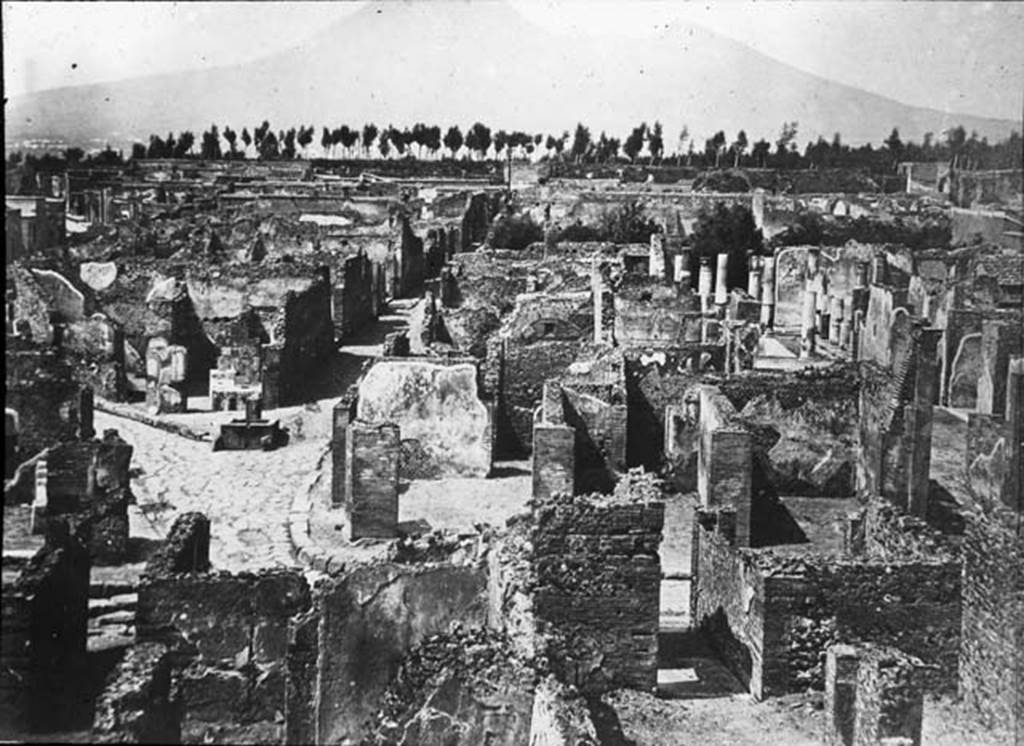
Looking north across north side of insula VII.6, lower photo, across to Via Consolare and junction with Vicolo di Modesto, centre left, and VI.6, centre right.
The entrance doorway of VII.6.7 would have been the one on the left of the photo.
Photo by permission of the Institute of
Archaeology, University of Oxford. File name instarchbx208im011. Source ID.
44337.
See photo on University of Oxford HEIR database
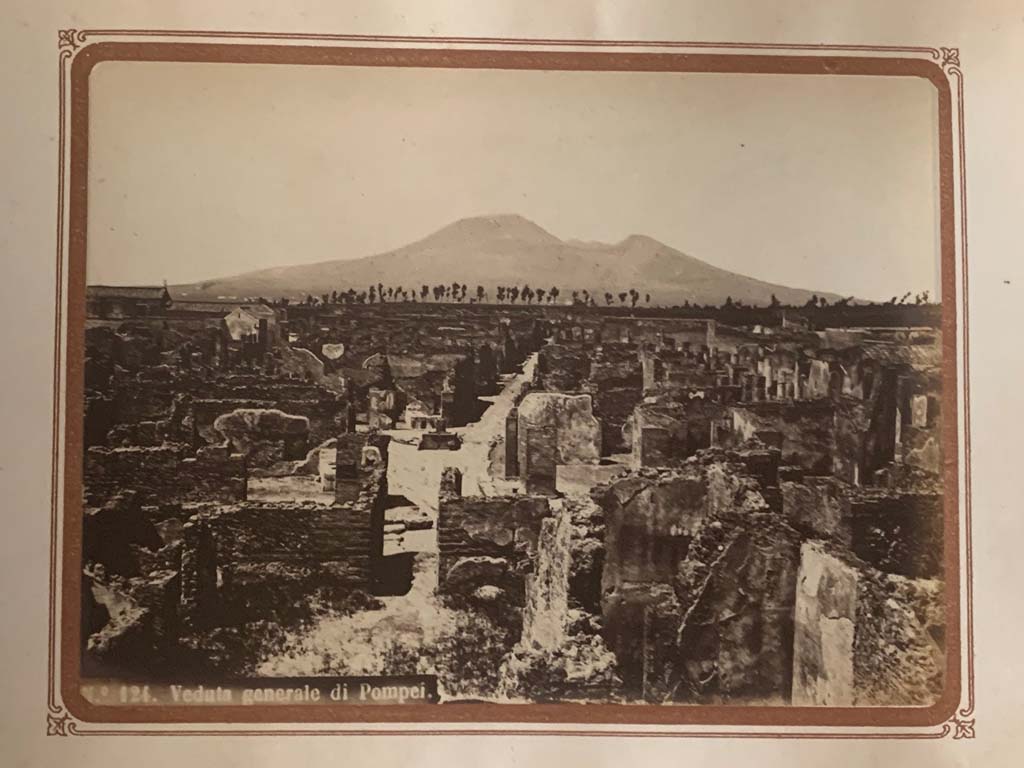
VII.6.7 Pompeii. From an album by Roberto
Rive, dated 1868.
Looking north towards the entrance doorway,
centre left in photo. Photo courtesy of Rick Bauer.
VII.6.7 Pompeii. 1910 piano di Spano.
Vedi Notizie
degli Scavi di Antichità, 1910, fig. 1, p. 437.
From
Notizie degli Scavi, 1910, p.454-461
(Il n. VII è
vano d'ingresso di una casa. Gli stipiti sono fatti con pezzi di tegole; vi è
soglia di lava tra essi, a cui segue un piccolo vestibolo, dopo del quale è la
soglia della porta, parimenti di lava. La casa risulta di tutte e tre le parti
principali, di atrio, di tablino e di peristilio ; le due prime parti
esattamente in asse tra loro, la terza leggermente spostata ad oriente. Fu
construita in tempo antichissimo, come risulta dai parallelepipedi di pietra di
Sarno qua e la adoperati nella costruzione, e dai vani alti e rastremati; pero
fu in vari punti posteriormente rifatti.
Le fauces 38
hanno il pavimento di coccio pesto, alquanto inclinato verso la via, e le
pareti conservano scarsi avanzi d’intonaco affatto logorato nella superficie.
Gli angoli verso l’atrio erano rivestiti di legno.
L'atrio 39 era
tuscanico. Ha pavimento di coccio pesto con larga fascia di opus segmentatimi
intorno all'impluvio che è di forma quasi quadrata, con fondo formato del pari
da opus segmentatum.
Intorno
all'atrio si aprono diversi ambienti, caratteristici appunto per i loro vani in
buona parte con stipiti di calcare, e che, quantunque conservati solo nella
parte inferiore, mostrano dal loro insieme di essere stati alti e rastremati.
Il primo vano
a sinistra introduce nella stanza 40; ha soglia di travertino coi fori per
l'incastro degli stipiti di legno, quelli pei cardini e un ultimo pel pessulus.
La stanza aveva le pareti dipinte, decorazione di cui avanza solo lo zoccolo
rosso, diviso in riquadrature da lineette chiare ; pavimento di musaico bianco
con doppia fascia nera intorno e recante un esagono al centro formato da tre
rombi di marmo colorato, con cornice a fascette nere, bianche e rosse.
Nella parete
settentrionale un piccolo vano murato, che dava nel dietro-bottega di VIII
(7.6.8), bottega dunque che in un tempo più antico fu in diretta comunicazione
con questa casa, come lo prova pure un alto vano murato, esistente nella parete
settentrionale dell'atrio a destra delle fauces. Di fronte (opposite) alla
descritta stanza, è in 41, alla estremità destra del lato occidentale, una
piccola cella recante scarsi avanzi d'intonaco, che, almeno oggi, si mostra
disadorno, e con la parete occidentale fortemente inclinata in avanti.
Segue in 42
un' apotheca dal vano rastremato, che fa esatto riscontro al vano d'ingresso in
40, che ha di fronte.
Ai due lati,
nel fondo, le alae 43 e 44.
La prima (43)
ha intonaco corroso nella pareti, pavimento molto grossolano, costituito da
pezzetti di marmo incrostati nel terriccio e reca traccia di stipite di legno a
sinistra dell'ingresso, con cuscinetto di marmo munito del foro per l'incastro
di quello.
L'ala di
fronte, 44, ha ugual pavimento, avanzi sulle pareti di grandi rettangoli rossi,
cuscinetto di marmo a destra del vano, che sosteneva lo stipite di legno.
Addossati alla parete di fronte (occidentale) due alti scalini in muratura,
forse avanzi di un sacrarium.
Il tablino 45
è vasto, ha pavimento di signino, esibente filari paralleli di tesselle bianche
messe ad uguali intervalli, una linea meandrica al posto della soglia dalla
parte dell'atrio, e un quadrato nel mezzo con entro un cerchio decorato a sua
volta con linee formanti rombi. Le pareti conservano scarsi avanzi di intonaco
corroso. I pilastri all'ingresso avevano stipiti di legno, dei quali si
conservano i cuscinetti di marmo.
Ai lati del
tablino due stanze, 46 e 47, entrambe con ingresso stretto, alto e rastremato
dal lato dell'atrio e con altro vano sul peristilio.
Il primo
ambiente, 46, aveva pareti ben decorate, di cui si conservano soltanto delle
tracce. 11 pavimento a musaico con fondo bianco, doveva avere un quadro nel
centro, o un ornato di pregio, che probabilmente fu tolto al tempo del primo
scavo. Intorno, sul fondo bianco, fascette nere rettilinee, formanti dei
rettangoli variamente disposti.
L'altra stanza
(47) aveva parimente le pareti ornate con pittura, di che è testimone l'avanzo
dello zoccolo dipinto in rosso. Pare che il pavimento fosse di coccio
pesto. Nella parete che questa stanza
aveva comune col tablino erano due finestre.
Il peristilio
48 (fig. 7 – page 457) sul quale il tablino si apre quasi in tutta la sua
larghezza, con un vano dalla soglia di travertino e dagli stipiti una volta
rivestiti di legno, ha il portico intorno a tutti i lati tranne che a
mezzogiorno, dove, invece è una parete decorata con tre semi-colonne (fig. 7,
lettera a). Le colonne, fatte di tegole ed intonaco, sono lisce ; recano un
alto zoccolo rosso mentre in alto sono bianche. Mancano tutte del capitello.
Esse ricorrono in numero di tre per lato, ripetendo due volte le angolari, e
invece di essere disposte ad uguali intervalli, si allontanano tra loro presso
a poco secondo l'ampiezza dei vani che si aprono intorno al portico.
Alla prima
colonna a destra dell'ambulacro occidentale corrisponde una semicolonna nella
parete. Delle semicolonne della parete meridionale rimane soltanto la parte
degli zoccoli. In uno si conservano delle fascette verticali bianche, con le
quali si volle imitare la baccellatura. Non si sa se le colonne sostenessero un
tetto o una terrazza. Tra le colonne è un pluteo in muratura grezza, interrotto
in corrispondenza del vano del tablino, inoltre, sostituito da altro pluteo più
basso in corrispondenza del vano d'ingresso in 51.
Nella parete
interna del pluteo la solita cunetta, che è di coccio pesto, nella quale, oltre
a raccogliersi le acque della terrazza, si scaricavano pure alcuni piccolo corsi
praticati attraverso il pluteo, corsi pei quali, secondo che a me pare, non
poteva scorrere altra acqua che quella adoperata per fare la pulizia del
pavimento del portico. Questo pavimento è di coccio pesto.
La parete
occidentale conserva una mediocre decorazione dipinta, consistente in un
altissimo zoccolo nero (più in alto la parete è bianca), scompartito in
riquadrature da fasce verdi.
L'area o
piccolo giardino conserva due aiuole in muratura “y” (e fig. 7, lettera b,)
alte m. 0,26, dipinte in rosso, con entro il terreno vegetale, nel quale, fatte
le solite esplorazioni, abbiamo trovato i fori lasciati dalle radici dalle
piante, e indicati nel rilievo con puntini e nella fig. 7 per mezzo di
ramoscelli secchi ficcati nei fori stessi.
See fig. 7 on
page 457.
Della parete
meridionale del peristilio non si conserva che la sola parte bassa, e su questa
è rappresentato un pluteo di legno, formato da stanghette incrociantisi più
volte, come vedesi in molte altre pitture del genere. Senza dubbio però questo
pluteo indicava la chiusura anteriore di un giardino rappresentato sull'intera
parete, con la quale pittura si voleva dare l'illusione che un vero giardino
seguisse al piccolo peristilio. Era, insomma, una rappresentanza di opera
topiaria, genere di dipinti, del quale avremo subito occasione di parlare più
estesamente. (Vedi. p.470).
Alla estremità
destra di detta parete una nicchietta rettangolare, forse un sacrarium.
Sotto il
portico si aprono diverse stanze.
La prima a
sinistra 49. di forma rettangolare, è vasta, ha pavimento di signino. il cui
disegno è quasi interamente distrutto, e conserva traccia di decorazione
dipinta sulle pareti, traccia consistente in una porzione di zoccolo nero
scompartito in riquadrature per mezzo di linee chiare. L'ingresso ha soglia di
lava, ed a destra di esso è una grande finestra che dà nel peristilio. Data la
forma della stanza e la sua vicinanza con la cucinetta 57, è probabile che
trattisi di un triclinio.
A destra della
parete orientale sono pochi scalini in muratura. Su di essi è probabile che
poggiasse una scala di legno, per la quale si saliva ad un piano superiore.
Questa scala copriva in parte il piccolo ambiente 50, dal pavimento di coccio
pesto, nel quale si entrava parimente dal descritto triclinio.
Segue la
stanza 51, che si apre sul peristilio quasi in tutta la sua larghezza, e dal
cui vano d'ingresso, pare, che i nostri predecessori nello scavo avessero tolta
la soglia, probabilmente di marmo. L'ambiente è di forma rettangolare, grande ;
ha pavimento di musaico, ed un incavo per la sponda di un letto nella estremità
destra della parete settentrionale, letto, quindi, che era messo lungo la
parete di fronte della stanza, della quale per tale particolare ci è dunque
nota la destinazione. Il musaico del pavimento è bianco, con doppia fascia nera
intorno e pezzetti informi di marmo oscuro qua e là incrostati. Al centro molto
probabilmente era un ornamento o un quadro che potè essere tolto. Della
decorazione dipinta non esistono che avanzi di grandi rettangoli gialli, e di
uno zoccolo dello stesso colore.
Un cubicolo
più piccolo, ma non meno elegante, si apre nell'ambulacro opposto, in 52. A
sinistra del piccolo ingresso aprivasi una grande finestra z, fatta tutta di legno,
della quale rimane vivissima traccia, con basso pluteo in muratura. La
divisione del vano dalla finestra era fatta per mezzo di un pilastro di legno.
L'ingresso ha soglia di lava, con cardine di ferro conservato a sinistra e il
foro dell'altro cardine, perduto, a destra.
La stanzetta
ha la parete di fronte scompartita in due rettangoli gialli con cornice
paonazza intorno, separati da una larga fascia parimenti gialla, sulla quale un
candelabro, il quale invade il fregio, che è bianco. Le pareti laterali, più
larghe, recano tre rettangoli ciascuna, dei quali i due opposti e più vicini
alla parete di fronte sono gialli, mentre gli altri sono paonazzi. Questa
apparente irregolarità indica come il fondo della stanzetta fosse riservato a
contenere il letto. Il fregio bianco della parete di fronte è una lunetta,
accompagnata esternamente in semicerchio dai fori dei travicelli di sostegno di
una volticina. Questa però, assai probabilmente, era lunga quanto lo spazio
destinato al letto, cioè quello dei due rettangoli gialli opposti, laddove la
rimanente parte anteriore era coperta da una piattabanda, come insegnano molti
altri cubicoli pompeiani, per esempio quelli notevolissimi dellacasa detta
delle Nozze di Argento. Alla volticina, impostata sempre più in basso della
piattabanda, erano sospese delle tendine, per le quali veniva a formarsi
un'alcova con dentro il letto. I rettangoli paonazzi laterali sono fra loro
scompartiti da una fascia gialla con candelabro. Nel mezzo di ciascuno di
questi rettangoli è o vi era un quadretto rettangolare, piccolissimo. Di essi
son conservati i due della parete di fronte, ciascuno dei quali esibisce una
veduta di piccoli fabbricati riuniti insieme, privi affatto di qualsiasi
importanza; inoltre è conservato l'ultimo a destra della parete settentrionale,
nel quale vedesi la rappresentanza di due lepri o cani inseguentisi a destra.
Il fregio è
conservato solo nella parete di fronte, dove, come ho detto, ha forma di
lunetta ed è bianco. È decorato con fasce e rabeschi e con due festoni. In
alto, in corrispondenza del piattello dell'alto candelabro divisorio dei
rettangoli, un Eros volante di prospetto, tutto giallo, con le braccia
simmetricamente portate innanzi, recante con le mani qualche cosa che non
arrivo a distinguere, e che si trasforma inferiormente in due volute. Lo
zoccolo, nero, è scompartito in riquadrature per mezzo di lineette chiare,
riquadrature in corrispondenza dei rettangoli e delle fasce divisorie di
questi, in modo da risultarne due più larghe, con in mezzo una più stretta. Le prime di queste esibiscono le solite
piante ; le seconde un paniere giallo sospeso, con manico ad arco, carico di
frutti, con nastri pendenti. Il pavimento a mosaico ha fondo bianco, doppia
fascia nera intorno, e in mezzo un quadrato esibente una stella risultante da
otto rombi bianchi con fascetta nera intorno, ciascuno comprendente un rombo
più piccolo, rosso. Ai quattro angoli interni del quadrato, Quattro quadratini
bianchi, ciascuno con un altro minore, rosso, al centro. Vicinissimo poi alla
soglia, il musaico esibisce la rappresentanza di un kantharos di colore
bianco,rosso e nero.
Segue a
settentrione un'altra stanza, 53, con largo ingresso, in origine con stipiti di
legno, pare senza battenti, con soglia di signino esibente una fascia con
doppio filare di semicerchi vòlti gli uni contro gli altri, a tesselle bianche
largamente disposte. La stanza è
quadrata, e ciascuna parete offre tre grandi rettangoli, dei quali il centrale
paonazzo, i laterali gialli, tra loro scompartiti da larghe fasce bianche. Un
fregio, a fondo bianco, è decorato con fasce e rabeschi variamente disposti; lo
zoccolo nero ha riquadrature larghe e strette, secondo che corrispondono ai
rettangoli od alle fasce divisorie. Le prime offrono due oche pascolanti, affrontate,
con sopra due festoni ; le seconde le solite piante. Dinanzi a ciascun
rettangolo centrale, due esili colonnine verdi, di tipo ionico, sostenenti una
trabeazione piana, verde. Ai lati, e solo nella parete di fronte, due
candelabri, color rosso e giallo, invadenti il fregio, dove terminano con
piattello circolare, sul quale si eleva qualche cosa, che insieme col piattello
è coperta da un panno rosso. I rettangoli medi, conservati solo nelle pareti
settentrionale e occidentale, esibiscono al centro un Eros alato di prospetto,
recante un oggetto in ciascuna mano, e terminante inferiormente in due volute
(motivo caro all'arte decorativa ellenistica ed ellenistico-romana); il tutto
giallo. Quello della parete di fronte ha nella destra abbassata un panierino, e
nell'altra un oggetto che pare un volatile; l'Eros della parete settentrionale
ha nella sinistra un pedum e nell'altra un oggetto che non distinguo che cosa
sia. In ciascun rettangolo laterale un quadretto allungato, piccolissimo,
esibente un toro od un cavallo marino, su fondo verde, dove più, dove meno
conservato e dove distrutto. Il pavimento è di signino, decorato con tesselle
bianche, poste a distanze uguali, e costituenti quindi filari paralleli in
ciascun senso. A destra dello ingresso, in alto, un finestrino.
La stanza
seguente, a settentrione, 54, ha ingresso con soglia di lava, in origine con
stipiti di legno, ed ha larga finestra nel peristilio, a sinistra di esso. La
stanza è quadrata e reca solo scarsissimi avanzi di decorazione dipinta ; il
pavimento è di signino, decorato con pezzetti di tesselle bianche, disposti
in filari
paralleli.
Segue,
parimenti a settentrione, un altro ambiente, 55, dal pavimento di coccio pesto
e dalle pareti disadorne.
In fondo
all'ambulacro orientale sorge una scaletta in muratura a1 (fig. 7, lettera e)
con arco di sotto. Per essa si montava sopra alcune stanzette, esistenti sugli
ambienti terreni 56 e 57, nei quali si entra da un piccolo vano a destra della
scaletta.
Di questi
ambienti, il primo (56) è una latrina, il secondo (57) una cucina.)
Le iscrizioni
che quivi ritornarono a luce sono tutte graffite.
Sulla faccia
orientale dello zoccolo rosso della seconda colonna a destra, nel lato
orientale del portico, da sopra in sotto:
40.
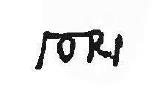
41.

42.
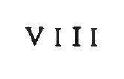
43. Busto
virile a destra, parimente graffito, e sotto: (CIL IV 9005),

44.
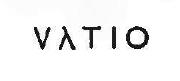
Sulla faccia
rivolta a settentrione, in lettere minutissime:
45.
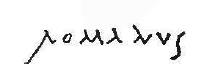
Fra le terre
tolte via dagli ambienti occupanti la estremità meridionale della casa si trovò
un medio bronzo di Vespasiano, Cohen 155 (552, 6-XI 1-909).
Sul pavimento
della camera posta all'angolo sud-est della casa lungo la parete meridionale,
molti oggetti calcinati o fusi dal fuoco, e tra questi: calotta di bronzo,
larga m. 0,17, che servì forse di rivestimento della estremità di una trave o
di altro oggetto di legno, insieme coi frammenti di un imbuto, del pari di
bronzo (553) ; bottiglia di vetro di forma quadrata, con ansa a nastro,
contorta dal fuoco ; frammenti di alter bottiglie simili (554); ventisette
monete di bronzo, tenute insieme dall'ossido e alterate dall'azione del fuoco
(555).
Nell'ambulacro
occidentale del peristilio si raccolse un asse repubblicano fuso, poco
riconoscibile, Babelon op. cit. I, 50, n. 26 ? (683, 4-III-910).
Nella
cucinetta, 57: orcio di terracotta, rustico, alto m. 0,26 (681); lucerna
monolychne di terracotta ordinaria, lunga m. 0,08, con ansa ad anello, disposta
trasversalmente all'asse della lucerna (682, 4-III-910).
Sul pavimento
del cubicolo 52: vassoio rettangolare di ardesia (m. 0,34X0,215), decorato al
di fuori dei lati brevi con due frontoncini a linea curva, terminanti con
volute (691, 11-111-910) ; specchio circolare di bronzo, misurante m. 0,205 in
diametro, privo di manico, ricoperto di ossido (692) ; altro specchio circolare
di bronzo, largo m. 0,134, parimenti privo di manico (693); serratura di
bronzo, di porta,con stanghetta (694); due robusti picconi di ferro, lunghi m.
0,30, tenuti uniti dall'ossido (695); falcetta di ferro, una volta con manico
cilindrico di legno, lunga m. 0,25, e roncola pure di ferro, lunga m. 0,17, con
la estremità piegata ad angolo retto, l'una e l'altra tenute insieme dall'ossido
(696); zappa di ferro, larga m. 0,10 (697); boccetta di vetro a corpo quasi
sferico e lungo collo, alta m. 0,065 (699); mascheretta muliebre con berretto
frigio, alta m. 0,03, con avanzo di perno di ferro all'interno, col quale era
tenuta aderente a qualche oggetto (700); due teste di chiodi, circolari,
concave, larghe m. 0,04 (701); un dente di cinghiale (702); una Conchiglia
(703); sei pezzi di catenella di bronzo a maglia e due anelletti (684,
7-III-1910).
Nella latrina,
57: borchia circolare di bronzo, larga m. 0,035 (Inv. 678, 1-III-1910)
Note: Ecco ciò
che dice il Fiorelli della parte della descritta casa da lui vista (op. cit,
pag. 435):
« 7. Seguono
due pilastri laterizi, che costeggiano la porta di una casa, in cui notatisi
residui di costruzioni molto antiche, e della quale si è scoperto l'atrio
tuscanico, avente a sin. un cubicolo ed un ala, a dr. la cella dell'ostiario
sottoposta ad una gradinata di legno, seguita da un apotheca e da un'altra ala,
nella quale era forse il sacrario domestico. Di fronte sta il tablino, che a
dr. ha un cubicolo e dall'altro canto un oecus, entrambi in comunicazione con
località non ancora scavate ».
Fine del Notizie degli Scavi, 1910, p.454-461