I.7.16 Pompeii. House used as officina scriptoria.
Linked to I.7.15 and I.7.17. Excavated 1868, 1927.
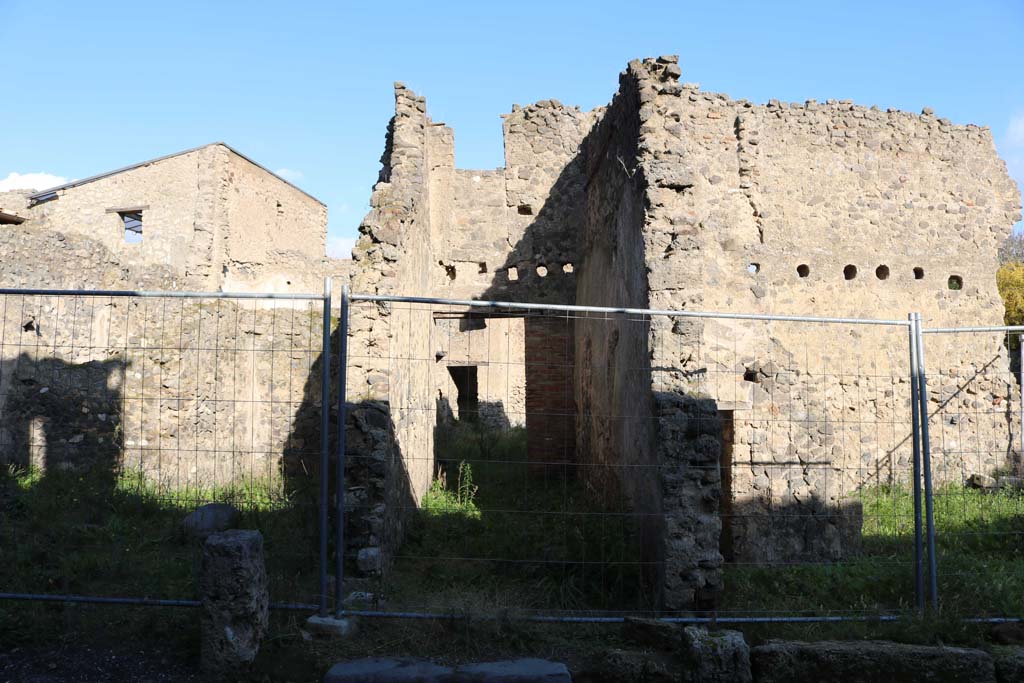
I.7.16, Pompeii, in centre. December 2018. Looking east on Vicolo
di Paquius Proculus. Photo courtesy of Aude Durand.
![I.7.16 Pompeii. September 2005. Entrance doorway, leading into courtyard. Looking east. In the south-east corner of the courtyard was a summer triclinium. According to Della Corte, graffiti found on the walls of the courtyard gave the names of the “scriptores” – Astylus, Iarinus, Papilio and Tychicus [CIL IV 7243, 7248, 7249 and 7251]
According to Epigraphik-Datenbank Clauss/Slaby (See www.manfredclauss.de), these read as -
L(ucio) Ael(i)o Magno
feliciter Astylus
Iarine fellas [CIL IV 7243]
Papilio v(ir) b(onus) [CIL IV 7248a]
Astylus [CIL IV 7248b]
Tychice habeas magnum propitium [CIL IV 7249]
L(ucium) Ceium Secundum IIvir(um) o(ro) v(os) f(aciatis) d(ignum) r(ei) p(ublicae)
Papilio [CIL IV 7251]](1%2007%2016_files/image004.jpg)
I.7.16 Pompeii. September 2005. Entrance doorway, leading into courtyard. Looking east.
In the south-east corner of the courtyard was a summer triclinium.
According to Della Corte, graffiti found on the walls of the courtyard gave the names of the “scriptores” –
Astylus, Iarinus, Papilio and Tychicus [CIL IV 7243, 7248, 7249 and 7251]
See Della Corte, M., 1965. Case ed Abitanti di Pompei. Napoli: Fausto Fiorentino. (p.320)
According to Epigraphik-Datenbank Clauss/Slaby (See www.manfredclauss.de), these read as -
L(ucio) Ael(i)o Magno
feliciter Astylus
Iarine
fellas [CIL
IV 7243]
Papilio v(ir) b(onus)
[CIL IV 7248a]
Astylus [CIL IV 7248b]
Tychice habeas magnum propitium
[CIL IV 7249]
L(ucium) Ceium Secundum
IIvir(um) o(ro) v(os) f(aciatis) d(ignum) r(ei) p(ublicae)
Papilio [CIL IV 7251]
According to Jashemski, I.VII.15-17 was a shop-house.
“The garden occupied a large part of this irregularly laid-out shop-house.
The masonry triclinium in the southern part of the garden had a lectus imus and lectus summus of equal length (3.80m); the lectus medius was 4.24m and the rectangular table was I.10 x 0.75m.”
See Jashemski, W. F., 1993. The Gardens of Pompeii, Volume II: Appendices. New York: Caratzas. (p.41).
She quoted her source as Soprano, p.296, no.6.
According to
Soprano,
I.7.16,
Abitazione.
Ubicazione:
giardino. L.imus e l.summus, m.3.80: l.medius, m.424: mensa,
m.1.10 per 0.75.
Fa parte di una
casa non ancora pubblicata.
Il triclinio,
situato sul lato sud del viridario, presenta tre rozzi letti affatto privi
d’intonaco e con i piani leggermente inclinati.
La mensa,
rettangolare, non ha traccia di intonaco.
(translation:
I.7.16, dwelling/house.
Location: garden. L.imus e l.summus,
m.3.80: l.medius, m.424: mensa, m.1.10 per 0.75.
This was
part of a house not yet published.
The
triclinium, situated on the south side of the garden, showed three coarse
couches entirely without plaster and with their top slightly inclined.
The
rectangular table had no trace pf plaster.)
See Soprano, P.
(1950). I triclini all’aperto di Pompei. (In Pompeiana, raccolta di
studi per il secondo centenario degli scavi di Pompei. Napoli, Gaetano
Macchiaroli, Editore, P. 296, no.6)