Pompeii Necropoli di Porta Stabia. Tombs near the Stabian Gate.
Pompei. Necropoli di Porta Stabia. Tombe vicino alla Porta Stabiana.
Pompeji. Nekropole von Porta Stabia. Gräber in der Nähe des Stabianer-Tors.
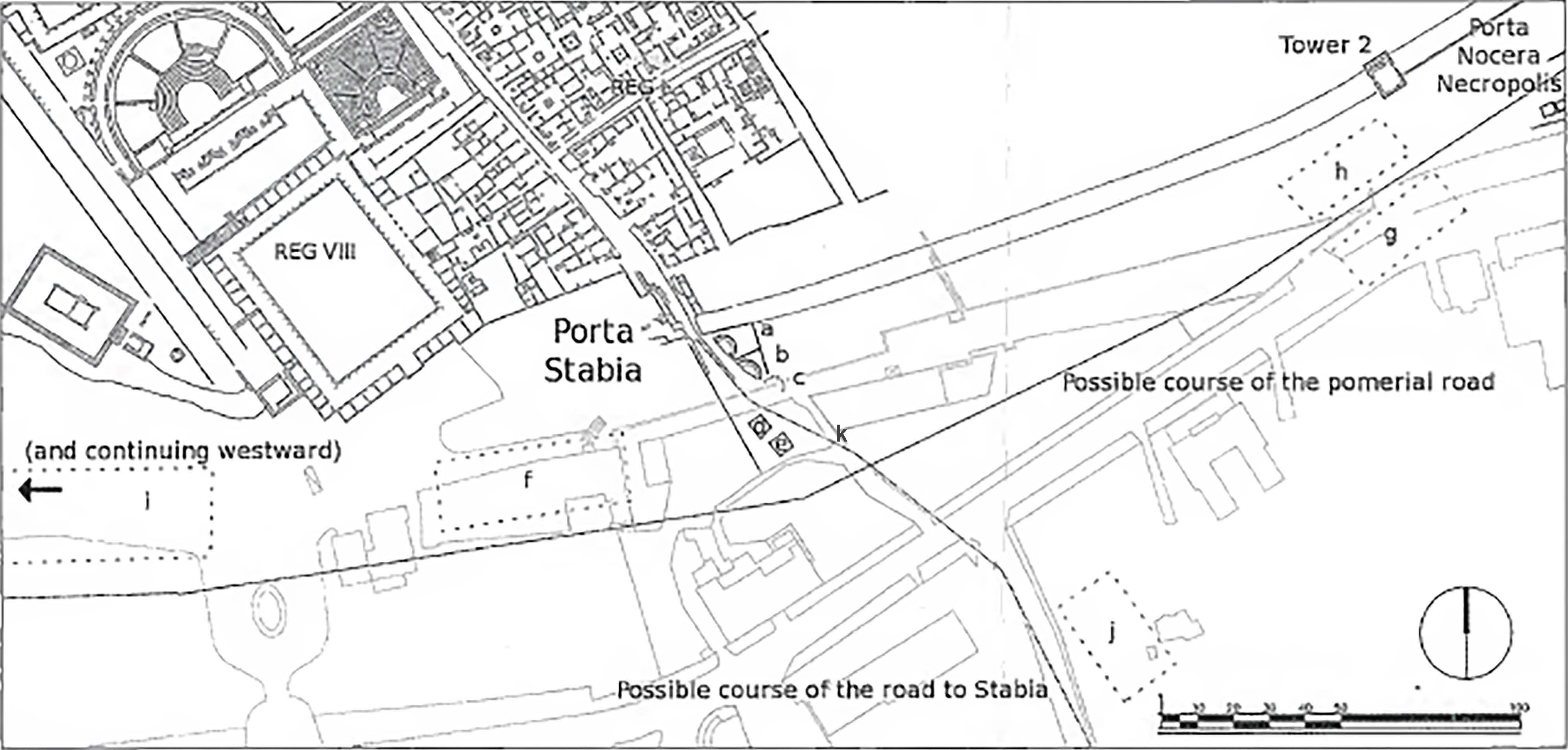
Funerary Landscape at Pompeii's Porta Stabia. Paesaggio funerario della Porta Stabia di Pompei. Grablandschaft an der Porta Stabia von Pompeji.
Plan of the funerary landscape at Pompeii's Porta Stabia, after Emmerson 2010, updated for later finds.
Emmerson suggests slightly differing locations for some tombs around Porta Stabia than our main Stefani 1998 based tombs plan.
Each tomb has a specific page on our site with information and photographs.
If your screen is large enough (more than 853px wide) press the tomb you want on the plan to see the pictures.
If you are on a smaller screen such as a phone or tablet you can use the links below to see the pictures.
According to Emmerson, as one of Pompeii's most heavily trafficked gates, the Porta Stabia must have been a desirable and high-status location for burial, and the roads around it must have been lined with densely packed tombs.
In 2010, four tombs stood outside the Porta Stabia: the two well-known semicircular benches (schola tombs) just outside the gate, and two lesser-known tomb podia located to the south, hidden behind an embankment and concealed by overgrowth.
This situation does not reflect the ancient reality. This article repopulates the burial landscape around the Porta Stabia by examining the standing tombs as well as the excavation reports of tombs that were reburied following their discovery, concluding that the extensive necropolis around the Porta Stabia is not something that must be imagined; rather, it is well documented and worthy of a place in future scholarship on Pompeian funerary culture.
See Emmerson A., 2010. Reconstructing the Funerary Landscape at Pompeii's Porta Stabia: Rivista di Studi Pompeiani 21, p. 83.
Since her article a new tomb has been discovered, a tomb with 4m long inscription in 7 rows, discovered in 2017 and we have added this and the two other tombs by the gate to the plan and this page.
Tombs. Tombe. Gräber.
a: M. Tullius
M Tullius Schola - Marcus Tullius schola tomb
M Tullius Recinto - Marcus Tullius enclosure at rear of schola
b: M. Alleius Minius
M Alleius Minius Schola - Marcus Alleius Minius schola tomb
M Alleius Minius Recinto - Marcus Alleius Minius enclosure at rear of schola
d: Unnamed altar style podium tomb discovered in 2001
e: Unnamed altar style podium tomb with graffiti on door discovered in 2001
f: Tomb of Cn Clovatius and gladiator relief
Tombs excavated by Avellino in the 18th century
Tomb of Cn Clovatius and gladiator relief
g: Fondo Santilli Necropolis
Tombs of the Petacii and others at Fondo Santilli, south of the pomerial road
h: Tombe presso la Strada Regia
Columellae of Claudiae Laudicae and Tutiae Licentiae on Fondo Santilli, north of the pomerial road
Claudiae Laudicae Tutiae Licentiae
i: Tombs said to be at Porta Marina
Tombs excavated by Weber in the 18th century
j: Fondo Squillante
k: Tomb with 4m long inscription in 7 rows discovered in 2017
Tomb with 4m long inscription confirming riot in amphitheatre
Possibly the tomb of Gnaeus Alleius Nigidius Maius.